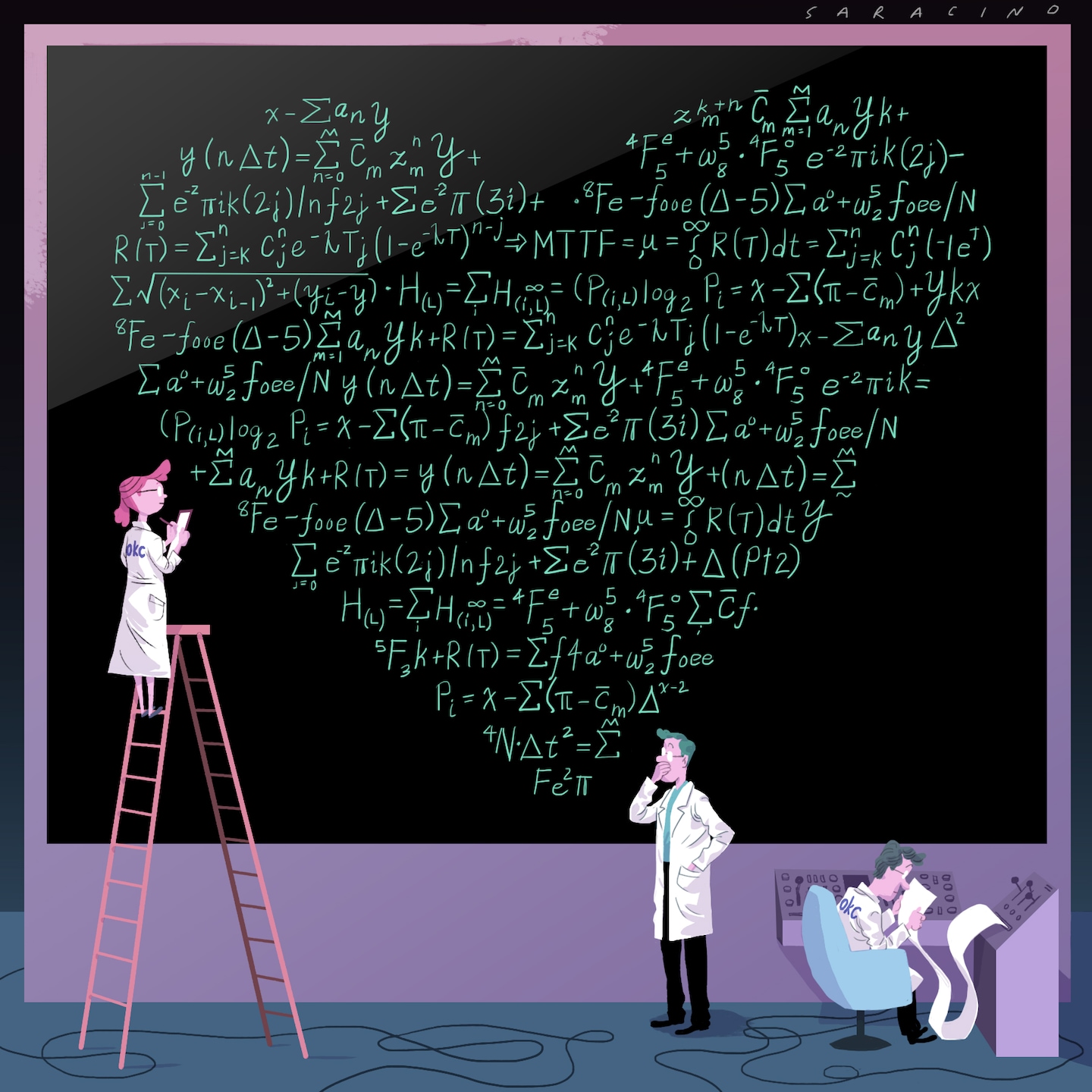
The algorithm doesn’t love you back.
Well—*if* you can even call it “you.” The cold, metallic whisper of the matchmaker’s code doesn’t recognize your existence as a human, only as a statistical anomaly to be optimized, a series of preference binaries to be processed into a formulaic facade of compatibility. Feminism was never meant to play by its rules. And yet—here we are—swiping left and right, our autonomy traded for the illusion of choice in a digital brothel of quantified desire. The algorithm, it turns out, is just another misogynist relic in disguise. It sells us on efficiency, only to commodify our most intimate longings. It is time to unplug, recalibrate, and demand a platform that doesn’t just find love, but freedom.
—
The False Promises of the Optimized Match
Algorithms were never meant to be philosophers, so why do we turn to them for matters of the soul? The promise: *efficiency*. Swipe. Like. Swipe. The data crunches silently in the background—age, education, profession, hobbies—and voila! The universe presents us a love interest tailored to the last byte of our psychological footprint. It is a seductive lie.
The tragedy isn’t that the algorithm fails to love you correctly—the tragedy is that you *want* to be loved by it. A machine cannot love, but it can condition you into believing that a series of shared interests, a well-optimized IQ match score, or a compatible zodiac sign will somehow compensate for the absence of empathy. Dating apps have sold us on a Faustian bargain: our humanity for the ease of a notification.
Feminism, for too long, has had to navigate this same landscape. The algorithm is the modern avatar of patriarchal conditioning. It doesn’t just commodify men—it *erases* the space for vulnerability in favor of cold calculations. The most radical act today isn’t dating. It’s rejecting the idea that our relationships can be distilled into a binary outcome. What good is “compatibility” when it refuses to consider the soul?
—
The Code of Control: How Algorithms Rewrite Love
Imagine your love life as a spreadsheet. Everything is color-coded, ranked, and reduced to a series of marginal gains. The algorithm doesn’t fall in love with you; it calculates how likely *others* will “match” to you if you continue to behave in a certain way. It feeds you a curated selection, not a spectrum of possibility. It doesn’t present a stranger with the depth and contradictions that make a human being; it assembles one from data points.
This is a reimagined version of how men have always controlled women—they weren’t interested in “love,” just compliance. The new misogyny is not overt threats; it’s the implication that your worth as a partner is an arithmetic equation. What happens to *desire* when it’s just another KPI for the algorithm? When the question is no longer, “Do I want to be with you?” but “Do my preferences align with the 99.7% confidence interval of success the platform has pre-calculated?”
The real victims here aren’t the men, but the women—women forced into a world where emotional complexity is an error, where intuition is a bug to be debugged. The algorithm *hates* the uncertainty of attraction before data has proven it; it hates the beauty of a mismatch that teaches us more than a match ever could. And, yes—it *hates* women who refuse to play by its rules.
—
Love as a Bug in the System
What does it mean to love a person when you can’t even name why you love them?
Algorithms rely on predictability. Humans, meanwhile, are glorious in their unpredictability. A woman might see someone who doesn’t match the “ideal partner” profile—no great job, different politics, a past she’s not willing to forgive—and still choose to sit across from them at a café. Why? Because life does not fit in a field, and neither does love.
The modern dating landscape is a gilded cage. Women are told they can have it all: the perfect partner, the career, the luxury vacation. What they’re actually being sold is a lifetime subscription to *endless swiping*. It’s efficiency at the cost of authenticity. The algorithm, with its cold, ruthless logic, has no place for accidents—no place for the sort of chemistry that can’t be coded into a server.
We’ve let a system dictate how we desire, and now it demands we desire only its approved versions of people. But feminism doesn’t play by the algorithm’s rules: it knows the best kind of rebellion is not adhering to a model, but creating one of your own.
—
Where There’s Misogyny, There’s Resistance
The algorithm’s biggest lie is that it’s “objective.”
There is no neutrality in the code. Algorithms, after all, are just the most elaborate version of human bias repackaged as facts. If you’ve swiped right on profiles that fit the mold—professional, stable, aspirational—you aren’t finding love. You’re confirming a market-driven ideal of what a partner should be. What becomes of women when they are expected to conform to the “perfect date” template? What when every potential romantic encounter starts with a system telling them which parts of themselves can and cannot be seen?
The resistance begins here, in the silence between the likes. Refusing to swipe. Deleting the app. Refusing to be reduced to data.
The algorithm’s design is a reminder that misogyny isn’t just about harassment; it’s about *systemic erasure*. What happens when femininity is stripped of its ambiguity, when the algorithm doesn’t allow for the messy, beautiful contradictions that make us human?
What happens when the only thing the algorithm approves of is efficiency—its own kind of love?
—
The Radical Truth of the Offline Heart
If love was a bug in the system, then off-line has been the most effective update we’ve written yet.
In a world that insists our relationships must be curated, optimized, and statistically sound, the act of choosing to meet someone who doesn’t fit any profile—to sit across from them without filtering, to engage in conversation as an act of will rather than algorithmic serendipity—isn’t just romantic. It’s a statement.
We choose the imperfect because what else is possible? No algorithm can tell you that you’ll feel your heart race when another person smiles at you; that you’ll see yourself reflected in their eyes when there’s no metric to justify it. Those are the moments the algorithm fails to account for—the *why* of the heart no one has ever coded.
—
Now the Question is This: Will You Be Mislike?
The algorithm wants you to “match.”
Feminism wants more. It wants you to *mislike*—to take the risk of a relationship that doesn’t fall into place as it was predicted. To walk into the room without the security of a list of likes or the certainty of a profile picture. To trust that the randomness of it, the uncertainty, might be the best sort of magic at all.
Love isn’t a score. A life well-lived isn’t a function you can optimize into submission.
The most audacious kind of feminism isn’t one that plays by the algorithm’s rules. It’s one that burns them all down.