**Why feminism—and your credit score—should be best friends (or maybe just roommates at this point).**
—
*Picture this: A pristine, sunlit lecture hall. Twenty-five female undergraduates turn to stare at their instructor as he announces, without irony, that “the 21st century is an era of *career mobility*—so long as you can afford to leap, and pay for the landing.” What follows is not an outraged mob scene, but a slow, collective realization that no one quite signed up for this particular kind of tuition. And thus, the greatest equalizer in higher education—student debt—become a blunt, unvarnished feminist issue.
—
A Love Story as Scathing as It Is Undeniable
Feminism and student loans were never meant to cohabit, yet here we are: a burgeoning alliance so contentious it’s like watching *Pride and Prejudice* get remade by a committee of IRS auditors. The narrative has long favored the idea that debt is a personal affliction, a punishment reserved for overambitious overachievers. But what if this isn’t simply an economic problem? What if we’ve been treating debt not as a structural misfire, but as a *feminine* failure in disguise? As the world rewrites its scripts for gendered oppression, debt stands as a lingering relic—and its weight is decidedly distributed along a gendered fault line.
—
The Phallocracy of the Credit Card
Here’s a provocative provocation: If feminism is the quiet yet relentless dismantling of patriarchal assumptions, then student debt is its stealthy handmaiden, waiting patiently in the background to prove that capitalism has no respect for equal-opportunity schemes. While men and women entered college as ostensibly equal, debt followed a distinct gendered trajectory almost as predictably as weather patterns in September.
The fact is, women now hold 65 percent of student loan debt in the United States—despite representing only 57 percent of undergraduates. This disparity isn’t due to some esoteric fluke of biology; it mirrors the systemic pressure women face as they navigate education, careers, and life’s other *unpaid* labor (women handle 70 percent of caregiving tasks globally). It’s as if we’ve replaced the “glass ceiling” with a “cement floor”—you *get* through the door, but only so far before the weight of tuition bills starts choking your ability to *climb*.
And let’s not forget the classic male narrative: graduate, earn big, buy the McMansion without flinching. For women? The numbers are different. Women’s earning potential dips mid-career as they shoulder reproductive labor. Their career trajectories often bend to accommodate family life changes, if they’re even given the choice in an economy that rewards unbroken upward arcs. In short, debt isn’t just “your” problem. It’s part of the structural recipe that ensures women, again and again, find their careers kneeling rather than thriving.
—
The Illusion of the “Meritocracy of Loans”
Ah, but here’s where things get uncomfortable. Feminism, like a stubborn friend, insists on telling inconvenient truths. If a woman’s burden is greater, does that mean she’s *less deserving*? Not by a long shot—but that’s the logic capitalism prefers. Debt doesn’t care about merit. It doesn’t care about potential. It only cares about *future* wages, and we all know who gets stuck in the present.
The idea that higher education is now “more accessible than ever” is a laughable relic of pre-debt times. What changed? Nothing. What *did* change? Tuitions multiplied like rabbits in the ’80s, subsidies evaporated, and women—again, disproportionately—chosen degrees that paid less and prepared more for roles in underpaid fields like education, nursing, social work. Not only does the system offer fewer high-earning pathways for women, but loans act as a drag anchor, forcing them to make choices between “I go all-in” and “I choose life.”
Worse, debt repudiates the “personal vs. political” distinction. When a woman chooses a lower-paying field, she’s not merely “not aggressive enough”—she’s negotiating a system that demands high risks for uncertain rewards. And yet, we see her debt and say, “See? She should’ve been an engineer.” It’s the same old song: women’s career choices are framed as lackluster, not a calculated strategy in an unequal playing field.
—
Loan-Based Liberation or a New Kind of Bondage?
So where does it go from here? First, we must stop celebrating women’s debt as a sign of *progress*, and start labeling it as a sign of *systemic failure*. The debt system isn’t a blank slate waiting for your dreams to be inscribed—it’s a framework that pushes women to trade their future for promises.
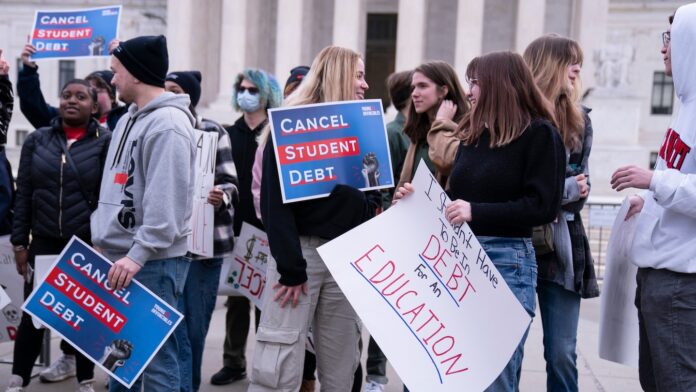
What will it take to turn the tables? Here’s the thing: it’s messy, costly, and demands radical rethinking. We could start by declaring student debt cancellation as a gender equity measure. Yes, you heard right—it’s no longer just *pragmatic*; it’s *just*.
If we accept that women disproportionally carry the weight of debt, we also owe it to ourselves to stop treating that weight as a personal burden. The system that saddled us with it needs dismantling, but more than that—we need to claim debt as a feminist lever. Every discussion of wage gaps is meaningless if one can’t even *navigate* a career without being held hostage to a balance sheet. This isn’t about asking nicely for forgiveness; it’s about demanding the conditions for a fair launch.
And who’ll lead the charge? Not the apathetic institutions that created this problem, but us—the women (and non-binary folks) who’ve been told to “lean in” to a system that consistently pushes us off the ladder as we climb. Perhaps that’s why we’re already here: carrying the load not out of complacency, but in defiance.
—
A Plea for Debt-Divorced Feminism
Feminism, at its root, is a fight against systems that tell us “no”—whether because we’re women, we’re poor, or, in this case, we’re drowning in debt. Student loans are the contemporary equivalent of the “I’ll get you a man,” of the outdated advice manuals, of “tuck your tailbone and hope.” They’re proof that progress isn’t linear, and fairness isn’t always just.
So let’s take our debt back—not as an insurmountable truth, but as the evidence of what a feminist economy—*and a feminist future*—could look like. Imagine tuition-free higher education. Imagine salaries that align with value, not societal biases. Imagine women with the power to choose their own routes instead of being forced to gamble everything on “get ahead, even if you end up paying 20 years.”
Because here’s the thing about debt: like so many feminist causes, it’s not something you “overcome” on your own. You need allies, policies, solidarity. It’s a war that won’t end until we stop apologizing for asking, “Why do we have to carry the weight of the past in our pocketbooks?”
So what’s next? Start by talking about it. Debate it. Refuse to pay more than you can shoulder without being buried. And leave no financial oppression unturned. Because if there’s one thing feminism has taught us, it’s that *no one owes you debt*—especially not their dignity or their future.