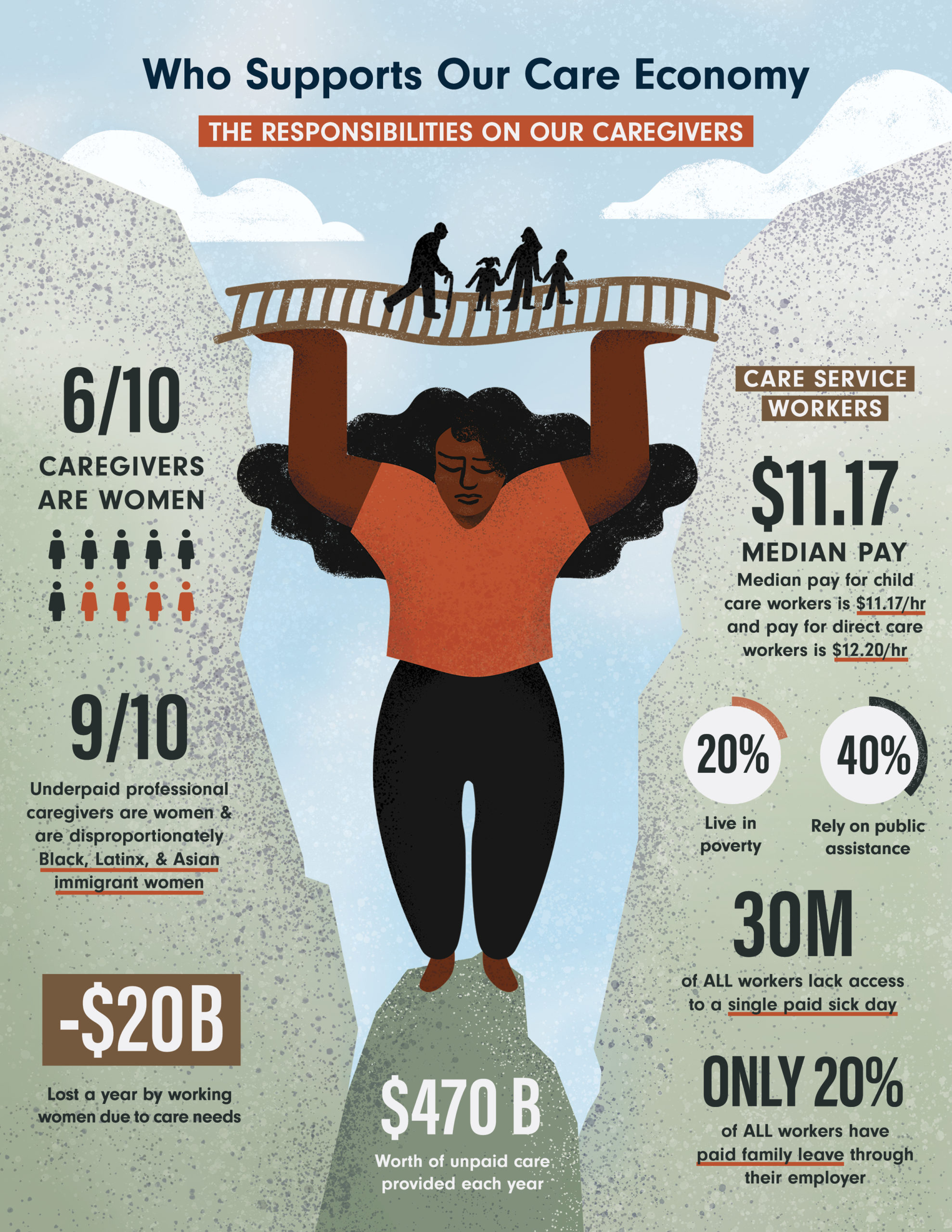
Imagine a vast ocean—its waves are relentless, its depths unexplored, its surface shimmering with unseen value. This ocean is the care economy, an immense and burgeoning sector that cradles our society yet remains perilously undervalued. Picture it as the quiet heartbeat of civilization, pulsing with the labor of millions, predominantly women, whose work sustains families, nurtures futures, and cements the foundations of human connection. And yet, despite being the largest sector poised to dominate the future economy, it languishes in economic shadows, saddled with systemic poverty and invisibility. Why does the care economy, this sprawling fortress of indispensable labor, inhabit the margins of financial recognition? This is a story etched in gender, power, and the paradox of value itself.
The Invisible Loom: Weaving Care in the Fabric of Society
The care economy operates like an invisible loom, quietly weaving the intricate tapestry of human life. It encompasses childcare, eldercare, healthcare, education, and domestic labor—activities that form the sinews holding society together. Yet the labor behind this loom often goes unnoticed or dismissed as mere extension of ‘natural’ female instincts rather than skilled, economic work worthy of remuneration. Society has long obscured the care economy beneath layers of cultural assumptions, where emotional labor and physical nurturing are misconstrued as voluntary acts of love rather than essential economic contributions.
This invisibility is not accidental. It is strategic, rooted in patriarchal structures that have historically relegated women’s labor to the private sphere, deemed less worthy of economic valorization. The paradox deepens when one realizes that while care work is essential for the labor force’s productivity—supporting the social infrastructure—its remuneration remains pitiful, locking caregivers into cycles of poverty despite burgeoning societal reliance on their labor.
The Paradox of Scale and Poverty
Here lies the grand irony: as the largest sector shaping the future, the care economy is simultaneously the poorest. This contradiction mirrors a grand societal failure—the inability to reconcile value with visibility. Care work is, in fact, a juggernaut. Demographic shifts, aging populations, and evolving social needs propel it into forefront economic discourse. Yet, this sector defies traditional market dynamics because it challenges the capitalist metric predicated on profit maximization rather than human sustainability.
The result is a dissonant economic narrative—one where the worth of care is immense in societal benefit but paltry in economic compensation. Care jobs cluster at the low end of pay scales. They are often part-time, precariously contracted, and lack benefits. The consequence? Millions of workers—most of them women, disproportionately women of color—are economically marginalized even as the demand for their work accelerates unabated.
Feminism’s Reckoning with the Care Economy
Feminism must confront the care economy not as a footnote but as a central battleground. It is here that the movement’s values—justice, equity, autonomy—clash with entrenched economic orthodoxy that trivializes caregiving labor. Feminist theory amplifies the demand for care work to be recognized as essential both socially and economically. This entails reimagining economic systems that have long devalued ‘women’s work’ and advocating for policies that uplift caregivers.
Moreover, feminism exposes the intersectional intricacies within the care economy: how race, class, immigration status, and gender converge to shape the experiences of care workers. For instance, many caregivers are migrant women, whose labor is extracted under exploitative conditions. Addressing the poverty of the care economy requires an intersectional feminist lens—one attuned not only to gender inequities but to the broader systems of oppression that permeate caregiving professions.
Unveiling the Chains of Gendered Labor
At the heart of the care economy’s poverty is a gendered alchemy that transmutes vital labor into undervalued servitude. This alchemy is forged by the centuries-old myth that care is innate to women and therefore not “real work.” Such myths create psychological and economic barriers—care work becomes synonymous with sacrificial devotion rather than compensated labor. These intangible chains bind not just the caregivers but the larger societal imagination, restricting both policy innovation and cultural recognition.
When care work is discounted, the ripple effects cascade across economies—undermining social welfare, exacerbating income inequality, and entrenching gendered economic disparities. The invisibility cloak that wraps care labor also shrouds its potential as a transformative economic force. Breaking these chains requires dismantling the patriarchal valuation system that commodifies productivity in narrowly defined terms, ignoring the indispensable human relationships care labor sustains.
Policy Myopia and the Care Economy
The impoverishment of the care economy is exacerbated by policy myopia, an institutional blindness that fails to allocate resources commensurate with the sector’s impact. Budgetary decisions often relegate care infrastructure to the periphery of economic planning. This neglect manifests in underfunded childcare systems, inadequate eldercare services, and insufficient protections for care workers. The lack of universal recognition and support perpetuates cycles of economic precarity for caregivers and collective inefficiencies for society.
Correcting this imbalance demands bold policy interventions: living wages for care workers, comprehensive labor protections, investment in expansive public childcare, and robust training and professionalization of care roles. Governments and institutions must pivot toward policies that reflect care as a public good—an economic imperative rather than a private dilemma.
The Promise of a Care-Centered Future
Yet within this paradox lies profound hope. Championing the care economy as the largest sector of the future also means unlocking its potential to redefine prosperity. By centering care in economic and societal frameworks, a new paradigm emerges—one that prizes relational wealth over mere capital, well-being over output. This shift could recalibrate gender relations, elevate marginalized labor, and foster more equitable and sustainable societies.
Emerging models that integrate care as a cornerstone of economic resilience point toward systemic transformation. Universal basic services, caregiver allowances, and cultural valorization of care work can usher in an era where care’s intrinsic worth is acknowledged and rewarded. Feminism’s provocative challenge is to refuse the silent acceptance of care’s poverty and to demand an economy that nurtures not just markets, but people.
Conclusion: Reclaiming Value in the Ocean of Care
The care economy is the silent ocean beneath our collective progression—vast, vital, yet submerged beneath waves of neglect and inequity. To reimagine a future where this ocean thrives is to confront uncomfortable truths about gender, value, and justice. It is to dismantle the invisibility cloak and illuminate care as the flourishing core of our economic and social worlds. This reclamation is not merely fiscal but deeply feminist, challenging paradigms that have long consigned care to poverty while relying on its boundless generosity.
In the end, the care economy is not just the largest sector of the future—it is the fuel that will ignite more equitable and humane societies. The question we face is simple but seismic: will we continue to let this ocean of care drown in poverty, or will we learn to navigate its depths with respect, recognition, and radical change?