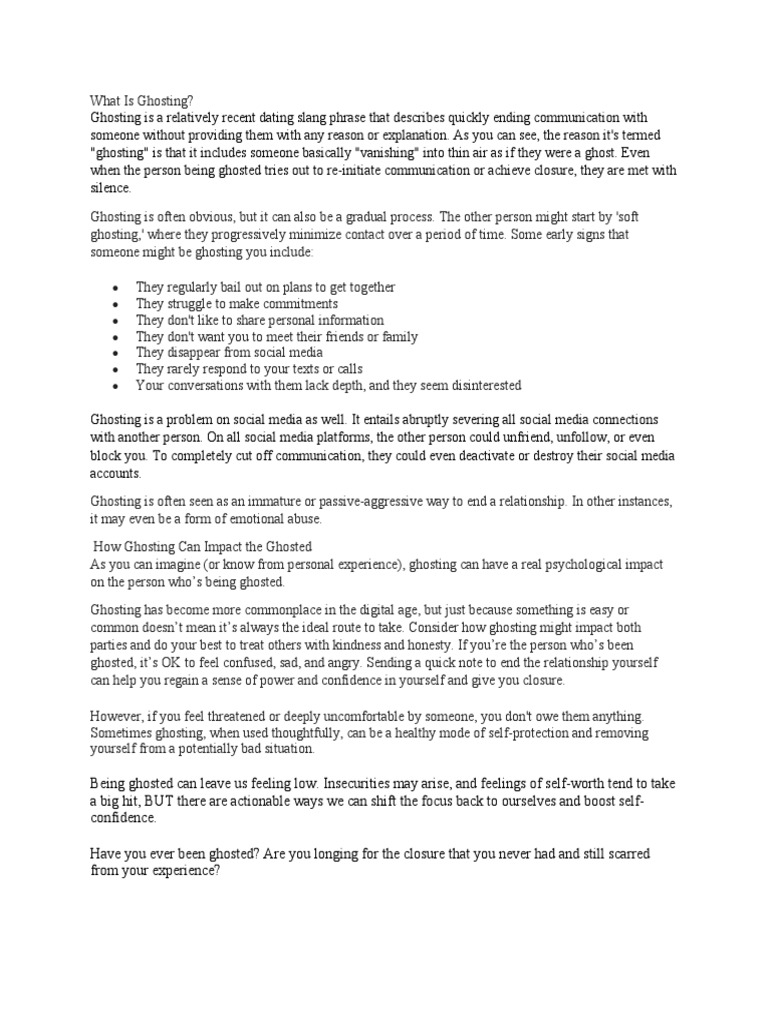
Ghosting—the abrupt vanishing act where communication ceases without warning or explanation—has become a hallmark of modern social interaction, especially within the labyrinth of romantic entanglements. Yet, beneath its seemingly impersonal veneer lies a gendered tapestry woven from societal expectations, power dynamics, and cultural narratives. Exploring ghosting through a feminist lens unravels not only the mechanics of disappearing acts but also exposes the intricate ways gender influences who ghosts, who gets ghosted, and how this silent severance resonates differently across genders. Prepare for a shift in perspective that illuminates ghosting not just as a dating quirk but as a reflection of deeper, systemic gendered tensions.
The Gendered Origins of Ghosting: A Cultural Excavation
To comprehend the gendered contours of ghosting, one must first excavate the cultural soil from which it sprouts. Historically, emotional labor—the effort involved in managing relationships and feelings—has been disproportionately hoisted onto women’s shoulders. This labor extends to communication norms, where women are socialized to be the nurturers and maintainers of relational harmony. Conversely, men often navigate emotional expression under the weight of stoic masculinity, sometimes framing confrontation as a vulnerability to avoid. Ghosting, in this context, can be perceived as a modern manifestation of these gendered scripts: men stepping back into the shadows to avoid emotional confrontations and women caught in the liminal space of unanswered messages and unresolved feelings.
Power Dynamics and the Silent Weapon of Ghosting
Ghosting is far from a neutral act; it is imbued with power. The act of disappearing confers an unsettling control over another’s emotional reality. When viewed through feminism’s prism, ghosting becomes a potent weapon in the asymmetric power struggles often endemic to gender relations. Men have historically navigated social and intimate spaces with greater latitude, and ghosting can be a tool in maintaining this dominance—sidestepping accountability while inflicting emotional disarray. For women, who are frequently socialized to seek connection and affirmation, being ghosted can be a disempowering experience that reinforces the very structures feminism seeks to dismantle.

Emotional Labor and the Weight of Disappearance
Women disproportionately shoulder the emotional fallout of ghosting. The unanswered texts, the unanswered calls, the endless internal questioning—who bore the fault, what was lacking, why was I deemed unworthy of an explanation? This relentless cycle of second-guessing underscores the heavy emotional labor expended in attempts to salvage self-worth amid silence. Feminism elucidates how this labor is invisible yet exhausting, trapping individuals in spaces where closure is denied. The refusal to communicate doesn’t merely sever ties but forces those left behind into a liminal state of doubt and pain, compounded by societal messages that often blame the emotionally vulnerable rather than the instigator of disappearance.
Ghosting as a Reflection of Patriarchal Constraints
Beneath the surface, ghosting encapsulates the contradictory nature of patriarchal society—a realm where emotional honesty is both demanded and feared. Men may ghost to evade emotional exposure, constrained by rigid ideals of masculinity that discourage vulnerability. Women, repeatedly ghosted, encounter the indirect consequences of these constraints, grappling with a culture that idealizes emotional transparency yet tacitly endorses avoidance. Feminism exposes how these patriarchal expectations trap both genders in a paradoxical dance of disconnection. The silence of ghosting is not merely an absence of words but a symptom of a broader cultural malaise in managing intimacy beyond gendered binaries.
Digital Shadows: How Technology Amplifies Gendered Ghosting
The advent of digital communication has revolutionized human connection, but it has also magnified the phenomena of ghosting, injecting it with new complexities. Women often face a gendered digital double-bind: they are encouraged to be approachable and communicative, yet are disproportionately subjected to harassment and boundary violations. Ghosting, in this digital milieu, can be a reaction to or a cause of these pressures. Men might ghost as an escape from accountability, while women endure digital silence not just as disconnection but as a persistent ghostly presence haunting privacy and emotional wellbeing. This digital shadow world, where presence can vanish at the tap of a finger, makes ghosting more than an interpersonal slight—it becomes an orchestrated erasure.
The Myth of Mutuality: Unequal Experiences of Ghosting
One might assume ghosting is a gender-neutral predicament, a mutual byproduct of contemporary communication breakdowns. However, feminist inquiry reveals glaring asymmetries. Women report disproportionately higher emotional distress stemming from ghosting, intensified by longstanding patterns of relational inequality. Men, socialized to disengage, are more likely to perpetrate ghosting as a means of avoidance. This imbalance disrupts the myth of mutuality and calls for a reckoning with how gender scripts dictate divergent experiences and consequences. A feminist perspective urges a reevaluation of ghosting’s purported neutrality, demanding acknowledgment of its gendered scars.
Reclaiming Agency: Feminist Responses to Ghosting
Feminism does not resign itself to the passive suffering of ghosting’s aftermath but rather proposes a reclamation of agency. This entails not merely surviving ghosting but interrogating and dismantling the cultural norms that birth it. Encouraging emotional literacy and vulnerability across genders challenges the stoicism that fuels evasive disappearances. Cultivating spaces where communication is transparent—free from fear of judgment or reprisal—disarms ghosting’s potency. Moreover, feminist frameworks advocate for communal acknowledgment of emotional labor and validation of those who are ghosted, fostering resilience through solidarity. Ghosting, then, transforms from a mechanism of silent power into a catalyst for empathetic discourse and authentic connection.
Ghosting’s Gendered Future: What Lies Beyond the Silence?
As society advances, the gendered nature of ghosting beckons unresolved contemplation. Will technological evolution further entrench the practice, or will emerging cultural paradigms—infused with feminist clarity—dismantle its silent tyranny? The path ahead demands a radical reimagining of intimacy, vulnerability, and power beyond traditional gender binaries. Ghosting’s future is not predestined to remain a spectral rupture in human relations; it holds potential to reveal deeper truths about how we communicate, connect, and respect one another. Embracing this possibility disrupts complacency and invites a transformative conversation—where silence no longer signals defeat, but the impetus for profound change.