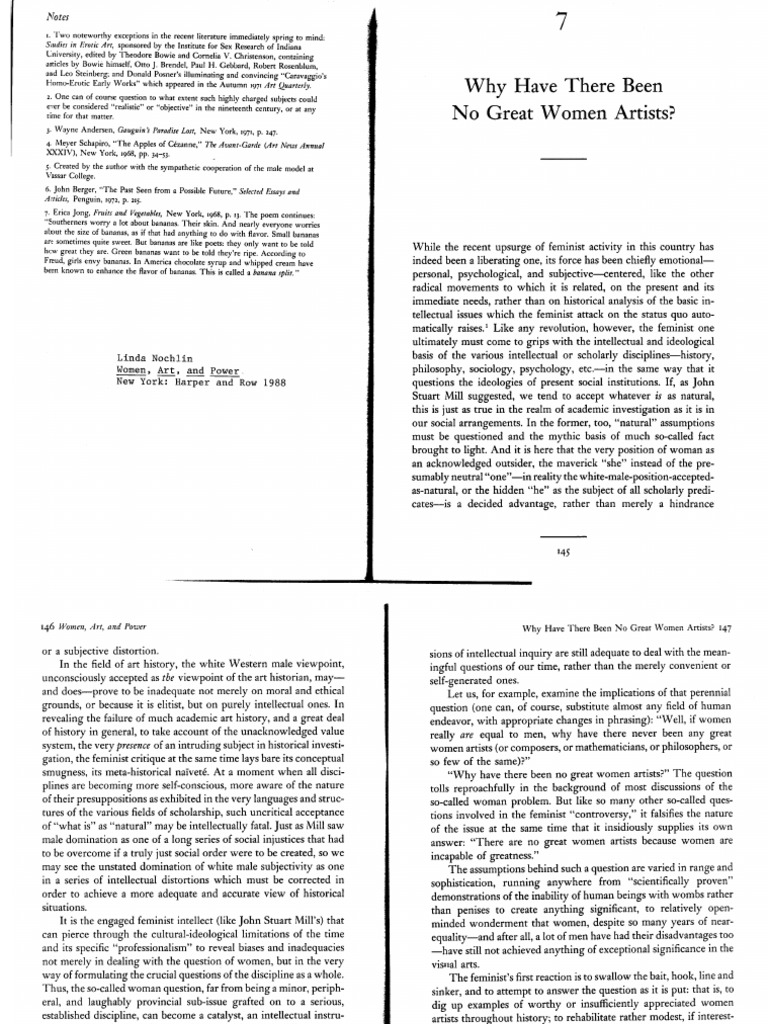
Feminism in art has long grappled with a persistent, provocative query: why have there been no great women artists? This question is not a mere curiosity; it is a mirror reflecting the entrenched systemic barriers, gendered prejudices, and historiographical omissions that have shaped the art world for centuries. Peeling back the layers of this conundrum reveals a labyrinth of sociocultural constraints and institutionalized sexism that stifled female creativity and erased their presence from the annals of art history.
The Myth of the “Great Artist” and Gendered Expectations
Our cultural imagination paints the “great artist” as a solitary genius — overwhelmingly male, often tormented, relentlessly ambitious. This archetype, deeply rooted in patriarchal ideology, has systematically excluded women by adhering to rigid gender roles that deemed them intellectually and creatively inferior. The myth itself becomes a gatekeeper, a dam holding back the recognition of women’s artistic endeavors. Women artists, constrained by expectations of domesticity and limited access to formal training, simply could not fit into this narrow mold of greatness.
Moreover, the valuation of artistic genius has historically prioritized large-scale, public, and often male-coded art forms — sculpture, monumental painting, heroic portraits — sidelining the mediums and themes more accessible to or preferred by women, such as textiles, miniatures, or domestic scenes. These biases have framed the narrative, marginalizing women’s contributions and confining them to the periphery of “serious” art.
Institutional Barriers and Exclusion from Art Education
Any serious consideration of why women were absent from the pantheon of great artists must contend with the brutal exclusionary practices of art institutions. For centuries, women were barred from prestigious academies, forbidden from life-drawing classes essential for mastering human anatomy. Such restrictions crippled their capacity to engage with the dominant artistic languages and techniques that conferred “legitimacy” in the art world.
This institutionalized gatekeeping was not a quirk of history but a deliberate mechanism to maintain male dominance. The result was a glaring disparity in opportunity — while men were nurtured and promoted within a socio-artistic ecosystem that valued their contribution, women were relegated to amateurism, craft, or clandestine practice at best. The few women who transgressed these boundaries became exceptions rather than the rule, their legacy often minimized or appropriated.
The Role of Societal Expectations and Domestic Constraints
Artistic creation demands time, space, and freedom — luxuries historically denied to women by the very fabric of societal expectations. Bound to the private sphere, entrusted with domestic duties and child-rearing, women rarely had the privilege to pursue art as a profession. The conflation of gender roles and social norms enforced a suffocating invisibility, making female artistry a byproduct of leisure rather than a serious vocation.
In many cases, women artists operated under the shadow of their male relatives — fathers, brothers, husbands — whose names overshadowed or subsumed their creative output. This dynamic perpetuated a hierarchy where women’s talents were commodified or obscured, reinforcing the illusion that “greatness” was inherently male.
Historiographical Neglect and the Reconstruction of Art History
The written history of art has been penned predominantly by men, curating narratives that exclude or marginalize women’s contributions. This historiographical bias entrenched the idea that great art and great artists are synonymous with male creators. Women were often omitted from canonical texts—not due to a lack of achievement, but because of a deeply ingrained patriarchal lens in scholarship and criticism.
Recent feminist art historians and critics have engaged in the arduous task of resurrection and reclamation, challenging the veracity of the “no great women artists” claim. Through meticulous archival research, reevaluation of works, and re-contextualization, they have unearthed talented women whose contributions were buried beneath layers of neglect. This reclamation project illuminates how history itself is a battleground marked by power and erasure.
Reframing “Greatness”: Beyond Traditional Metrics
Confronting the myth demands a redefinition of what constitutes “greatness” in art. The hegemonic criteria, steeped in gendered and Eurocentric biases, must be interrogated and expanded. Women’s artistic expressions — often rooted in different experiences, techniques, and mediums — offer alternative paradigms that challenge the status quo.
Greatness should not be tethered solely to the ability to conform to masculine-coded aesthetic standards or institutional approval. Instead, it ought to embrace diversity of voice, context, and innovation. Feminist critiques urge us to recognize that artistic value transcends the narrow confines historically imposed, championing myriad forms of creativity that have been systematically undervalued.
The Present and Future: Forging Spaces for Women Artists
The contemporary art world, while still grappling with inequalities, has witnessed a seismic shift driven by feminist activism and critical awareness. There is now an unprecedented spotlight on women artists, increased representation in galleries, museums, and academia, and vigorous discourse surrounding gender equity in the arts.
This progress, however, is far from complete. Structural biases persist, along with subtle markers of exclusion, such as differential market valuation and critical reception. The ongoing challenge is to dismantle these residual barriers and cultivate environments where women’s artistic brilliance can flourish unencumbered.
Ultimately, understanding why there were historically no “great” women artists exposes the sociopolitical underpinnings of greatness itself. It is less a question of individual genius and more a reflection of systemic inequities that feminism relentlessly seeks to dismantle.