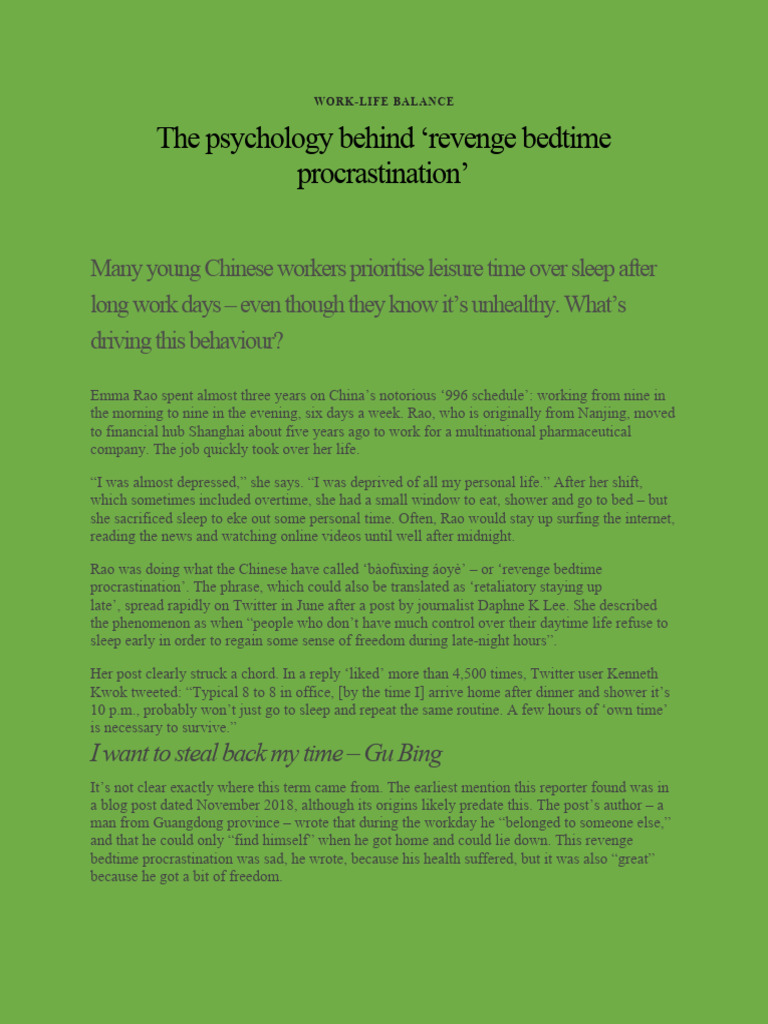
In quiet moments long after the world has succumbed to slumber, a curious defiance unfolds. Mothers—icons of unconditional sacrifice—find themselves ensnared in a paradoxical rebellion against exhaustion. This is not mere fatigue or absence of will, but a deliberate insurgency against the unyielding demands of day-to-day caretaking. It is the revenge bedtime procrastination of mothers, a phenomenon that destabilizes the traditional narratives of feminism and maternal identity, promising a seismic shift in how agency, autonomy, and selfhood are understood amid relentless societal expectations.
The Invisible Shackles: Maternal Exhaustion Re-Examined
Motherhood is often romanticized as a sacred toil, but beneath this sanctified veneer lies an exhaustion so profound it permeates every fiber of a mother’s being. The notion of revenge bedtime procrastination—delaying sleep to reclaim a semblance of freedom—becomes an act of quiet subversion. It’s not merely about stolen minutes; it symbolizes the erosion of personal sovereignty. Mothers labor ceaselessly, synchronizing their lives around others, sacrificing sleep as currency for their children’s needs, only to find themselves robbed of the very rest they deserve.
Here, the familiar tropes of feminism meet a disquieting crossroads. Feminism, at its core, advocates for autonomy and liberation, yet the lived experience of many mothers exposes fissures in this promise. The reclamation of bedtime becomes a desperate, sometimes furtive, assertion of identity outside of prescribed maternal roles. It is rebellion without banners—silent, nocturnal, and unacknowledged.
The Double Bind: Societal Expectations and Feminine Autonomy
Women have long been ensnared in a labyrinth of societal expectations that valorize their sacrifices and simultaneously punish their dissent. Mothers are expected to be inexhaustible wellsprings of emotional and physical labor, their existence often circumscribed by the needs of children, partners, and household. The allure of a bedtime revolt is the siren song of autonomy in a world that rarely offers women permission to seize it.
This double bind reveals a paradox: Feminism champions freedom and empowerment, yet the cultural script often traps mothers in an endless cycle of selflessness. Revenge bedtime procrastination thus becomes a poignant metaphor—a demand for space, a resistance encoded in those stolen nocturnal moments. It surfaces the fundamental question: How can mothers navigate the impossible tightrope between societal duty and personal liberation?
Reframing Feminism: From Collective Ideals to Individual Acts of Defiance
The traditional feminist discourse centers on systemic change—political, economic, and structural revolutions aimed at dismantling patriarchy. While these battles rage front-and-center, an undercurrent of micro-rebellions pulses quietly within the sanctum of motherhood. Revenge bedtime procrastination epitomizes a radical reconsideration of feminism’s scope, spotlighting the intimate, personal wars waged away from public scrutiny.
In these stolen moments, mothers carve out spaces that defy the binary of dutiful nurturer versus autonomous woman. This nocturnal reclamation is an intimate form of feminism, a testament to the resilience and complexity of identity. It suggests that empowerment need not always roar; sometimes it whispers in the shadows, daring to rewrite the narrative one insomnia-addled minute at a time.
Psycho-Social Dimensions: The Emotional Undercurrents of Nocturnal Rebellion
The psychology behind revenge bedtime procrastination unveils a labyrinth of emotional undercurrents—guilt, frustration, longing, and a profound hunger for self-recognition. Mothers often encounter sleep as a battleground where these emotions converge. Delaying sleep is not simply avoidance; it is a yearning to reclaim a fragment of individuality, a silent protest against invisibility.
Sleep, conventionally viewed as a passive surrender, is transformed into a terrain of active resistance. The choice to forgo rest becomes an embodiment of agency, a declaration that a mother’s identity transcends caregiving. This practice contextualizes motherhood not as negation of self, but a continuous negotiation between desire and duty. It underscores the necessity to understand maternal fatigue not solely as physical depletion but as an intricate psycho-social phenomenon.
Intersectionality and the Varied Landscapes of Maternal Experience
Not all mothers experience revenge bedtime procrastination uniformly. Race, class, geography, and cultural norms intricately weave the canvas of maternal experience, affecting how and why this procrastination manifests. For some, nocturnal rebellion is a privilege borne of relative security; for others, it is a scarce reclaiming amid relentless hardship.
Intersectional feminism demands recognition of these differentiated realities. The bedtime resistance of a middle-class mother in urban America contrasts starkly with that of a single mother juggling multiple jobs or a mother trapped within rigid patriarchal traditions. Thus, revenge bedtime procrastination beckons a broader dialogue about inclusivity—about ensuring feminism encapsulates the rich heterogeneity of motherhood rather than an idealized monolith.
Disrupting Narratives: From Martyrdom to Sovereignty
The prevailing maternal archetype perpetuates martyrdom—endless giving at the expense of self. Revenge bedtime procrastination punctures this archetype with a disruptive force. It refuses silent submission, foregrounding sovereignty over sacrifice. This unsettling narrative shift posits that self-care is not indulgence but reclamation; it reframes motherhood as fertile ground for both profound connection and unyielding autonomy.
This paradigm challenges feminist discourse to grapple with the dualities embodied by mothers: caregiver and individual, nurturer and sovereign. It demands a recalibration of how liberation is defined and pursued, insisting that motherhood itself can be a locus of empowerment rather than a halting point for personal freedom.
Conclusion: Towards a Feminism that Honors Complexity and Contradiction
Feminism’s trajectory is frequently envisioned as a linear arc toward emancipation and equality, yet the revenge bedtime procrastination of mothers exposes the nonlinear, often contradictory nature of gendered existence. These nocturnal acts of defiance offer a prism through which the paradoxes of motherhood and feminism can be refracted, illuminating the complex interplay between duty and desire, sacrifice and sovereignty.
To understand and honor this complexity is to advance feminism beyond abstraction and ideology—towards a movement that embraces the messy, intimate realities of women’s lives. It promises not only a shift in perspective but a deepening curiosity about what true liberation for mothers might look like when whispered in the twilight hours, long after the world has ceased to watch.