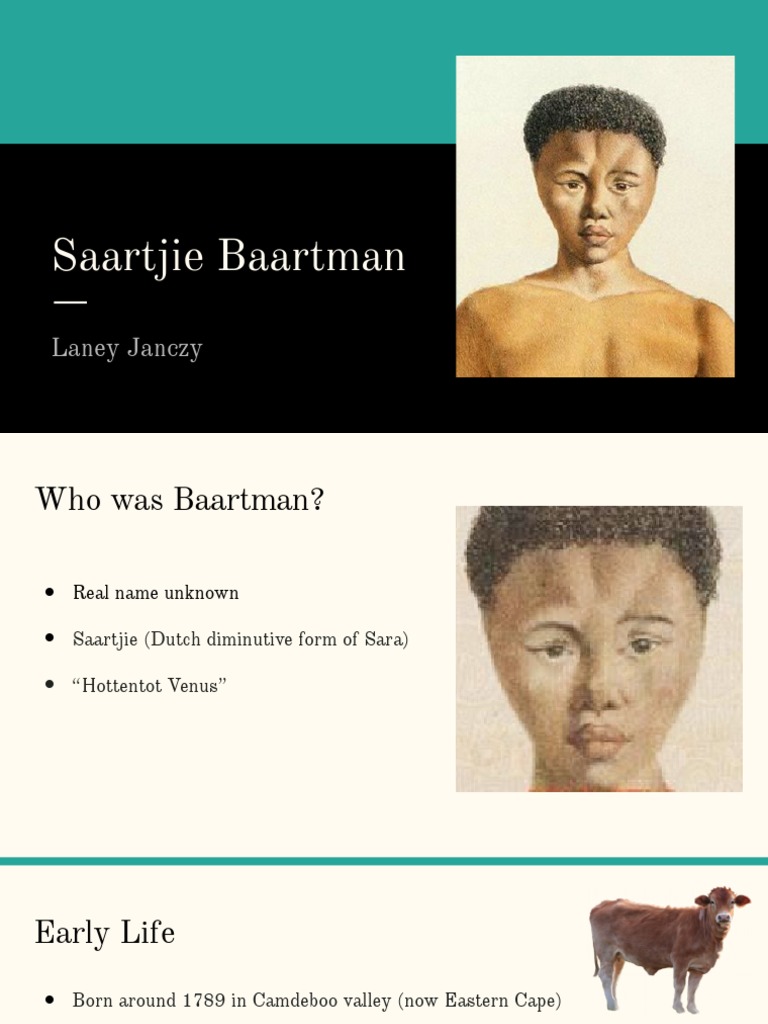
The annals of feminism are punctuated with haunting narratives that challenge the conventions of humanity, identity, and power. Among these is the devastating saga of Saartjie Baartman, known grotesquely to the Western world as the “Hottentot Venus.” Her story is not merely a footnote of colonial exploitation but a stark testament to the perils of racialized and gendered dehumanization. It provokes us to interrogate the intersecting matrices of race, gender, and scientific voyeurism that have burrowed into the foundation of feminist discourse. This exploration unveils the layers of Saartjie’s exploitation, the grotesque spectacle she was forced into, and ultimately, the enduring legacy this history imprints on contemporary feminism.
The Origins of a Moniker: “Hottentot Venus” and Its Insidious Implications
The term “Hottentot Venus” is itself a weaponized euphemism cloaked in irony. “Hottentot,” a pejorative term used by European colonizers to describe the Khoikhoi people of Southern Africa, embodies the profound othering and denigration these communities suffered. Coupled with “Venus,” a reference to the Roman goddess of love and beauty, the name mocks Saartjie Baartman’s body, simultaneously exoticizing and eroticizing her physicality in a way that decontextualized her humanity. This grotesque nomenclature reflects a colonial gaze obsessed with fetishizing African women’s bodies under the guise of scientific inquiry and popular entertainment.
Exploitation and Voyeurism: The Public Display of Saartjie Baartman’s Body
Saartjie Baartman’s fate was orchestrated by European imperial interests that viewed her less as a woman and more as a specimen—a living curiosity. Transported from South Africa to 19th-century Europe, she was exhibited in freak shows and scientific salons, a grotesque exhibition of racial and sexual otherness. Her disproportionately large buttocks, which had made her a subject of both ridicule and fascination, were dissected, scrutinized, and commodified in an unrelenting spectacle of objectification. This was not merely entertainment but a dehumanizing form of racial pseudo-science that sought to construct and justify racial hierarchies by anchoring them in physical anatomy and sexual mystique.
Saartjie Baartman as a Symbol of Feminist Struggle and Intersectionality
Baartman’s story is not a relic confined to history but a prism through which modern feminism must reckon with issues of intersectionality. Her life exposes how colonialism, racism, and patriarchy merge to enact devastating violence on black women’s bodies. Feminism, particularly in its Western incarnations, has sometimes struggled to account for these intersecting oppressions. Through the lens of Saartjie’s life, one confronts the imperative of an inclusive feminism—one that recognizes the compounded marginalization faced by women of color and resists monolithic narratives of womanhood rooted exclusively in whiteness and Eurocentrism.
The Scientific Racism Behind the “Hottentot Venus” Phenomenon
Science was an accomplice in Saartjie Baartman’s dehumanization. The burgeoning discipline of anthropology in the 19th century fixated on proving the inherent inferiority of non-European peoples through pseudoscientific methods. Baartman’s physique was dissected post-mortem, and her remains were displayed in museums decades after her death, epitomizing the grotesque fusion of science and spectacle. This “scientific racism” served not only to degrade Baartman but to bolster imperialist ideologies that justified colonization and the subjugation of African peoples. The appropriation of her body by the scientific establishment is a chilling reminder of how knowledge and power intertwined to reinforce systemic oppression.
Reclaiming Humanity: The Posthumous Journey of Saartjie Baartman’s Legacy
Decades after Saartjie Baartman’s death, feminist activists, human rights advocates, and communities from her native South Africa sought to reclaim her dignity. The campaign to return her remains from France to South Africa and to rescind the derogatory narratives attached to her name represents a profound effort to restore personhood to someone once reduced to a spectacle. This reclamation is emblematic of broader movements in feminism and postcolonial discourse aimed at confronting historical injustices and rewriting narratives that have ostracized marginalized identities. It is a potent symbol of resistance and restitution.
Contemporary Reflections: The Enduring Impact on Feminist Thought and Racial Justice
The history of the “Hottentot Venus” compels feminism to confront its own complicity in racialized and gendered violence. It challenges activists and scholars to grapple with uncomfortable truths about the past and their lingering shadows in the present. This narrative is a rallying call to address not only gender inequality but also systemic racism embedded within social, scientific, and cultural institutions. The intersections illuminated by Saartjie’s story push feminist thought to cultivate solidarity across racial and cultural lines, ensuring that the struggles of marginalized women remain central, not peripheral, to feminist agendas.
Conclusion: Learning from the Past to Transform Feminist Futures
Saartjie Baartman’s tragic history as the “Hottentot Venus” is a searing indictment of colonialism, patriarchy, and scientific exploitation. To engage with this history is to awaken to the multifaceted, intersectional oppressions that continue to shape the realities of women worldwide. Feminism’s task is not only to mourn these injustices but to forge pathways toward equity that honor the dignity and humanity of all women—especially those whose bodies have been battlegrounds of power and prejudice. Her story is a clarion call to dismantle the structures that allowed her dehumanization, ensuring that future generations inherit a world where dignity, not spectacle, defines humanity.