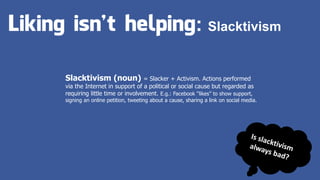
What if I told you that your digital activism—those perfunctory likes, the performative shares, the hollow hashtags—might be doing more harm than good? Welcome to the paradox of slacktivism, where the illusion of progress is mistaken for actual change. It’s the modern-day equivalent of shouting into the void, only to convince yourself the echo is a revolution.
The Illusion of Impact: Why a Like is Not a Lifeline
We’ve all been there: scrolling through our feeds, stumbling upon a post about gender equality, and—without a second thought—hitting that blue thumbs-up. It feels good. It feels like we’ve done something. But let’s be brutally honest: a like is not a lifeline. It’s a dopamine hit disguised as activism. The psychology behind this is fascinating, if not infuriating. Our brains are wired to seek validation, and what better way to get it than by aligning ourselves with a cause, even if it’s just a virtual nod? Yet, this performative allyship creates a dangerous feedback loop. We pat ourselves on the back for our “engagement,” while the systemic issues we claim to care about remain untouched. The real question isn’t whether we care—it’s whether we’re willing to do more than just care in the most superficial way possible.
The Sharing Paradox: Amplification Without Accountability
Sharing a post is the digital equivalent of passing the buck. You see a call to action, you hit retweet, and suddenly, you’ve done your part. But here’s the catch: sharing doesn’t equate to solidarity. It’s the activism equivalent of buying a wristband for a charity run and then never showing up. The act of sharing creates a false sense of collective momentum, as if the mere act of circulating information is enough to dismantle oppression. Yet, without follow-through—without donations, without protests, without tangible support—the shared post becomes just another drop in the ocean of performative noise. Worse, it can lull us into complacency, making us believe that awareness alone is enough to spark change. But awareness without action is just voyeurism dressed in moral clothing.
The Psychology of Slacktivism: Comfort Over Conviction
Why do we settle for slacktivism? The answer lies in the delicate balance between comfort and conviction. Engaging in real activism is hard. It demands time, energy, and often, personal sacrifice. Slacktivism, on the other hand, offers the illusion of participation without the discomfort of commitment. It’s the activism equivalent of ordering a salad instead of going to the gym—you feel like you’ve done something, even if you haven’t. This psychological sleight of hand allows us to sidestep the discomfort of true allyship. We convince ourselves that our digital gestures are meaningful, even as the status quo remains firmly intact. But comfort is the enemy of change. If we’re not willing to disrupt our own complacency, how can we possibly disrupt the systems that oppress others?
The Danger of Performative Activism: When Virtue Signaling Replaces Real Work
Performative activism is the dark cousin of slacktivism, where the performance of activism becomes more important than the cause itself. It’s the influencer who posts a black square on Instagram for Blackout Tuesday but never mentions systemic racism again. It’s the corporate brand that slaps a feminist slogan on a product but pays its female employees pennies. Performative activism thrives in the gap between intention and action, where the optics of allyship matter more than the substance. The danger here isn’t just that it’s ineffective—it’s that it actively undermines real activism by co-opting its language and imagery for profit or clout. When activism becomes a trend, it loses its teeth. And when it loses its teeth, it becomes just another commodity to be bought, sold, and discarded when the next outrage cycle begins.
From Slacktivism to Real Activism: Breaking the Cycle
So, how do we break free from the slacktivism trap? The first step is recognizing that digital gestures, while not inherently bad, are not enough. They are the starting point, not the finish line. Real activism demands more than a like or a share—it demands action. It demands that we step out of our comfort zones and into the messy, uncomfortable work of creating change. This could mean donating to grassroots organizations, attending protests, or educating ourselves on the issues we claim to care about. It could mean using our platforms to amplify marginalized voices rather than speaking over them. It could mean holding ourselves and others accountable for the performative gestures that do more harm than good. The key is to move beyond the performative and into the practical. Because at the end of the day, change isn’t created by hashtags—it’s created by people who are willing to do the hard work.
The Challenge: Are You Part of the Problem or Part of the Solution?
Here’s the challenge: the next time you feel the urge to like, share, or retweet a post about feminism or any social justice issue, pause. Ask yourself: what am I actually doing to support this cause beyond the digital realm? If the answer is nothing, then you’re part of the problem—the problem of performative activism that masquerades as progress. Real change requires more than a click. It requires courage. It requires commitment. It requires the willingness to be uncomfortable. So, the next time you see a post that demands your engagement, ask yourself: is this performative allyship, or is this the first step toward real action? The choice is yours. But remember—silence is complicity, and half-hearted gestures are just another form of silence.