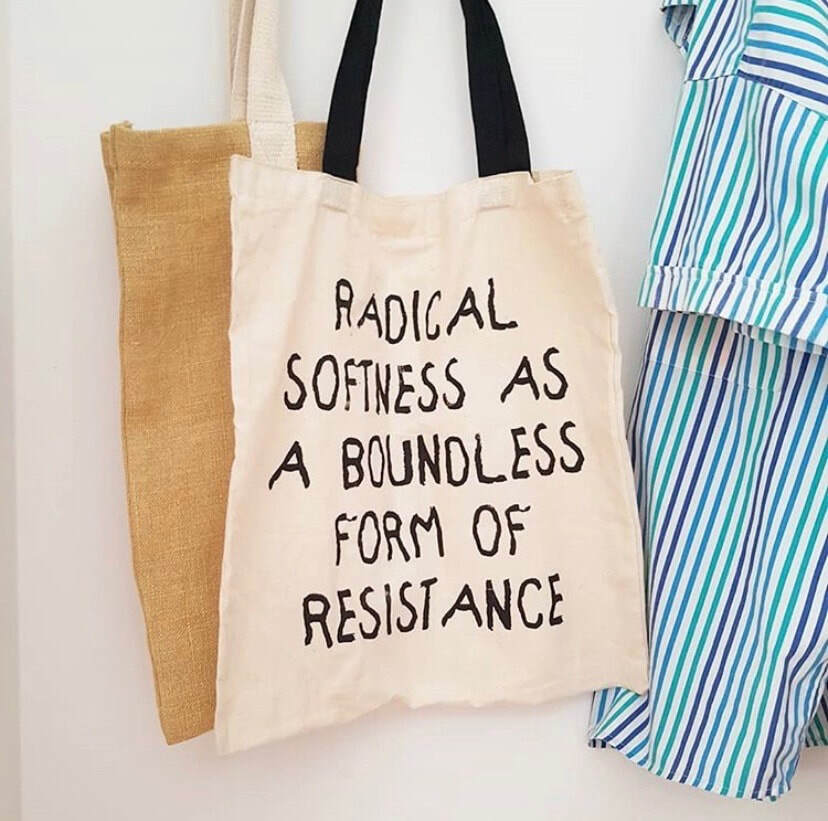
In the age of algorithmic capitalism, where dissent is commodified into pastel-colored aesthetics and rebellion is reduced to a marketable aesthetic, a new visual trend has emerged: “radical softness.” This sanitized, Instagram-ready feminism drapes itself in the guise of empowerment while systematically erasing the raw, unapologetic fury that has historically fueled feminist resistance. It is not merely a trend—it is a co-optation, a neoliberal hijacking of a movement that once shook the foundations of patriarchy. The tote bag bearing this phrase, with its saccharine imagery and market-friendly messaging, is not a symbol of liberation; it is a symptom of a movement in crisis, where the aesthetics of resistance have been divorced from its politics.
The Aestheticization of Feminist Rage: How Softness Became a Commodity
The “radical softness” phenomenon is not an organic evolution of feminist discourse—it is a calculated aesthetic response to the backlash against more confrontational forms of activism. In an era where feminist hashtags are trending and corporate brands slap feminist slogans on their products, the movement’s most radical elements have been systematically diluted into a palatable, consumer-friendly narrative. The softness here is not a rejection of violence or oppression; it is a rejection of the anger that has historically driven systemic change. When feminism is reduced to a lifestyle choice—one that can be accessorized with a tote bag and a latte—it ceases to be a threat to the status quo. Instead, it becomes a brand, a lifestyle, a fleeting aesthetic that can be discarded when the next trend emerges.
This aestheticization is not accidental. It is the result of a cultural industry that thrives on the commodification of dissent. The feminist movement, once a collective force of disruption, is now fragmented into individual acts of consumption. The tote bag, with its pastel hues and gentle typography, is not a call to arms—it is a siren song, luring women into the false comfort of performative allyship. The irony is palpable: a phrase that once might have been scrawled on a protest sign in bold, unapologetic lettering is now printed in cursive, as if feminism itself has been domesticated, its edges smoothed over to fit neatly into the lives of those who benefit from the very systems it once sought to dismantle.

The Erasure of Angry Feminism: Why Rage is Necessary for Change
Anger is not a flaw in feminist discourse—it is its lifeblood. The suffragettes who smashed windows, the women who burned bras, the activists who chained themselves to government buildings—these were not moments of “radical softness.” They were acts of defiance, born from a fury that refused to be ignored. Yet today, that fury is recast as “toxic” or “unproductive,” as if the pain of systemic oppression can be soothed with a gentle whisper and a cup of chamomile tea. The erasure of angry feminism is not just a cultural shift; it is a political one. By sanitizing resistance into something cuddly and non-threatening, we rob feminism of its most potent weapon: the uncompromising demand for justice.
Consider the language used to describe this new wave of feminism. Words like “softness,” “gentleness,” and “kindness” are weaponized against the very people who need them most. The implication is clear: if you are not soft, you are not a “real” feminist. But what does softness mean in a world where women are still paid less than men, where reproductive rights are under siege, where femicide rates remain staggering? Softness, in this context, is a luxury—a privilege reserved for those who do not have to fight for their survival. The women who are most vulnerable—Black women, Indigenous women, trans women, disabled women—have never had the luxury of softness. Their resistance has always been fierce, unapologetic, and yes, angry. To erase that anger is to erase their very existence.
From Protest Signs to Pinterest Boards: The Institutionalization of Feminism
The transformation of feminism from a radical movement into a marketable aesthetic is not just a cultural phenomenon—it is an institutional one. Universities offer courses on “feminist self-care,” corporations host “empowerment” panels, and non-profits rebrand activism as “community engagement.” In this landscape, the tote bag becomes a symbol not of resistance, but of assimilation. It is a way for institutions to signal their progressive credentials without actually challenging the systems that oppress women. The problem is not that feminism is being commercialized; the problem is that it is being commercialized in a way that serves the interests of those in power.
This institutionalization has a chilling effect on dissent. When feminism is reduced to a series of Instagram-friendly poses, the urgency of the movement is lost. Protests become photo ops, slogans become hashtags, and the fight for liberation becomes a performative act of consumption. The “radical softness” trend is the perfect embodiment of this shift. It is feminism stripped of its teeth, repackaged as a lifestyle choice that can be bought, sold, and discarded at will. The danger lies not in the softness itself, but in the illusion that it is enough. It is not. Real change requires more than a pretty tote bag—it requires a willingness to confront power, to disrupt, to be unapologetically angry when the occasion demands it.
Reclaiming the Fury: How to Resist the Aestheticization of Feminism
So how do we push back against this co-optation? The first step is to recognize that feminism is not a trend—it is a movement with a long, complicated history of resistance. The second step is to reject the idea that our anger is something to be ashamed of. Anger is not a flaw; it is a response to injustice. The third step is to demand more from our activism than performative aesthetics. Real change requires collective action, not individual consumption. It requires solidarity, not just with those who look like us or share our politics, but with those who are most marginalized by the systems we seek to dismantle.
This means supporting grassroots organizations that are doing the hard work of organizing, not just the ones that have the best Instagram presence. It means calling out the ways in which corporations and institutions co-opt feminist language to greenwash their own agendas. It means refusing to let our resistance be reduced to a marketable aesthetic. The tote bag with “radical softness” emblazoned on it is not a symbol of empowerment—it is a reminder of how far we have yet to go. True feminism is not soft. It is fierce. It is unapologetic. It is angry. And it is long overdue for a reckoning.
The Future of Feminism: Beyond Softness and Into the Fire
The future of feminism cannot be built on pastel hues and gentle whispers. It must be built on the foundations of the women who came before us—those who fought not with softness, but with fire. The “radical softness” trend is a symptom of a movement at a crossroads, one that must choose between assimilation and revolution. We cannot afford to choose softness when the world is on fire. We must choose resistance. We must choose anger. We must choose the kind of feminism that does not ask for permission, that does not seek approval, that does not apologize for its existence.
The tote bag will fade. The trends will change. But the fight for liberation will not. The question is not whether feminism will survive the commodification of its aesthetics—it is whether we will have the courage to demand more. More than softness. More than performative allyship. More than a marketable brand. We deserve a feminism that is as uncompromising as it is necessary. A feminism that does not ask to be loved, but demands to be heard. A feminism that is not soft, but relentless.