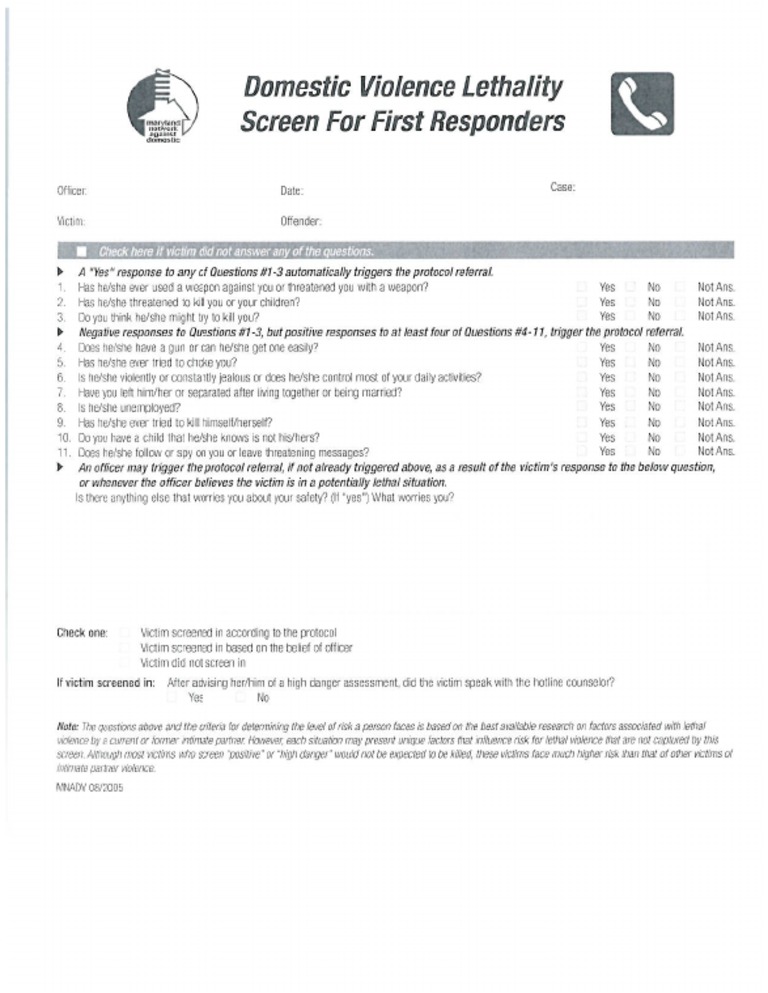
Feminism has long been a beacon for dismantling the systemic oppression that women and marginalized genders endure, particularly in the shadows of domestic violence. One of the most insidious aspects of this violence is its potential to escalate into lethal outcomes—a reality that first responders and social workers confront daily. The Domestic Violence Lethality Screen (LAP) emerges not just as a tool, but as a feminist heuristic, a framework that forces us to confront the brutal calculus of risk assessment in intimate partner violence. It is a mirror held up to the failures of a society that too often treats domestic abuse as a private matter rather than a public health crisis. This screen is not merely procedural; it is a radical act of recognition, a way to quantify the unquantifiable—the moment when love curdles into lethality.
The Lethality Screen as a Feminist Provocation
The Domestic Violence Lethality Screen is more than a checklist; it is a feminist provocation that demands we ask uncomfortable questions. Why do we wait for violence to reach a tipping point before intervening? Why are women’s lives treated as collateral in a system that prioritizes property over personhood? The screen forces us to confront the intersectionality of risk—how race, class, immigration status, and disability compound the danger for those already trapped in abusive relationships. It is a tool that refuses to let us look away from the fact that domestic violence is not an equal-opportunity predator; it preys disproportionately on those who are already marginalized.
Consider the woman whose partner threatens to kill her if she reports him to the police, knowing that her undocumented status will be weaponized against her. The lethality screen, when applied with nuance, can expose the gaps in our legal and social safety nets. It is a feminist intervention because it centers the lived experiences of survivors, forcing institutions to acknowledge that their “neutral” policies often perpetuate harm. The screen is not just about predicting danger; it is about exposing the rot in systems that claim to protect.
Beyond the Binary: Gendered Violence and the Lethality Screen
Feminism has taught us that gender is not a monolith, and neither is domestic violence. The lethality screen must evolve to reflect the realities of queer, trans, and non-binary survivors, whose experiences of abuse are often erased or misclassified. A cisgender man in a heterosexual relationship may face different barriers to safety than a bisexual woman in a same-sex partnership, yet many lethality assessments remain stubbornly heteronormative. The screen must become a chameleon—adapting to the fluidity of gender and the unique tactics abusers use to control and isolate their victims.
For trans women, for example, the threat of violence is not just physical but existential. An abuser may weaponize their partner’s gender identity, threatening to out them to employers, families, or law enforcement. The lethality screen must account for these psychological warfare tactics, recognizing that for many survivors, the risk of death is not just from a knife or a gun, but from the erasure of their very existence. Feminism demands that we stop treating gender as a checkbox and start seeing it as a spectrum of vulnerabilities that abusers exploit.
The Illusion of Neutrality: How Bias Distorts the Lethality Screen
No tool is neutral, and the lethality screen is no exception. It is shaped by the biases of those who design it, those who administer it, and the systems in which it operates. A study in Violence Against Women found that Black women are often perceived as less vulnerable by law enforcement, their reports dismissed as “drama” or “mutual combat.” The lethality screen, if wielded without critical self-awareness, can perpetuate these biases, reinforcing the idea that some lives are more expendable than others.
Feminism compels us to interrogate who benefits from the illusion of objectivity. When a lethality screen fails to account for the ways racism, ableism, and classism intersect with gender-based violence, it becomes complicit in the very harm it claims to prevent. The solution is not to abandon the screen but to radicalize it—to infuse it with the voices of survivors, to center the most marginalized, and to demand accountability from those who wield it. The lethality screen must become a site of resistance, not just risk assessment.
From Prediction to Prevention: The Radical Potential of the Lethality Screen
The true power of the lethality screen lies not in its ability to predict violence, but in its potential to prevent it. Feminism teaches us that prevention is not just about individual behavior change; it is about dismantling the structures that enable abuse in the first place. The screen can be a catalyst for systemic transformation—pushing for mandatory training on coercive control, for example, or for policies that prioritize survivor autonomy over punitive measures. It can force courts to recognize that a restraining order is meaningless if the abuser has access to firearms, or that a “cooling-off period” is a death sentence for a woman trapped in a cycle of violence.
But prevention also requires imagination. What if the lethality screen were paired with community-based interventions—safe houses run by survivors, for survivors? What if it were used to fund grassroots organizations led by those most affected by violence? The screen, in the hands of feminists, becomes more than a tool; it becomes a blueprint for a world where no one has to choose between their safety and their survival.
The Lethality Screen in the Courtroom: A Feminist Reckoning
Courts are where the lethality screen’s limitations—and its radical potential—are laid bare. Too often, judges and juries treat domestic violence as a “he said, she said” affair, ignoring the fact that most abusers are serial offenders who groom their communities into complicity. The lethality screen can disrupt this narrative, providing empirical evidence that what appears to be an isolated incident is part of a pattern of escalating violence. Yet, in the hands of a defense attorney, the same screen can be twisted to pathologize the survivor, framing her as “paranoid” or “unstable.”
Feminism demands that we reclaim the lethality screen in the courtroom, using it to expose the failures of a legal system that treats women’s lives as negotiable. It can be a wedge to push for trauma-informed judges, for expert testimony on the psychology of abuse, and for restorative justice models that center survivor healing over carceral punishment. The screen is not just a piece of paper; it is a weapon against the erasure of women’s pain in the eyes of the law.
The Future of the Lethality Screen: A Call to Arms
The Domestic Violence Lethality Screen is not a panacea, but it is a starting point—a feminist heuristic that forces us to confront the brutality of intimate partner violence with clarity and urgency. Its future lies not in its perfection, but in its evolution. It must become more intersectional, more survivor-centered, and more willing to challenge the systems that uphold violence. Feminism teaches us that change is not given; it is seized. The lethality screen is our tool, our weapon, our demand for a world where no woman has to prove she is worthy of safety.
So let us wield it wisely. Let us use it to expose the rot in our institutions, to center the voices of the most vulnerable, and to build a future where lethality is not a prediction but a relic of the past. The screen is not just about saving lives; it is about reclaiming them.