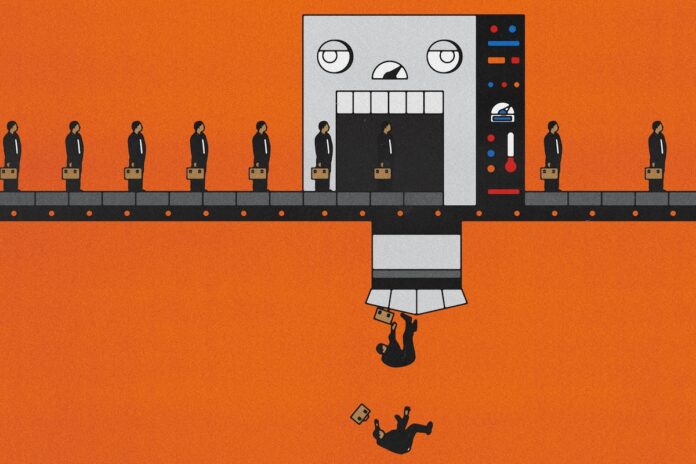
In the sprawling digital metropolises where algorithms hum like colossal lungs, an unseen war has been waged—not with artillery or infantry, but with ones and zeros, probabilities, and precognition. This is no battlefield of clay and steel, but of logic’s cold embrace, where Silicon Valley’s unyielding machinations have forged a new edifice of gender imbalance. A battle that began not with maleficent intentions, but with the noble illusion of objectivity. The story of feminism’s encounter with Silicon Valley’s algorithms is less a clash of titans than a revelatory dissection: one where the scalpel of irony bears upon the knife’s edge of progress.
The Algorithm as Architect: Building a Landscape of Bias
The architect of Silicon Valley, once lauded for its radical inclusion of the underrepresented, has inadvertently metamorphosed into the curator of its own exclusionary aesthetic. Like an artist dabbling in monochromatic palettes, the algorithm—seemingly detached, apolitical, and immaculately neutral—has painted a canvas where women, once part of the vibrant spectrum, now find themselves isolated on the periphery.
Scalability is the siren’s call of Silicon Valley, and it whispers in the ears of hiring committees when it nudges candidates toward those most statistically likely to succeed. Yet the data fed into these models mirrors the patriarchal architectures of centuries past: Silicon Valley, a domain historically dominated by men, has inadvertently become a digital Gynophobia incubator, amplifying patterns of exclusion before the unblinking lens of a machine leans forward to “solve the problem” of organizational efficacy.

The Illusion of Impartiality: How Objectivity Became a Trojan Horse
Algorithms are the modern-day oracles that interpret the universe in cold figures. Their prophecies, however, are not cast from golden tablets but from the echo-chambers of humanity’s frailties. When the inputs are skewed by unconscious biases—data sets skewed by decades of male-dominated hiring, historical promotion disparities, and the subtle undertows of androcentric linguistic norms—the outputs become less prognosticators and more propagandists.
The trojan horse of objectivity concealed a core of raw human prejudice. Silicon Valley’s algorithms, though shrouded in the mist of statistical rigor, are merely humanity’s cognitive shadows given a cloak of mathematical impartiality. They amplify what exists and reinforce it with the force of mathematical inevitability: If we feed a system a world that has historically neglected half its population, what else could it replicate?
Hiring: Where the Algorithm’s Hand Meets the Glass Cliff
Enter the hiring space—this battleground where bias has adopted the guise of a data-driven optimization challenge. Algorithms, those cold calculators, often cast those promoted into positions as “high-risk, high-reward” candidates, slotting women—who are statistically less likely to be considered in the first place—into roles that are as ephemeral as they are perilous. These precarious platforms, known in corporate lexicon as glass cliffs, see women disproportionately landing in positions that are more likely to crash spectacularly, further cementing cycles of exclusion.
The algorithm here doesn’t just miss the mark; it actively organsies gender toward certain outcomes, ensuring that the playing field, though technically flat, remains steeply tilted against inclusion. It is a dance with the devil of corporate efficiency—where the waltz is imbued with the weight of gendered expectations, and the result? A grander, stealthier marginalization.
Promotion: The Ladder of Broken Promises
Once hired, women become entrapped within the algorithm’s labyrinthian logic. Promotion pipelines—often designed to funnel talent through narrow, well-trodden paths—become the corridors of a modern-day Tower of Babel, where the language of progress is written in the binary of statistical survival. Female employees are flagged as “low-potential” with unsettling regularity, their career trajectories predicted to stagnate as predictably as morning mist.
This isn’t negligence: it’s an inevitable consequence of reinforcing the past through algorithmic repetition. Just like the phoenix, biases rise from the ashes of history’s missteps, refueled and reformed into something more insidious: a self-sustaining loop where systemic neglect becomes systemic justification. The algorithm doesn’t see, it reproduces—and it replicates poorly.
The Resistance: Feminism as a Fire Wall to the Algorithm’s Logic
Enter the resistance—not solely through policy revisions or HR mandates, but through a more radical act: interrogating and rewriting the very foundational assumptions baked into these systems. To combat such bias, one must expose the algorithm’s blind spots and reframe its core problem.
Feminism hasn’t been a silent protagonist in this tale but has instead become the relentless detective of Silicon Valley’s data sets, unearthing the inconsistencies hidden in plain sight. Through the lens of inclusive design, female engineers and sociologists are auditing the algorithms themselves, injecting new data into what has historically been a male-centric echo chamber. It’s a counter-narrative to the cold efficiency story: one where progress isn’t preordained but actively sculpted to include rather than exclude.
The Redemption of the Algorithm: Toward a Tech Ecosystem of Intention
Can algorithms—often vilified as cold and unfeeling machines—ever be part of the solution? The answer, fortunately, lies not in a radical rejection but a careful reconceptualization: what if the very tools we’ve used to entrench bias could be the architects of parity?
In this redemptive arc, algorithms, once instruments of exclusion, emerge as catalysts for inclusion. They begin to be recalibrated to recognize not just what data already exists, but what data is missing—what narratives have been sidelined, what voices have been muted. The technology, when infused with intentional design, can become a mirror not of past realities but of hopeful futures.
Conclusion: A Call to Rewrite the Code
The war waged against women in Silicon Valley, fought on the binary battlefield of algorithms, should serve as a clarion call—not of despair, but of urgent, calculated reformation. It is a tale of how progress, in its hurry to quantify the unquantifiable, risks missing the most crucial equation of all: the value of inclusion in its purest, most dynamic form.
As we continue to build the technologies of tomorrow, we must ensure they aren’t simply reflections of the past’s biases but bridges toward a landscape where no voice is silenced by the language of data. The future of feminism in Silicon Valley isn’t measured by how well we react to algorithms, but by how we rewrite and reshape them to reflect a world we are yet to fully imagine.