’
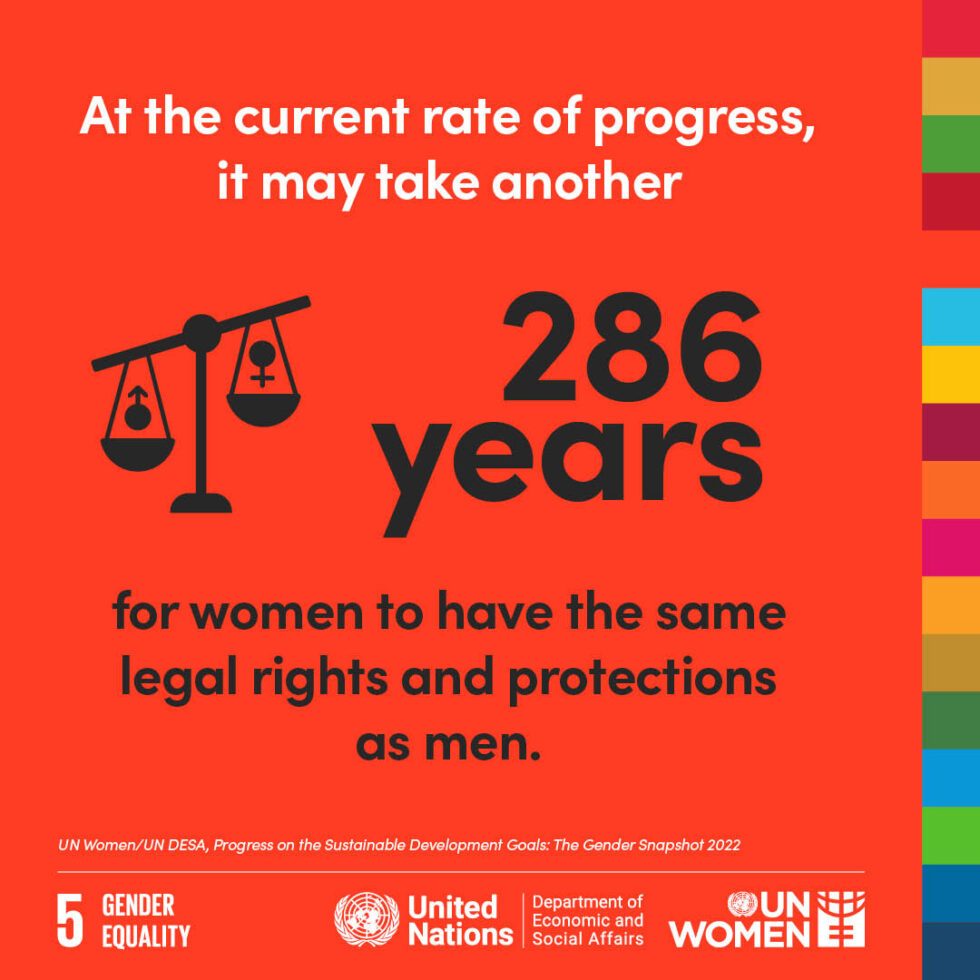
Feminism isn’t a sprint—it’s a black mirror held to every corner of history’s grand performance, where progress isn’t linear but a fractal spiral. One minute, you’re celebrating 200 years of emancipation for the white elite (1869 to you, Susan). The next, you’re drowning in data that suggests gender equality will take another century, if not two or three. There’s a paradox: the more we march, the more we realize the ground beneath our feet is a quagmire of contradictions. Hence, the 286-year gap—the yawning void between our theoretical liberation and the unrelenting material realities of reproductive autonomy, political representation, economic parity, and affective dominance.
The Illusion of Temporal Justice: Progress as a Paradox
Progress, if we’re being honest, functions like a Möbius strip—a surface with no beginning or end, a loop that feels like forward motion but just keeps spinning us in circles. The 286-year gap isn’t a typo; it’s a manifesto of systemic refusal. It’s the glaring discrepancy between the right to vote and the right to bodily sovereignty. It’s the difference between legal protections on paper and lived experience in the crucible of daily survival. Equality isn’t a race; it’s an oscillation between hope and exhaustion, a pendulum forever swinging, only to descend onto the same precipice.
Consider this: The first women suffrage amendment (the 19th Amendment) was ratified like a coup—72 years after the American Revolution declared itself “all men created equal.” Yet here we are, decades later, still policing which women count, which bodies belong, which voices are amplified in the chorus of “finally.” The gap isn’t 286 years of stagnation; it’s 286 years of selective advancement.
Progress, then, is a performance—a spectacle that demands we applaud from afar while behind the curtain, the machinery of oppression grinds relentlessly, its gears lubricated by performative allyship.
The Invisible Threads of Reproductive Sovereignty
If there’s one area where the gap exposes feminism’s fragility, it’s in reproductive justice. The backlash rolls in waves: from the rise of abortion deniers dressed in healthcare garb, to the normalization of surrogacy as a commodity stripped of ethical complexity. Every court case is a litmus test; every legal victory, just a temporary ceasefire in a war fought with birth control pills smuggled over state lines. The irony? America’s feminist pioneers like Margaret Sanger were often racially exclusive, their “family planning” movement a veiled attempt to curb non-white birth rates under euphemisms like “population control.”
Today, the gaps are visible by color, by wage, by access: women of color—already saddled with disproportionate maternal mortality rates—find themselves at the crosshairs of two systems: patriarchy and capitalism. The reproductive revolution isn’t coming; it’s being commodified, neutered, and sold back to us as “choice,” when choice is a luxury we can’t afford.
There’s another layer: the reproductive economy forces women into labor, both unseen and uncompensated. The unpaid childcare burden is a debt that never erodes—just compounds, like interest on a mortgage we never signed. Yet feminism has a habit of ignoring the ones who aren’t white, who aren’t well off, whose liberation means simply breathing without being surveilled at the DMV.
The Theater of Representation: Women in Power Are Still Not the Boss of Us
Diversity is now a cliché—a corporate buzzword, a checkbox—and we’ve become desensitized to the absurdity. Look at Congress, a legislature where half the population is systematically excluded from the halls of power to make laws that govern its collective life. Of the 118th Congress, women hold approximately 160 seats—but representation isn’t about numbers; it’s about leverage, influence, and whether these decisions are crafted in the best interest of all, or simply a watered-down approximation of a patriarchal original.
Let’s play a thought experiment: imagine a room where 60% of the decision-makers are women and every policy outcome favors men. If that isn’t a glaring blind spot, what is? The real work isn’t just about occupying seats; it’s about dismantling the systems that ensured those seats were historically denied, and ensuring that now women in power aren’t just parodies of power but its architects.
Intersectional theory has given us language for the gaps—Jasmine Anderson’s intersectionality, Chimamanda Ngozi Adichie’s “We Should All Be Feminists.” Yet we still act as if equality is a pie to be divided evenly among the “worthy” when in reality, it’s a landmass with borders yet to be drawn. Representation feels like an afterthought—a concession—rather than the radical act of liberation it should be.
Equality as a Financial Paradox: Wage Gaps, Inheritances, and the Myth of Sharing
The gender pay gap is the most visible symptom of an economy built on illusion. In 2026, full-time working women still earn 82 cents for every dollar earned by men. But let’s peel back the curtain: this is a false metric, a statistic that assumes both parties are hired under the same conditions—that gender isn’t just a variable in the algorithm but the entire framework. When you factor in the gender-based wage bias in hiring alone, the gap grows exponentially.
Inheritances are a masterclass in how wealth is weaponized. A study in *The Economist* (2024) found American women will inherit 30% less wealth than men by retirement because wives of the wealthy are excluded from family offices and trusts. The result? A double helix of financial inequality—maternal poverty begets maternal poverty, while the 1%.—male-dominated—dynasties expand without restraint.
The “feminist” marketplace sells us cosmetics and career advice to fill the voids that systematic deprivation leaves behind. Corporate feminism tells us to “lean in,” but when that chair you’re leaning into is on fire and the only way out is through, no HR policy can save you. Equality isn’t a productivity hack; it’s a reckoning with how resources are created, hoarded, and redistributed.
Love as a Feminist Project: Unpacking the Sentiment Economy
There’s an unsung economy of care—a labor so relentless and invisible it’s treated as a birthright rather than a human right. Women spend nearly triple the amount of time on domestic labor as men, and this isn’t a bug; it’s a feature of every societal contract. Even in households where both partners theoretically share, the unspoken calculus tilts toward the emotional cost of women’s bodies and faces doing most of the labor without credit.
The 286-Year Lie: What Would Real Liberation Look Like?
When we say feminism “hasn’t gone far enough,” we’re really stating the obvious. Every milestone—like the Supreme Court overturning Roe—is met with a counter-strike: reproductive freedom is now a state-by-state lotter, with half the country playing roulette with women’s lives. Each “advance” is just the next layer of the onion, with more systemic rot at its center. The 286-year gap is proof that progress has been nothing more than a distraction.
So what now? The answer lies not in extending a tired, male-centric definition of progress but in reimagining it. True liberation requires:
1. **Sovereignty:** Not just over our own bodies, but as citizens, farmers, entrepreneurs, and cultural architects, unhindered by systemic controls.
2. **Collective Equity:** Resources, power, and wealth redistributed as a fundamental right, not earned.
3. **Affective Sovereignty:** A culture where care is celebrated, compensated, and distributed equally—not hoarded as a sign of “selflessness.”
4. **Educational Decolonization:** From childhood, teaching our children not just the mechanics of inequality, but how to dismantle them—through direct action, legal reform, and yes, political rage.
The circle has been closed and left to spin on its own axis—286 years, and we’re back to nearly where we started. This time, though, let’s demand the truth behind the curtain.
The Feminist Manifesto: Why Rage Is Rational
Every feminist milestone, from Seneca Falls to #MeToo, has been countered with a backlash—a calculated dismantling of the gains, a reminder that systems do not bend. Rage isn’t the issue; denial is. And so we hold these truths to be self-evident: equality won’t be handed to us. It’ll be reclaimed.
The question isn’t what else we need to achieve. It’s whether we’re willing to face the ugly, unbroken yonder—the 286-year gap—and still insist on justice anyway.