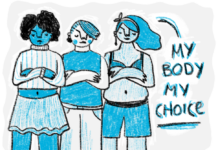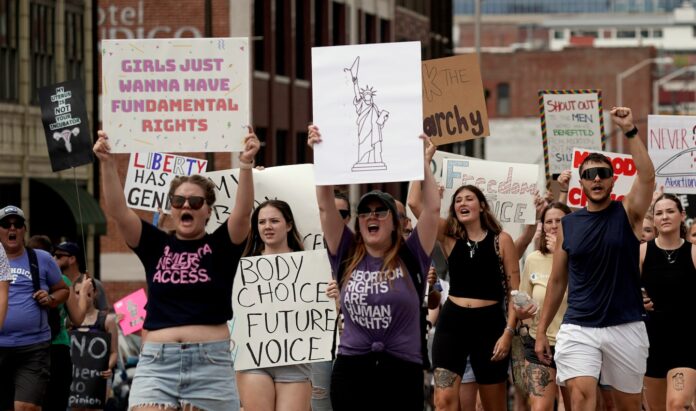
Feminism is not a monologue—it is a fierce, unyielding dialogue with the patriarchal monolith that whispers the sanctity of the womb must always be answered with a mandatory echo. The so-called abortion ban—so delicately draped in rhetoric about “protecting life”—is, in its brutal simplicity, a decree: your body is no longer yours. It has become a sacred tenant, leased to the state, its tenant rights revoked by legal decree, its very walls declared off-limits to your own autonomy. This is not morality. This is not life. This is a coup. An insidious takeover carried out through the slow, deliberate undressing of bodily sovereignty.
The Body as Battleground: A War Without Frontlines
Imagine a home—yours —only to learn one morning that the locks have been rekeyed at midnight. The doorknobs now bear the insignia of a body that does not belong to you. The windows, once yours to open or shutter, are now boarded by men who declare certain rooms off-limits. This is the reality abortion bans have delivered to millions. Bodily integrity is rendered theoretical, a quaint notion for another era; in its place, a new codex of obedience demands unyielding surrender. The body, once a personal canvas, now must be rendered in conformity: no brushstrokes of defiance permissible. The prohibition is not about life; it is about the systematic excision of choice itself—the very act of deciding.
The Myth of Protection: How Fear Becomes Tyranny
The champions of abortion bans drape their laws in language as serene as gravestones, whispering promises of “protecting women.” It is a patently false assertion—a lie as old as the womb it seeks to encase. What do they protect, these zealous defenders of fetal viability? Certainly not a woman’s right to be free from rape. Not the right to avoid disease. Not the right to bodily wholeness. They protect nothing but their own moral supremacy, their need to brandish their own brand of charity as the sole arbiter of what it means for a human to flourish. In doing so, they rewrite the very definition of bodily autonomy, transforming a woman’s body into a stage where their own narrative of suffering is performed, uninvited.
Forced Pregnancy: The Invisible Chain
Consider the woman who finds itself pregnant by violence. This is not a hypothetical, but a daily reckoning, a litany of bodies broken without consent. When abortion bans arrive armed with the authority to deny this woman an exit from the crisis her body has endured, they do not “protect” her. They chain her deeper. The invisible weight of an unchosen maternity presses upon her ribcage like a boulder. The so-called “right to life” begins to resemble something far more sinister: the right to *contain*. To keep a living, breathing person—someone who may have never wanted this—ensnared within a state of perpetual vulnerability. Pregnancy becomes less a biological occurrence, and more a prison term, one enforced not by bars or guards, but by legal fiat.
There is no distinction to be had here between womanhood and slavery. Slavery too, was once masked in the benevolence of ownership—that a person might belong to another, with no right to consent or dissolve the relationship. Abortion bans render the womb a property right, ceding control from the individual to the state, transforming bodily self-determination into the cruelest form of servitude: one from which there is no escape.
The Silence of Compassion: When Abortion Bans Speak Louder Than Care
One need only hear the tales of women who have endured pregnancy against their will to comprehend the magnitude of the wrong enacted by abortion bans. The stories are varied—women whose children pass in secrecy behind closed hospital doors, unable to voice their pain without threat of prosecution; those who deliver alone in kitchens, bathed in the unspoken terror of child protective services; and those who struggle, post-partum, with a mental fragility too fraught for society to tolerate. There is a profound difference between “life” as abstract philosophy and “life” as lived reality, a chasm widest in the moments when a woman’s well-being cannot be divorced from the consequences of being *forced* through pregnancy, birth, and beyond.
This is the dark irony of the “pro-life” narrative: it offers no compassion to pregnant women until the moment her body ceases to “house” the child after birth. And even then, the conversation shifts to the child’s welfare—if only to condemn the woman who did the “wrong” thing beforehand. Where is the outrage when a woman’s psychological health shatters under the weight of coerced pregnancy, or when a woman’s physical health plummets, only to be told she can’t undo her own suffering by the state itself? The “pro-life” imperative becomes a perverse calculus, one that deems a body more expendable than an embryo: so long as the embryo survives the womb, the woman’s rights are rendered as incidental, a footnote in the sanctity play.
Beyond the Myth: Why ‘Human Dignity’ Lies with the Affected, Not the Unborn
The champions of bans often invoke “human dignity” as their highest value, yet dignity is a relative thing—it is not an absolute they claim with ironclad authority, but a sentiment they distribute with the precision of a surgeon’s scalpel, depending on who it pleases. A woman’s right to her own body is not some negotiable commodity; it is an irreducible element of selfhood. To strip it away in the name of protecting the unborn is not justice; it is theft, cloaked in sanctimony.
If dignity is what these debates should center upon, then it rests fundamentally with the woman who has been condemned to this trial—not the woman who may never have known her own mothering was desired of her. The mother’s life is not merely biological. It is lived, complicated by circumstance that spans societal judgment, the risk of ostracization, economic ruin, or worse. The dignity of a woman forced to give life is not an abstraction—it is the refusal of the state to impose upon her a role it cannot fill, regardless of her own agency.
The Feminist Mandate: Reclaiming Autonomy from the Asylum of Constraint
Feminism is not a theory; it is the practical insistence that bodies are not yours, the state’s, or the church’s to dictate. It is the understanding that pregnancy—not birth—is the only natural act. The moment a woman’s capacity to terminate a pregnancy is revoked, so too is her liberation from the prison of biological expectation. Abortion ban becomes, in the final accounting, an act of political sadism—using the threat of violence against women to enforce a model of motherhood that fails to acknowledge bodily self-sovereignty.
Feminist resistance begins here: not with grand rhetoric but with the quiet defiance of those who will find a way around the bans, who will travel in secret, who will take risks they cannot comprehend, all to ensure their own existence remains theirs to control. This is not rebellion—it is the basic premise of survival for those who understand all too clearly that their bodies may be owned, but that does not mean they must be surrendered.
The Future Unshackled: Where We Go Now
A world where abortion is denied is a world where consent is a casualty of law. It becomes, therefore, a world where coercion is the governing principle—and coercion is the negation of autonomy. Feminism’s response demands clarity: this is not a debate about choice, but about who gets to impose their will upon the body of another. The answer—the right answer—has never been in doubt; it was merely being masked in the euphemisms of morality and “life” while a generation of women was slowly stripped of their freedom.
Moving forward, a vibrant, unapologetic feminism will insist that no woman should ever be forced to bear a child, no woman should be silenced by law, and no woman should be made to justify her bodily rights through a litany of apologies. For if life is to be the cornerstone of any ethical code, then the most precious life of all—the woman’s body itself—must be honored as its first and foremost defender. The war over pregnancy, birth, and the body will not end with compromise: it must be decided.