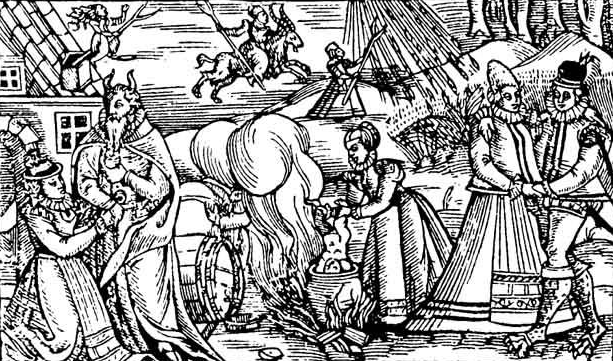
What if the first feminist icon wasn’t a suffragette marching in the streets, but a woman hunched over a birthing mother’s body, her hands stained with blood and herbs? What if the original “witch” wasn’t a hag cackling over a cauldron, but a midwife, her knowledge of life and death so potent that men in power trembled? History has a way of twisting the truth into cautionary tales, and nowhere is this more evident than in the demonization of midwives—those unsung heroines of the birthing chamber, whose wisdom was once revered, now reduced to folklore and firewood.
The Witching Hour: When Knowledge Became a Crime
In the dim glow of candlelight, before the rise of modern medicine, midwives were the gatekeepers of life itself. They knew the secrets of the body—how to ease pain, how to turn a breech baby, how to coax a struggling newborn into the world. Their tools weren’t scalpels and stethoscopes, but herbs and intuition, passed down through generations of women who whispered remedies in the dead of night. But knowledge, especially when wielded by women, has always been a threat to the status quo. So the church, in its infinite wisdom, declared their craft heretical. A midwife’s healing hands became “unnatural.” Her prayers to the old gods—herbs, moon cycles, the rhythms of the earth—were recast as pacts with the devil. The birthing stool, once a symbol of female autonomy, became a throne of damnation. And just like that, the witch hunts began.
Imagine, for a moment, the absurdity of it all. A woman who could bring life into the world with nothing but her bare hands was suddenly accused of consorting with demons. The irony? The same men who burned her at the stake were the ones who couldn’t even deliver their own children without fainting. Midwives weren’t witches—they were scientists, albeit ones who operated outside the rigid confines of patriarchal institutions. Their crime wasn’t witchcraft; it was competence. And in a world where men feared losing control, competence was the most dangerous magic of all.
The Body as Battleground: Who Controls the Narrative?
The demonization of midwives wasn’t just about religion—it was about power. Who gets to decide what’s “natural”? Who gets to dictate the terms of birth, of pain, of life itself? The answer, historically, has always been men. The medical establishment, built by and for men, sought to monopolize the birthing process, replacing the intimate knowledge of women with cold, clinical procedures. The witch hunts weren’t just about erasing female healers; they were about erasing female agency. A woman’s body became a territory to be conquered, her pain a problem to be managed, her choices a threat to be controlled.
Consider the language used to describe midwives: “superstitious,” “backward,” “unscientific.” These weren’t neutral terms—they were weapons. By framing their knowledge as primitive, the medical elite could justify their takeover. But what if the real superstition was the belief that men, with their sterile gloves and steel tools, were somehow better equipped to bring life into the world? What if the real backwardness was the idea that a woman’s body needed to be “fixed” by a system that had no understanding of its rhythms?
The witch hunts didn’t just silence midwives—they silenced generations of women. For centuries, the knowledge of how to birth a child, how to heal a wound, how to navigate the mysteries of the female body, was passed down in hushed tones, in the dead of night, under the threat of persecution. The cost of this erasure? Countless lives lost to preventable complications, women shamed for their bodies, and a medical system that still struggles to see women as anything more than hysterical patients.
The Herbal Rebellion: When Plants Became Subversive
Midwives didn’t just deliver babies—they cultivated rebellions. Their pharmacies weren’t apothecaries with gleaming jars of pills, but gardens of rebellion, where plants like mugwort and raspberry leaf whispered secrets of fertility and pain relief. These weren’t just weeds; they were tools of autonomy. A woman who knew which herbs to brew could control her own fertility, could ease her own pain, could birth her own children without the interference of a man in a white coat. And that, my friends, was a threat too great to ignore.
The persecution of midwives wasn’t just about religion or science—it was about fear. Fear of a woman’s body. Fear of a woman’s knowledge. Fear of a woman who could create life without a man’s permission. The witch hunts were, at their core, a war on female power. And the weapons? Slander, fire, and the slow, creeping erasure of women’s history.
But here’s the thing about rebellions: they never truly die. The knowledge of the midwives didn’t vanish—it went underground. It hid in the recipes of folk healers, in the whispered advice of grandmothers, in the modern resurgence of doulas and home births. The witch may have been burned, but her spirit lived on in the women who refused to be silenced.
The Modern Witch: Reclaiming the Birthing Chamber
Today, we see the echoes of the midwife’s persecution in the ongoing battles over reproductive rights. The same institutions that once called her a witch now call her a “quack,” her methods “unproven.” The same fear that drove men to the stake now drives them to legislate women’s bodies, to control the narrative of birth, to dictate what is “natural” and what is not. But the midwives’ legacy lives on in the women who choose home births, in the doulas who stand as witnesses to the sacred act of creation, in the feminists who refuse to let their bodies be policed.
The witch wasn’t a monster—she was a healer. The midwife wasn’t a criminal—she was a scientist. And the real crime wasn’t her knowledge, but the fact that it threatened a system built on the subjugation of women. So the next time you hear the word “witch,” ask yourself: who, really, was the witch? The woman who brought life into the world with her bare hands? Or the men who feared her so much they had to burn her to feel powerful?
The birthing chamber was never a place of darkness—it was a temple. And the midwives were its priestesses. The witch hunts were never about evil—they were about control. And control, my friends, is the oldest trick in the book.