Imagine a gallery where every mirror is cracked, each fragment reflecting a version of oneself distorted and scrutinized under a gaze that is never truly one’s own. This is the crucible of female self-perception within the male gaze—a relentless lens that fractures reality into a kaleidoscope of objectification, judgment, and imposed desire. It is not merely an external phenomenon, but an insidious force that seeps into the marrow of female identity, warping how women see, value, and even speak to themselves. To unravel this complex web, one must journey through the theory’s roots, its pervasive impacts, and the profound paths toward reclamation and healing.
The Male Gaze: A Prism of Power and Objectification
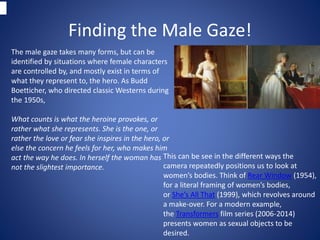
At its core, the male gaze is an architectural blueprint of power, etched deeply into the fabric of visual culture. It is a prism through which women are viewed primarily as objects of male pleasure, their subjectivity erased beneath the weight of voyeuristic consumption. This gaze does not merely observe; it constructs, categorizes, and confines. It casts women into rigid archetypes—the seductress, the damsel, the muse—each a cage gilded with societal expectations and patriarchal demand.
More than a cinematic or artistic device, the male gaze reverberates in daily interactions and social structures, setting the stage for how women internalize their bodies and worth. The eyes that scan, assess, and appraise become internalized voices, transforming external judgment into a relentless self-surveillance. It breeds a silent choreography where every movement, every glance, is a coded dialogue rooted in external validation.
Fractured Reflections: How the Male Gaze Distorts Female Self-Perception
Within this landscape, female self-perception becomes a fractured mirror, each shard reflecting not an authentic self, but a reflection shaped by contingent approval. The male gaze instills a pernicious duality, compelling women to view themselves both through their own eyes and through the eyes of an imagined observer. This dichotomy engenders a ceaseless tension—a battle between true selfhood and the role-scripted persona demanded by patriarchal norms.
Distortion manifests in multifaceted ways: body dysmorphia rooted in idealized beauty standards, learned helplessness where autonomy is undermined by imposed narratives, and a pervasive alienation from one’s desires and ambitions. The psyche becomes a battleground where self-worth fluctuates based on external appraisal, rather than internal affirmation. Beauty becomes currency, compliance becomes survival, and authenticity often dissolves into performative façades.
Moreover, the male gaze commodifies female identity, reducing rich complexity to marketable aesthetics. It polices behavior and appearance, fostering a culture where women’s narratives are muted or edited to fit palatable archetypes. The consequence is a pervasive invisibility—of pain, of intellect, of dissent—contradicting the notion of women as holistic beings with evolving stories.
Diagnosis and Dissection: Theoretical Foundations and Cultural Contexts
The male gaze theory emerged as a critical lens to dissect how patriarchal societies encode gendered power relations into visual mediums. It elucidates how film, advertising, and media perpetuate visual regimes that privilege male spectatorship and marginalize female subjectivity. These insights catalyze not just academic discourse but soak into everyday consciousness, unveiling the mechanics behind often unseen forces shaping gender dynamics.
However, the theory’s utility extends beyond cultural critique; it serves as a diagnostic tool exposing the psychological sediment left by persistent objectification. This sediment crystallizes into anxiety, depression, and diminished self-efficacy for many women. The male gaze is not static. It mutates and infiltrates new terrains, including digital spaces where performative femininity is policed by the quantified desires of online spectatorship.
Shattering the Glass: Pathways to Healing and Reclamation
Healing from the distorting effects of the male gaze requires more than individual resilience—it demands collective resistance and the deliberate reclamation of self-authorship. The first act of defiance is recognition: acknowledging the gaze’s pernicious influence and untangling its threads from one’s self-concept. This process destabilizes the normalized internal surveillance, allowing authentic self-perception to emerge.
Art, narrative, and community become crucibles of reclamation. Women’s storytelling—whether through literature, visual arts, or discourse—serves as a counter-gaze, refracting female experience back onto itself with complexity and nuance. This counter-narrative dismantles reductive archetypes and reclaims agency over representation.
Moreover, feminist praxis emphasizes the necessity of redesigning cultural codes. This involves disrupting media narratives, advocating for diverse and intersectional representation, and fostering environments where women can inhabit their bodies and identities without mediation through oppressive gazes. Therapeutic interventions, support groups, and mindful practices also play critical roles in rebuilding trust between women and their embodied selves, transforming discord into harmony.
The Unique Appeal: A Revolution of Vision and Selfhood
The male gaze theory’s power lies in its ability to illuminate the invisible strings that perpetually pull at female identity, revealing how deeply entwined perception and power can be. This understanding does not render women as mere victims but equips them with a revolutionary clarity to reclaim their vision—to gaze back, to complicate, to redefine.
There is a unique, almost electric appeal in this confrontation, a provocation to dismantle imposed narratives and reconstruct selfhood on unapologetically authentic terms. It is a journey not only of rupture but of synthesis: mending fractured reflections into a mosaic that glorifies the complexity, strength, and sanctity of female existence. The transformation is both inner and outer—a recalibration of perception that radiates into every realm of life.
In the end, confronting and transcending the male gaze is not solely feminism’s labor—it is a radical invitation to all who yearn for a world brimming with honest, unmediated human connection, where self-perception is not shaped by the shadowy silhouette of objectification but by the luminous contours of autonomy.