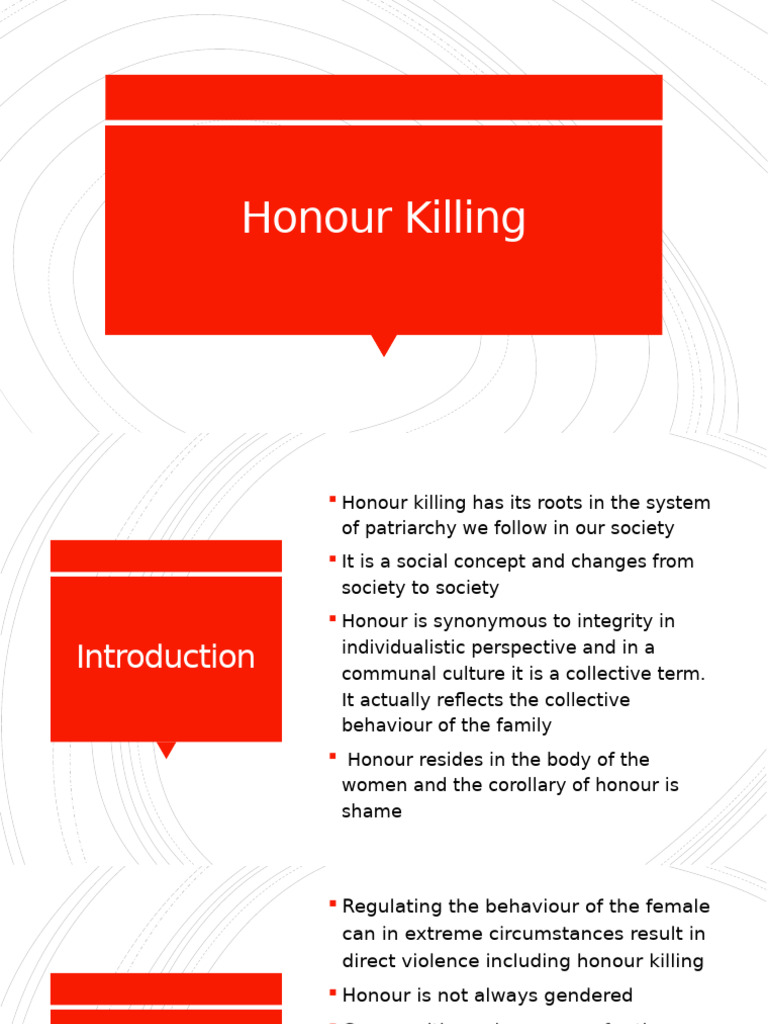
Honor killings are not merely relics of a bygone era—they are a brutal, ongoing manifestation of patriarchal control, where women’s bodies become battlegrounds for familial reputation. These murders, often justified under the guise of “honor,” are not isolated incidents but systemic violations embedded in cultural and legal frameworks that prioritize male dominance over female autonomy. The law, far from being a shield, frequently acts as a complicit spectator, offering loopholes that allow perpetrators to evade justice. This is not just a legal failure; it is a moral abdication, where the state’s reluctance to dismantle oppressive structures perpetuates cycles of violence.
The Anatomy of Honor Killings: A Weaponized Tradition
Honor killings are not spontaneous acts of rage but meticulously orchestrated executions, where the victim is often chosen for perceived transgressions—dressing “immodestly,” rejecting an arranged marriage, or daring to love outside prescribed boundaries. The violence is not just physical; it is psychological, a slow unraveling of a woman’s sense of self, culminating in a final, irreversible act. These killings are not about honor; they are about power—the power to control, to punish, to erase. The language of “honor” is a smokescreen, a euphemism for the deep-seated misogyny that treats women as property rather than people. In societies where virginity is commodified and female autonomy is a threat, honor killings become the ultimate tool of subjugation.
The Legal Charade: When Justice Wears a Blindfold
The law’s response to honor killings is a study in hypocrisy. In many jurisdictions, “honor” is weaponized as a mitigating factor, allowing killers to receive reduced sentences under the guise of “provocation” or “family honor.” This is not justice; it is legalized complicity. Courts that entertain such defenses are not neutral arbiters but active participants in a system that devalues women’s lives. Even when laws are reformed, enforcement remains a mirage. Police often dismiss cases as “family matters,” prosecutors hesitate to pursue charges, and judges hand down lenient sentences, reinforcing the message that women’s lives are expendable. The legal system, in these instances, does not protect—it perpetuates.
Cultural Myths and the Normalization of Violence
Honor killings thrive in cultures where myths about female sexuality are weaponized. The idea that a woman’s virtue is a family’s property, that her body is a vessel for male honor, is not an ancient superstition but a living ideology. These myths are reinforced through media, religious dogma, and community pressure, creating an environment where violence is not just tolerated but expected. When a woman is killed for “dishonoring” her family, the narrative is not one of tragedy but of necessity—a perverse logic that frames murder as a moral duty. This normalization is the soil in which honor killings grow, and until these myths are dismantled, the violence will continue.
The Global Face of a Global Crime
Honor killings are not confined to a single region or religion; they are a transnational epidemic. From rural Pakistan to urban Europe, from conservative Middle Eastern societies to diaspora communities in North America, the pattern is the same: a woman’s autonomy is a threat, and her punishment is inevitable. In some cases, the violence is state-sanctioned, as in Afghanistan under Taliban rule, where women are executed for “moral crimes.” In others, it is a private enterprise, where families take justice into their own hands. The global nature of this crime exposes the lie that honor killings are a cultural issue—they are a human rights crisis, one that demands a unified, uncompromising response.
The Role of Religion: A Double-Edged Sword
Religion is often invoked to justify honor killings, but the connection is tenuous at best. While some interpretations of Islamic law have been misused to condone violence, the Quran itself does not sanction murder as a response to perceived dishonor. The real issue is not religion but the patriarchal structures that distort it, turning sacred texts into tools of oppression. In Christian-majority societies, similar dynamics play out, where purity culture and rigid gender roles create environments where women are policed and punished for defying norms. The problem is not faith but the weaponization of faith to control women’s bodies and lives.
The Silence of the Complicit: Why Bystanders Enable Violence
Honor killings do not happen in a vacuum. They are enabled by a culture of silence—neighbors who turn a blind eye, community leaders who refuse to intervene, and even well-meaning allies who prioritize “cultural sensitivity” over a woman’s right to live. This silence is not neutrality; it is complicity. When we refuse to name honor killings for what they are—femicide—we give perpetrators license to act. The fight against honor killings is not just a legal battle; it is a cultural reckoning, one that requires us to confront the ways we enable violence through our own inaction.
Breaking the Cycle: Strategies for Change
Ending honor killings requires a multi-pronged approach. Legal reforms must eliminate loopholes that allow killers to evade justice, and enforcement must be rigorous and uncompromising. Education is critical—teaching young people about consent, autonomy, and the dangers of patriarchal control can dismantle the myths that fuel these crimes. Community leaders, religious figures, and activists must speak out, refusing to let “honor” be used as an excuse for murder. And most importantly, survivors must be supported, their stories amplified, and their agency restored. This is not a fight that can be won overnight, but it is a fight that must be waged with relentless determination.
The Cost of Inaction: Why This Matters for All of Us
The fight against honor killings is not just a women’s issue—it is a human issue. When a woman is killed for daring to live on her own terms, it sends a message to every woman: your life is not your own. This violence is not an aberration; it is a warning. Until we dismantle the systems that allow it to persist, no woman is truly safe. The law must stop being an accomplice to murder. Culture must stop being an excuse for oppression. And all of us must stop being silent. The cost of inaction is not just lives lost—it is the erosion of our collective humanity.