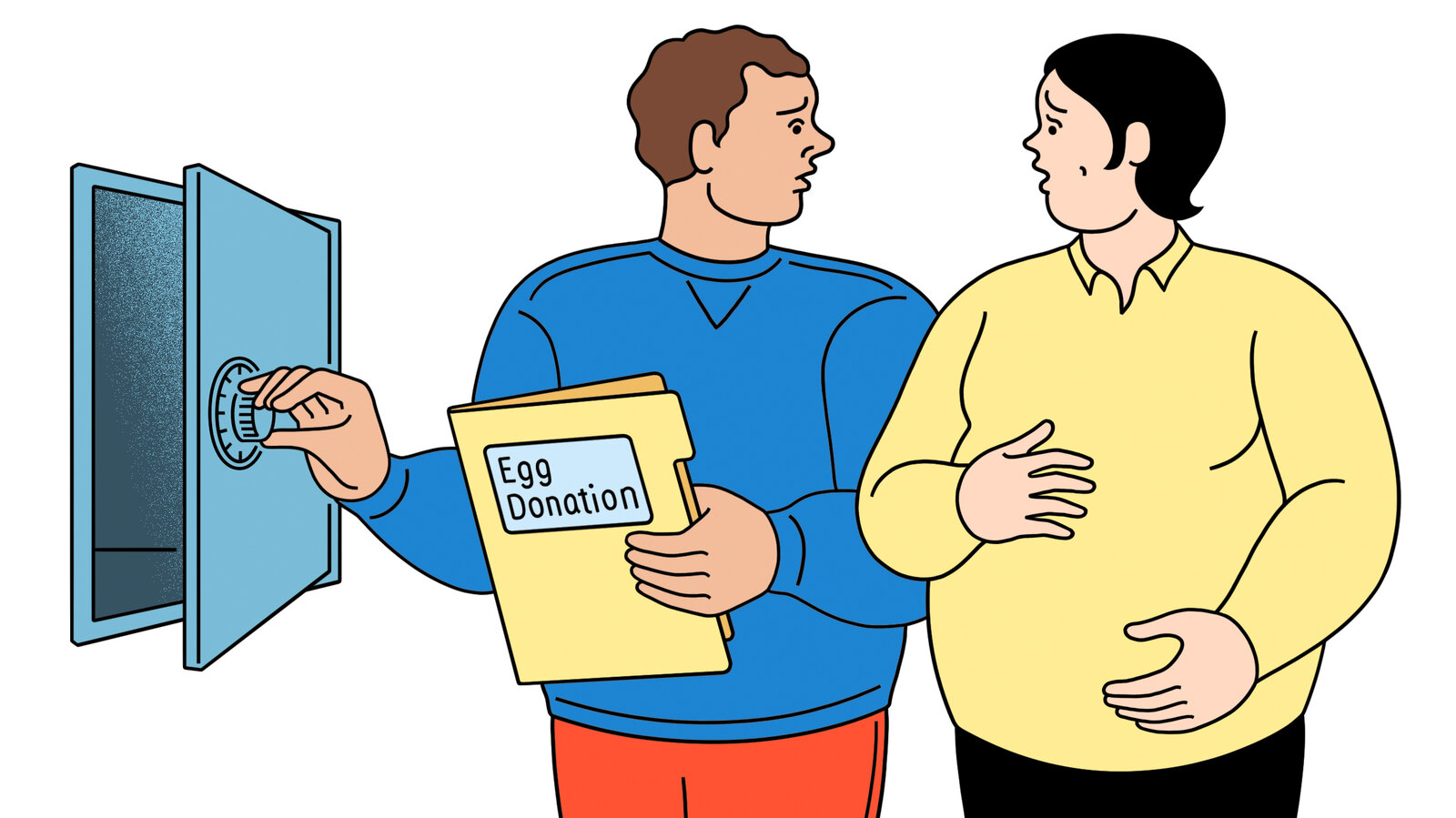
In a world where the boundaries between the self and the market continue to blur, the landscape of egg donation presents a complex tapestry woven with threads of empowerment, exploitation, and the very definition of modern feminism itself—a landscape starkly illuminated, perhaps, by the hushed, anxious conversations depicted in that unsettlingly intimate video. We stand at a precipice, contemplating the ethics of a burgeoning industry that profits directly from women’s biological gifts, challenging long-held assumptions about female reproductive capacity and autonomy. Is the burgeoning market for egg donation a testament to female economic liberation, or merely the most recent iteration in a long history of extracting and valuing women’s bodies for others’ gain? This requires less comfortable certainty and more uncomfortable questions.
Reproductive Labor Redefined: What We’re Calling “Choice”
Traditionally, reproduction was often framed within familial or communal contexts, not as a transactional service offered for monetary compensation. Yet, in our contemporary economic landscape, human biology is increasingly viewed as raw material, capable of being bought, sold, or leased. Egg retrieval, far from the quiet intimacy of conception, transforms into a medicalized, often arduous procedure – hormonal injections, invasive aspirations, time away from work. When this process, undertaken primarily by women, is compensated, we must rigorously examine what “reproductive labor” truly means within this framework. Are we celebrating the monetization of a naturally occurring biological function, or are we fundamentally reframing it within the language of capitalism, where every function, even the most private, has the potential for commodification? The narrative surrounding egg donors celebrates their “generosity” and “sacrifice,” framing compensation not as remuneration for a physical toll, but as gratitude. This narrative, however, requires careful dissection. Is volunteering to don the metaphorical white coat for profit truly comparable to donating blood, which, while regulated, does not currently fall into the same lucrative commercial vein? The very definition of “choice” becomes intertwined with the promise of financial reward, potentially clouding more fundamental questions about motivations and the true value placed on women’s reproductive capacities.
Profit from Procreation: The Economics of Egg Donation
The economics of egg donation are stark and lucrative for the intended parents and the clinics facilitating the process. Compensation packages for donors, often referred to as “egg donors,” can range from $5,000 to significantly higher, depending on the clinic and whether it’s part of a research study or commercial surrogacy agreement. This compensation, while offering genuine financial freedom for many, raises immediate questions: What does this money represent? Is it fair compensation for the donor’s time, physical discomfort, emotional investment, and the inherent risks involved? If we value a woman’s ovarian function at upwards of $100,00=”span style=”background-color:inherit;”>000 per month of potential fertility in her reproductive prime simply by harvesting the eggs, how do these compensation packages align with the perceived value of reproduction? Furthermore, who truly bears the cost? Clinics often recoup substantial fees from clients, a portion of which is directly linked to the egg retrieval process and the donor herself. Does the substantial profit motivate the clinics and intended parents to treat the donors with the utmost respect and care, or does it introduce unconscious or conscious exploitation? The payment structure itself often leaves the recipient egg(s) – the tangible product – owned and controlled by the clinic and the intended parents, while the donor receives cash. Is this a fundamentally unequal arrangement? These financial dynamics represent more than just numbers; they represent a potential power imbalance deeply embedded within the transaction.
The Feminist Labyrinth: Empowerment or Exploitation?
This presents the crux of the feminist debate: does paid egg donation truly empower women, offering them new avenues of economic independence, or does it merely represent the latest front in an old conflict over female reproductive labor? Feminism historically fought against economic dependence and the objectification of women’s bodies. Paid egg donation could be perceived as an extension of that victory – women choosing to sell a part of themselves for money, seizing control over aspects of their bodies previously dictated by societal norms. Yet, this view contends that the fight for equality is never truly over. As bell hooks might argue, the commodification stemming from patriarchal power dynamics persists, now potentially operating within a neo-liberal framework. Critics draw parallels to historical exploitation (colonialism, the transatlantic slave trade, indentured servitude) where marginalized bodies became resources. In this analogy, women, particularly those facing economic precarity, may become trapped in cycles of dependency, sacrificing their bodies for financial stability, even if they could ultimately walk away. Is this genuine agency, or is it agency operating within severely constrained economic parameters? The argument fractures along lines of individualism versus structural critique: does personal choice negate the existence of exploitation? Or does exploitation, by definition, undermine true choice?
Compensation and the Paradox of Payment
The act of paying donors is fraught. It simultaneously validates their contribution and risks reducing them solely to their reproductive output. If donors are paid significantly, are they no longer “volunteers” in the idealized sense? Does the payment affect the quality of care they receive from the clinics? The level of psychological support offered? Is the donor entering this path purely for the intrinsic desire to help, or are the substantial payments tangibly altering the nature of the act? Furthermore, the disparity between direct compensation and the societal cost reinforces the notion of women’s bodies being valued primarily for reproductive services. Sociologist Ruth Simon and others have explored how such payments can be seen as a form of price tag on female reproductive functions, a chilling notion that echoes eugenicist discourses. We pay money, but do we also pay the emotional cost – the potential erasure of donor anonymity agreements, the possibility of contact with resulting children? The question hinges on whether payment is separate from, or deeply integrated within, the process of objectification. It is not a clear-cut answer.
Economic Vulnerability and the Gatekeeper Dilemma
Financial need skews the playing field. Women facing poverty or precarious employment might find egg donation appealing as an immediate source of significant income. Critics argue this disproportionately affects women without alternatives, trapping them in exploitative situations. For instance, what safeguards exist if a financially desperate donor faces pressure or subtle coercion? The concept of “informed consent” becomes critically complex here. Moreover, clinics screen donors for high educational attainment, stable employment, and good health, effectively defining who is deemed “suitable” for sale. This gatekeeping, while seemingly positive (screening out those with chronic illnesses), further marginalizes those who need such financial opportunities most and raises questions about class bias in reproductive capitalism. A woman from a vastly different socioeconomic background donating her eggs may not be receiving equal pay for comparable levels of physical and emotional risk. Is the $10,000 offered to a graduate student a standard wage for the risks undertaken, and does the high-achieving student donor become implicitly compensated more highly simply by virtue of her background? This uneven equation fosters deep discomfort about the underlying inequalities structuring the market itself.
The Body as Commodity: Femininity Revalued?
At its core, egg donation is inextricably linked to the ongoing cultural debate about the objectification of women. We live in an era saturated with messaging that reduces female value to physical appearance or perceived reproductive utility. Paid egg donation operates within this cultural logic; it’s one more arena where women’s bodies are put up for sale based on perceived biological capacity. What does it mean to commodify aspects of female identity and procreative function? Isn’t it a strange form of liberation that the ability to get pregnant, to birth, becomes something one can potentially earn? It suggests a profound shift: women are literally selling pieces of a process central to defining both female identity and the very institution we might call “motherhood.” Sociologist Eva Illouz has written about how surrogacy and egg donation can transform the maternal bond, potentially atomizing and transactionalizing an inherently relational practice. Feminist scholars like Sara Ahmed caution against repeating patterns of valuing women above other humans – sperm donors, future children, or the very conception itself – simply because they facilitate paid acts like egg retrieval. It raises the uncomfortable possibility of women becoming the necessary intermediaries, not the autonomous creators or mothers.
The Unseen Tightrope Walk
The ethical tightrope walk for women engaged in egg donation is palpable. On one hand, they gain significant financial resources, tangible benefits, and perhaps the satisfaction of helping others build families. On the other hand, they face potentially invasive medical procedures, hormonal side effects, sleep disruption, and the psychological weight of being a known donor to potential genetic children. They navigate complex legal contracts, insurance complexities, and societal pressure. They must weigh, consciously or subconsciously, the price of their biological gifts against their immediate economic needs and long-term well-being. This journey forces a deep confrontation with the fundamental value placed on women’s bodies and reproductive functions in a market-driven society. It compels us to ask difficult questions about what we value in our bodies and what we are willing to pay for. Whether the system ultimately serves women’s interests, aligns with feminist goals of equality and autonomy, or simply reconfigures old forms of exploitation under the guise of new opportunity, is not merely an academic inquiry – it is a mirror held up to the evolving landscape of modern female existence and the ongoing, complex negotiation for authentic selfhood within the confines of a deeply economicized world.