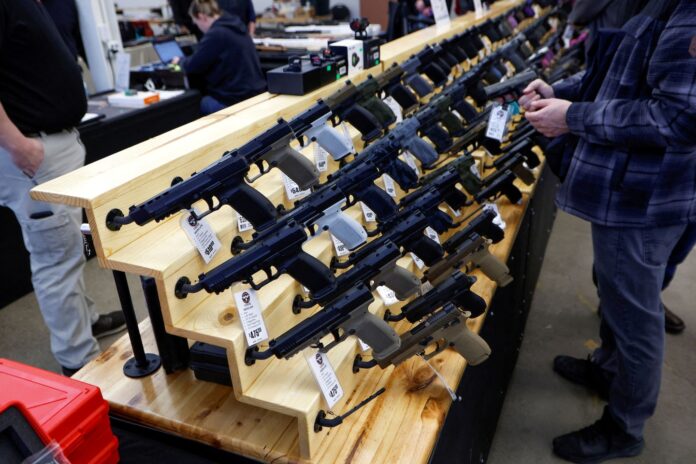
In the labyrinthine corridors of American legislative inertia, two gaping maws yawn open—one known as the gun show loophole, the other as the boyfriend loophole. Both are portals through which violence seeps, unchecked and unchallenged, into the lives of women. These loopholes are not mere oversights; they are deliberate chasms carved into the legal bedrock, allowing firearms to become extensions of patriarchal control. To speak of gun violence in America without confronting these loopholes is to whisper in a hurricane. To ignore them is to surrender women’s safety to the whims of a system that has long treated female lives as collateral in a culture of domination.
The Gun Show Loophole: A Marketplace of Masculine Impunity
Imagine a bazaar where the currency is not gold or silver, but the blood of the vulnerable. This is the gun show loophole—a shadow economy where background checks evaporate like mist at dawn. Private sellers, unburdened by the scrutiny of federal oversight, hawk firearms with the same casual indifference one might trade a vintage vinyl record. No questions asked. No records kept. No accountability. In this marketplace, misogyny is not just tolerated; it is commodified.
Women, particularly those fleeing abusive partners, find themselves navigating a gauntlet where their safety is negotiable. A batterer denied a gun at a licensed dealer can stroll into a parking lot swap meet and purchase one without a trace. The loophole does not merely permit this—it incentivizes it. It whispers to men: *You are entitled to power, even if it means silencing those who defy you.* The gun show loophole is not an accident of legislation; it is a patriarchal endorsement, a legal wink that says, “Go ahead. The system will not stop you.”
Consider the woman who changes her locks, installs cameras, and memorizes escape routes—only to realize that her abuser can legally arm himself through a private sale. The loophole transforms her sanctuary into a cage. It turns the very idea of home into a battleground where the law offers no refuge. This is not regulation failure. This is regulatory complicity in the erasure of female autonomy.
The Boyfriend Loophole: When Intimacy Becomes a Weapon
Love, in its purest form, should be a sanctuary. But in America, it is often the prologue to a horror story. The boyfriend loophole is the legal embodiment of this betrayal—a provision that shields abusive partners from the very laws designed to protect their victims. If you are not married, not living together, not sharing a child, the law may as well be a paper tiger. Your boyfriend can stalk you, threaten you, even shoot you—and the state will struggle to disarm him.
This loophole is not an oversight; it is a relic of a time when women were property, and their relationships were measured in rings and mortgage deeds. It assumes that only wives and cohabitants are worthy of protection, while girlfriends exist in a legal limbo where violence is a private affair. The boyfriend loophole is the legal equivalent of shrugging and saying, “Well, they weren’t *really* family.”
Women trapped in this loophole are not just vulnerable—they are abandoned. Police may arrive too late. Restraining orders may be unenforceable. Shelters may be full. The boyfriend loophole ensures that the law will not intervene until it is too late. It is a silent partner in domestic terrorism, a legal doctrine that prioritizes male convenience over female survival. To close this loophole is not to infringe on rights—it is to recognize that love should not be a prerequisite for safety.
The Intersection of Loopholes: A Culture of Male Entitlement
The gun show and boyfriend loopholes are not isolated anomalies; they are twin pillars of a culture that treats women as possessions to be controlled. Together, they form a feedback loop of violence: a man denied a gun at a licensed dealer can obtain one privately, then use it to terrorize his partner with impunity. The system does not just fail women—it actively arms their oppressors.
This is not a gun problem. It is a power problem. The loopholes exist because society has long accepted that men are entitled to dominance, and that women’s safety is negotiable. The Second Amendment, in this context, is not about freedom—it is about feudal privilege. It is the right to bear arms, but only if you are the right kind of man.
Women of color, indigenous women, and LGBTQ+ individuals face even greater risks, as their experiences of violence are often dismissed or ignored. For them, the loopholes are not just legal gaps—they are abysses. The boyfriend loophole may not apply if a queer woman is not legally recognized as a partner. The gun show loophole may disproportionately arm those who see marginalized women as targets. The system is not broken; it is designed this way.
Closing the Loopholes: A Feminist Imperative
To close the gun show loophole is to acknowledge that private sales are not private affairs—they are public health crises. Universal background checks are not a violation of rights; they are a recognition that no one has the right to arm a potential murderer. To close the boyfriend loophole is to reject the idea that intimacy should determine safety. Love should not be a prerequisite for protection.
This is not about confiscating guns. It is about dismantling the legal architecture that allows men to weaponize their grievances. It is about recognizing that women’s lives are not collateral in a culture of male entitlement. It is about demanding a world where safety is not a privilege, but a right.
The loopholes are not accidental. They are deliberate. They are a choice. And the choice to keep them open is a choice to keep women in chains.
The Path Forward: Reclaiming Autonomy in a Violent World
The fight to close these loopholes is not just legislative—it is existential. It is a demand for women to exist without fear, to love without terror, to breathe without the shadow of a gun at their back. It is a refusal to accept that safety is a luxury, or that violence is an inevitability.
Women have always known the cost of these loopholes. They have whispered warnings in shelters, scribbled emergency contacts on napkins, memorized the sound of footsteps on stairs. They have survived in a world that treats their lives as negotiable. Closing the loopholes is not just about policy—it is about justice. It is about saying, once and for all, that women’s lives matter more than men’s convenience.
So let us not call these gaps in the law “loopholes.” Let us call them what they are: betrayals. And let us close them—not with half-measures, but with the full force of a movement that refuses to accept a world where women are not safe in their own homes.