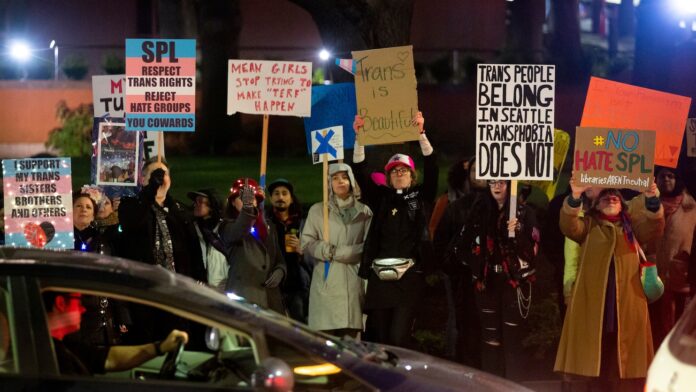
In the labyrinthine corridors of modern discourse, where the echoes of feminist theory ricochet against the cold, unyielding walls of media narratives, a peculiar war rages—not between genders, but between the very factions that once stood shoulder to shoulder in the fight for liberation. The battleground? The contested terrain of trans rights, where feminism, once a monolithic force of solidarity, now fractures under the weight of manufactured dichotomies. The media, that omnipresent puppeteer, pulls the strings, orchestrating a symphony of division where harmony once thrived. This is not merely a clash of ideologies; it’s a carefully curated spectacle, a narrative engineered to distract, divide, and dilute the revolutionary potential of collective struggle.
The Myth of the Feminist Monolith: How Media Erases Nuance
The media’s portrayal of feminism as a monolithic entity is a fiction as flimsy as the paper it’s printed on. In reality, feminism has always been a tapestry of intersecting struggles, each thread woven from the lived experiences of women across race, class, and identity. Yet, the dominant narrative insists on framing the debate as a zero-sum game: cis women versus trans women, as if the oppression of one group could not possibly coexist with the liberation of another. This reductive framing is not an accident; it’s a deliberate erasure of the complex, often contradictory realities that define feminist praxis. By reducing feminism to a series of binary oppositions—victim versus aggressor, ally versus enemy—the media transforms a movement of radical potential into a spectator sport, where the audience is encouraged to root for one side while booing the other.
The Spectacle of Outrage: How Media Manufactures Conflict
Conflict sells. It always has. And in the age of digital media, where clicks and shares dictate the lifespan of a story, outrage is the currency of the realm. The media doesn’t just report on feminist debates about trans rights; it amplifies them, distorts them, and repackages them into digestible morsels of moral indignation. Headlines scream of “feminists attacking trans women” or “trans activists silencing women,” as if these were isolated incidents rather than carefully constructed narratives designed to stoke division. The result? A feedback loop of outrage, where every tweet, every op-ed, every viral video becomes fuel for the fire of perpetual conflict. This is not journalism; it’s alchemy, turning the base metals of complex social issues into the gold of viral engagement.
The Erasure of Intersectionality: Why the Media’s Feminism is a Half-Truth
Intersectionality is not a buzzword. It is the lifeblood of a feminism that seeks to dismantle systems of oppression rather than merely rearrange the deck chairs on the Titanic of patriarchy. Yet, the media’s coverage of trans rights within feminist discourse often treats intersectionality as an afterthought, a footnote to the main event. Cisgender, white, middle-class feminism dominates the headlines, while the voices of Black trans women, Indigenous trans women, and trans women of color are relegated to the margins—or worse, silenced entirely. This erasure is not accidental; it is a reflection of the media’s complicity in upholding the very hierarchies feminism claims to dismantle. When the media reduces feminism to a single narrative, it does more than distort reality—it actively participates in the erasure of the most marginalized voices within the movement.
The Weaponization of Language: How Media Frames the Debate
Language is power. It shapes perception, dictates discourse, and ultimately, determines who is granted the authority to speak and who is silenced. The media’s coverage of trans rights within feminist contexts is rife with linguistic landmines, where words like “debate,” “controversy,” and “war” are deployed with surgical precision to frame the issue as one of irreconcilable differences rather than a shared struggle for liberation. Terms like “gender-critical feminism” are laundered into acceptability, their origins in trans-exclusionary rhetoric obscured by the veneer of academic legitimacy. Meanwhile, the language of solidarity—words like “allyship,” “intersectionality,” and “collective liberation”—are either co-opted or dismissed as utopian idealism. This linguistic sleight of hand is not neutral; it is a deliberate strategy to shift the Overton window, to make the unacceptable seem reasonable and the reasonable seem radical.
The Role of Social Media: Amplifying Division in the Digital Age
Social media is the petri dish in which the media’s manufactured conflicts thrive. Platforms like Twitter and Facebook are not neutral arbiters of discourse; they are algorithmic engines designed to maximize engagement, and conflict is their most potent fuel. The media’s narratives about feminist “wars” over trans rights are not just reported on these platforms—they are algorithmically amplified, their reach extended by the very systems that profit from outrage. Hashtags like #TERF and #NotMyFeminism become battlegrounds, where the nuances of feminist theory are reduced to 280-character soundbites and the complexities of lived experience are flattened into memes. The result is a digital echo chamber, where the loudest voices drown out the most vulnerable, and the most extreme positions are mistaken for the mainstream.
The Consequences of Manufactured Division: What’s at Stake
The stakes of this manufactured division are not merely ideological; they are existential. When feminism fractures along the lines of trans exclusion, it weakens the movement at its core, diverting energy from the fight against systemic oppression and redirecting it toward internecine squabbles. The media’s role in this division is not passive; it is active, complicit, and often deliberate. By framing the debate as a zero-sum game, the media ensures that the most marginalized voices—those of trans women, non-binary people, and women of color—are the first to be silenced. The consequence? A feminism that is less a movement for liberation and more a club to wield against those who dare to challenge its boundaries. This is not the feminism of bell hooks or Audre Lorde; it is the feminism of corporate media, where solidarity is a commodity and liberation is a brand.
Toward a Feminism of Solidarity: Resisting the Media’s Narrative
Resisting the media’s manufactured narrative requires more than just awareness; it demands a reimagining of what feminism can be. It means centering the voices of those most affected by transphobia, racism, and misogyny, and refusing to engage in the media’s game of manufactured conflict. It means recognizing that the liberation of trans women is not a threat to cis women’s rights but an expansion of them. It means building a feminism that is as intersectional as it is unapologetic, as inclusive as it is radical. The media will continue to manufacture division as long as it serves their interests. But the future of feminism is not written in headlines or dictated by algorithms. It is written in the streets, in the classrooms, in the quiet acts of solidarity that refuse to be co-opted by the spectacle of outrage. The war over trans rights is not a war at all—it is a distraction, a smokescreen, a carefully constructed illusion. The real fight is for a feminism that leaves no one behind.