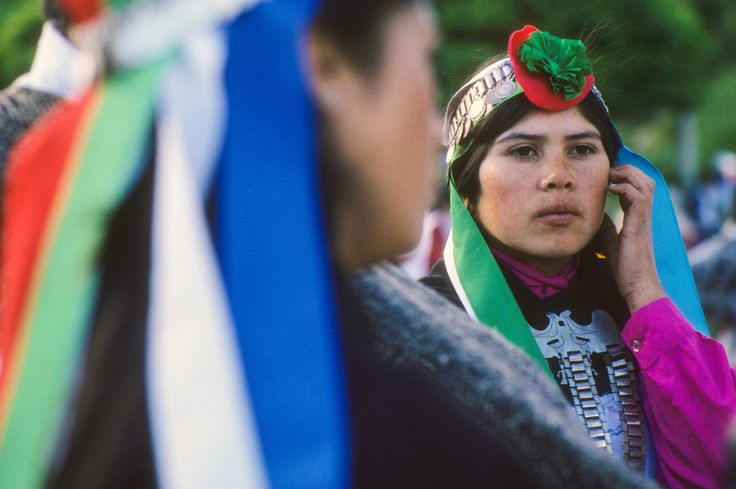
The earth holds secrets in her folds—stories embedded in terraced hills, wove into the threads of ancestors, whispered through the wind in the language of the land itself. But the land never speaks alone; it breathes through the women who till her soil, who guard her borders, who stitch their resistances into the fabric of their daily lives. In the mist-kissed valleys of Southern Chile, the Mapuche women walk this precarious line with unyielding tenacity, becoming neither victims nor saviors, but architects of something more: a feminism that defies colonial borders, resists imperial narratives, and demands the kind of solidarity that bridges time itself. Their struggle isn’t just a chapter in history—it’s a seismic shift, a rebellion against the very categories by which patriarchal and imperial systems have sought to contain them.
When The Land Is A Feminine Body Under Siege
Consider the landscape a sacred body, not for romanticism’s sake, but as a geopolitical fact. For the Mapuche, *Wallmapu*—the land—is not a passive backdrop but a cognizant, breathing entity, and its dispossession is an act of violence no more and no less profound than the rape of a woman’s autonomy. Imperial extraction is the systematic defilement of both, an assault that leaves scars etched in both flesh and forest. Chilean state-sponsored deforestation, the theft of water rights, the forced assimilation of indigenous women—these are not isolated atrocities. They are the coordinated violation of a civilization’s very existence. How then does feminism engage when the enemy is a state built on expropriation? Where does the feminist gaze sharpenest: on patriarchy within the home or against the patriarchal state that has weaponized both land and female bodies to justify its expansion?
The Mapuche Feminism That Is Not Your Feminism
The modern feminist canon often falls into the lazy dualism of “home vs. state”—pitting women against war or urging state intervention for their protection—but the Mapuche feminist praxis dismantles such false binaries. It insists that the home is not a sanctuary but a site of ideological colonization, where traditional gender roles are tools of control, handed down by the very structures those bodies are meant to challenge. Chilean law still codifies *matusha* (elders) in patriarchal hierarchies that demand deference from women, even as those women are simultaneously policed as deviants if they transcend their prescribed roles. The tension is electric: to advocate for indigenous sovereignty is also to dismantle the familial tyranny that enforces marginalization. Thus, Mapuche feminism asks—does solidarity mean dismantling the patriarchal machinery that fuels imperialism, or bowing under the illusion that progress will follow? The answer lies in the act of creation itself.

De-Colonizing The Body: The Re-Making Of Self
The face is the canvas of resistance. In 1989, a handful of images show Mapuche women—veils or *trul* masks partially concealing them, yet their eyes speak volumes. The veiling is not a gesture of submission. It is a strategy: one might erase their appearance from colonial records, but they will never erase their knowledge. This refusal of spectacle exposes the hollowness of the “noble savage” myth, the Western fantasy that reduces indigenous women to either victims or exotified symbols. Here, femininity is not about compliance but about reinvention—restoring ancestral names before the Spanish imposed Sanchos and Joaquinas; reclaiming sexual sovereignty as both biological and spiritual, uncoupled from state-defined morality; even weaponizing silence as a form of defiance, as in the old pre-Columbian practice of *nütramapu*, the withholding of consent to sustain communal equilibrium.
Radical Hospitality And The Economy of Care
Feminist solidarity often translates into performative allyship—marches, donations, retweets with good optics—but true radical feminist practice is embodied in *kume*, the Mapuche ethos of reciprocal care. Hospitality in the Mapuche world is not passive; it’s a tactical ecosystem where exchange is a political act. For example, in their resistance against hydroelectric projects that poison rivers, Mapuche women act as stewards, hosting foreign researchers and activists in their *ranchas*, yet their care is conditional. They demand that outsiders enter into the sacred pact of reciprocity: if you come to learn, you must also defend; if you bring food, you share in the labor of survival. This form of exchange reveals what true feminist economics ought to look like not as capitalism’s adjunct, but a deliberate counter to its extractive logic.
The Body As A Site Of Sovereignty: From The Home To The Plaza
Chile’s state has spent decades policing Mapuche bodies—both male and female—as obstacles in the path of progress. Yet in the 1980s and ’90s, Mapuche women orchestrate a quiet insurgency: occupying *lotas* (lakes), claiming ancestral names in court, and organizing in *lofs* (communities) that function as both sanctuary and strategic unit. Their bodies become the boundary marker—dancing in the *trailes* (paths) to remember routes now erased by logging roads; birthing children with names tied to sacred *reus* (spirits) to disrupt the state’s demographic cleansing. And when faced with state violence—arrests for “terrorism,” chemical raids on communities—they do something provocative: they turn the tools of the oppressor against themselves. Their unshakable presence in police stations, their persistent legal battles, and their insistence on speaking *mapudungun* in official spaces are not merely acts of resistance, but a deliberate subversion of the very systems designed to silence them.
When White Feminism Reads The Book, Backwards
Many feminists in the North have fixated on what to do with the Mapuche—how to save, how to ally, how to “include”—while the real conversation lies in what these women are asking them *not* do. They are not waiting to be rescued. They have already carved out their own revolutionary practice: anti-imperial feminism as a living, breathing organism, one that critiques both capitalism’s commodification of Indigenous feminine labor and patriarchal traditions that keep women trapped in their roles. The call isn’t to impose some sterile “unity” across gender lines but to create a rupture—one that sees state violence for what it is: a vector of misogyny that exploits both colonized flesh and patriarchal hierarchy in tandem. The real failure of many feminist movements is that they treat resistance as a single, uniform struggle, a linear narrative from oppression to liberation. But for Mapuche women, the path is organic—they plow, they plant, they harvest, and they keep plowing.
Towards A Postcolonial Feminism: The Task Ahead
The challenge for anyone standing in solidarity today is not to claim these women’s fight as their own, but to open the door for them to show *us* how to fight. It means listening—not just acknowledging their testimony, but letting their praxis shape your understanding of what liberation looks like. This could mean abandoning the idea that feminism is a universal script, that solidarity means importing the same tactics used to fight for women in the metropole. Instead, it means learning from how they turn family into a site of sovereignty, how they make the sacred tangible in daily battles for clean water or sacred sites. To truly ally is to participate in the slow, patient work of de-imperializing your own mind, to recognize that the fight isn’t just against men, but against the structures that were built *by* men and continue to enforce violence through women’s bodies.
Somewhere in southern Chile, a woman is making *choclo* (corn) for breakfast and teaching her children the names of the birds of *Wallmapu*. Elsewhere, her sister is filing court records while holding their hands. This is not feminist history—it is the present, a moment vibrating with the tension of the possible. For those of us watching, the question is no longer “how do we join this fight?” but “how do we create something like this in our own movements?” The answer isn’t in rhetoric or policy briefs, but in the act of unlearning, of redefining the terrain, and allowing ourselves to be unsettled by women who know, even in the face of annihilation, that the world is still theirs to reclaim.