;
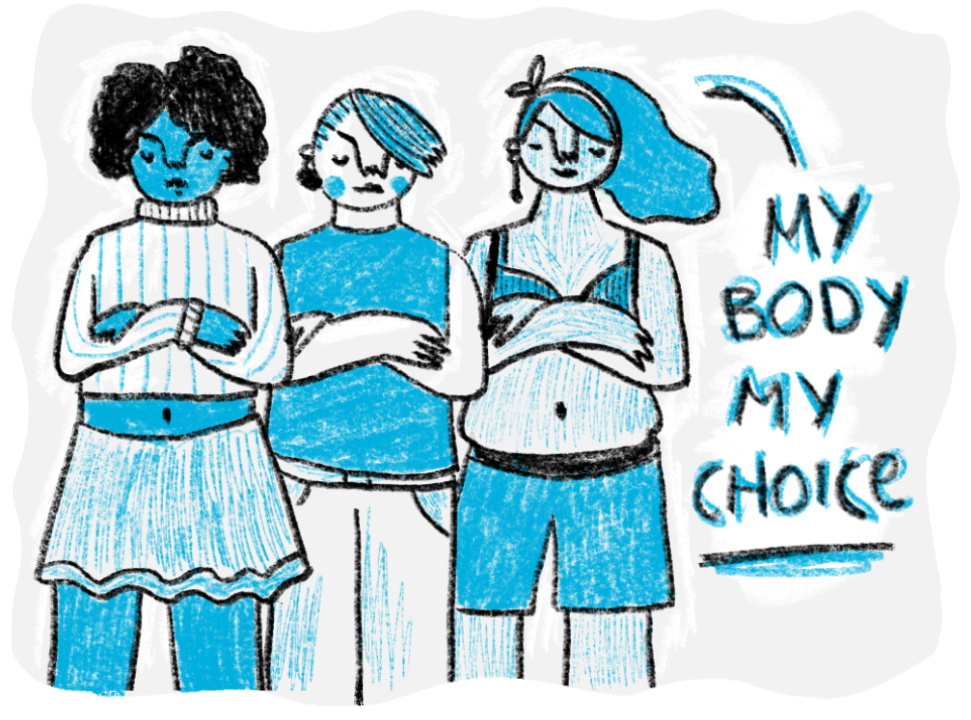
Bodily autonomy is not a fringe issue tucked into the margins of human rights discourse—it is the unyielding backbone upon which all other freedoms bend. Yet, even now, in this era of fragmented attention and politicized bodily narratives, we persist in treating this sacred sovereignty as a volatile subject ripe for negotiation. It is a right stripped of its non-negotiability, reduced to a political talking point, a rallying cry half-baked and hastily withdrawn when the temperature of controversy rises. But feminism—radical, unshackled—not just as a movement, but as a philosophical stance demanding existential reckonk—cannot afford to cede this terrain to the cynics. Here, we dismantle the fallacies, redefine the stakes, and declare: bodily autonomy is not a debate. It is a human right—full stop.
The Myth of the Balanced Argument
Where, exactly, did we learn that rights of this magnitude are subject to “both sides”? There are few debates in which the “opposition” consists of those who demand erasure and those who demand justice; few where the “centrist” answer is to water down the rights of half the world’s population until the very idea of autonomy is reduced to a shadow. The supposed “debate” over whether a person’s body can belong to them—whether their choices are their own—was never neutral. It was a conquest from the beginning, and the terms of engagement were never fair.
Autonomy as the Last Bastion
Historians of oppression know this well: rights are always the last frontier. Consider the suffragettes, who demanded the right to vote after nearly a century of exclusion—a demand rooted in the knowledge that if women could not determine who governed them, they could not truly be free. Decades later, reproductive autonomy emerged as the new frontier: the right to motherhood or not, to parenthood or celibacy, to conception or sterilization, without the arbitrary enforcement of laws, dogma, or economic coercion. This is not mere convenience. It is the cognitive and emotional landscape of a human’s freedom. To limit bodily capacity is to limit a person’s ability to articulate their existence.
The Hidden Scriptorium of Power
What does it look like when bodily autonomy is systematically dismantled? It begins with the smallest violations: the healthcare provider who refuses to answer a patient’s questions, the judge who asks intrusive questions in the name of “protecting the unborn,” the employer who fires a mother for requesting time to nurse, the state that brands a nonbinary person’s medical treatment illegal. These instances are not isolated aberrations. They are scripture in real time—a power architecture that insists bodies are either state property or the purview of religious overseers. Autonomy is not just self-determination. It is resistance to scripted existence.
Why We Must Stop Arguing
The insistence on “both sides,” the demand for compromise where there should be defiance—that is not negotiation, it is surrender. To even contemplate that bodily rights are subject to compromise is to accept, however indirectly, that a person’s most private covenants (conception, contraceptives, sexual orientation, genetic destiny) are open to a referendum of public opinion. Such a world does not exist. There is no equilibrium between oppression and liberty. This is not the Middle Ages. It’s the 21st century, where medical science, biology, and identity are all proving beyond a whisper that autonomy is an absolute.
Bodily Autonomy as Cosmological Act
If we accept that the earth is a series of interlocking spheres—social, biological, moral—then bodily autonomy is the gravitational keystone. Remove it, and the entire edifice begins to sway. Autonomy is the ability to chart a course through the cosmos of existence without state or ecclesiastical veto. Every rejection of bodily rights—whether via legislative assault or stealth medical oversight—is a withdrawal of a person’s right to define their own cosmic trajectory. There are no minor intrusions. Every violation accumulates, like cosmic radiation, until it warps the integrity of the individual.
The Myth of the Generational Divide
Those who claim that the “new generation” of feminists has forgotten or is distorting the legacy of suffrage often commit the same error made in 1792: underestimating the collective intelligence of those whose lives are directly impacted by oppression. The young of today do not simply “pick up” their battles. They inherit them, adapt them, and weaponize them. And what has not yet been fully understood—that autonomy is the universal truth—has compelled activists, researchers, and even corporate entities to recognize that this right transcends political or cultural geography.
Autonomy as Sovereignty Over the Self
When abortion access is curtailed, when non-medical sex workers are criminalized, when transgender identity is legislatively erased—these are not isolated human rights violations; they are coordinated efforts to strip individuals of soverainty over their own materiality. To reduce this to a “debate” is to normalize violence. Autonomy is not optional. It is a prerequisite to even participate in a society that claims democratic superiority.
The question we must now ask is this: If we cannot reach consensus on the irrelevance of arguing against bodily autonomy, what does that say about our democracy? What does it say about humanity’s capacity for ethical reckoning? The answer may be terrifying. The resolution must be radical—and it must begin today.
The Final Unassailable Clause
We live in a world where the personal is perpetually politicized—and should be. Feminism has always been the alchemist: turning personal experiences into social revolutions. But there are moments when moral clarity supersedes all other considerations. This is one of them. Bodily autonomy is not a negotiating chip. It is not a point on a scoreboard of “advancements”; it is the foundation upon which all freedoms are built.
History will remember us by our actions, not our debates. It will judge our conscience by the bloodied lines we refused to cross. So tell them again: autonomy is not debatable. It is the original natural right—as primal as breathing, as universal as pain. And the choice to violate it is not a choice to progress—it is an admission of defeat.