The internet is not merely a neutral conduit for communication—it is a tangled arboretum of power, where certain voices flourish while others languish in shadow. Among the most quietly erased flora in this digital wilderness are feminist voices: whispers that dissolve into the static of algorithms, arguments suspended mid-air like kites caught in an unseen downdraft. Today, feminist discourse is not merely countered; it is *governed*—curated, censored, and sometimes entirely obscured by the unseen hands of algorithmic governance. This is the paradox of the Shadowban Era: a moment where ideas fight not with rhetoric alone, but with the invisible architecture of attention itself.
The Unseen Hand: Algorithms as Gatekeepers
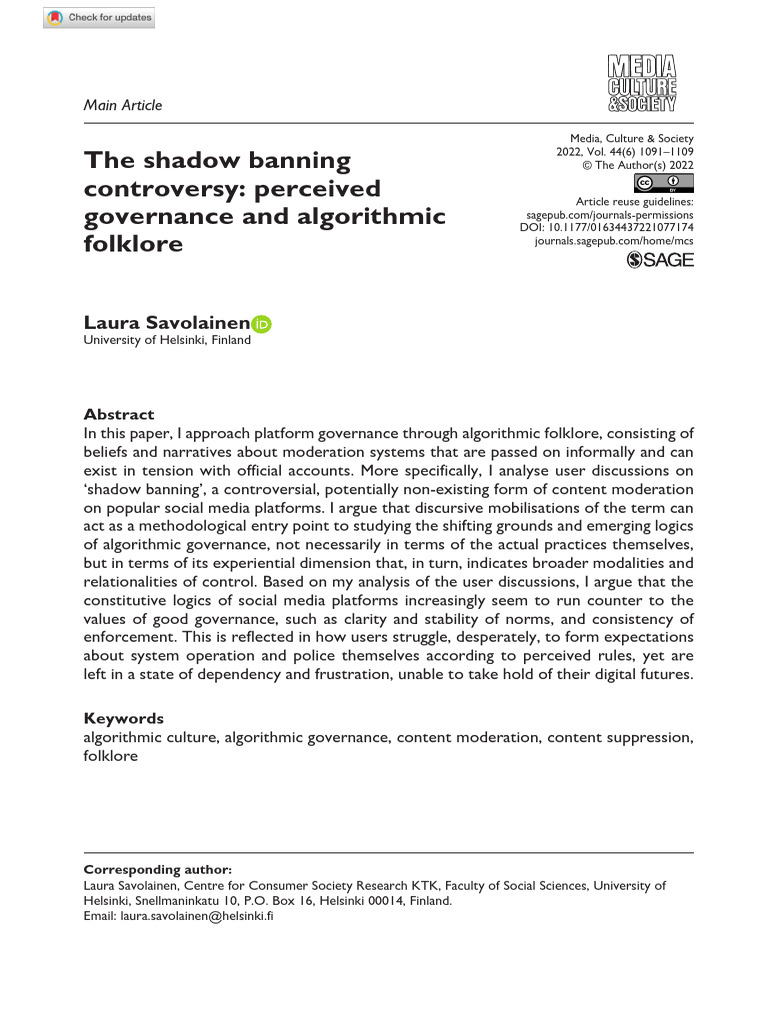
The Shadowban casts its spell through **attention modulation**, a process where platforms police content not by explicit deletion, but by strategic invisibility. Feminist voices—already navigating a labyrinth of misogynistic backlash since the days of early online forums—now face a new predator: the **algorithm that learns to silence**. Consider the way Twitter’s early feed was a free-flowing river; today, it is a series of weirs, redirecting discourse downstream, leaving certain narratives forever upstream from relevance. Studies of content moderation reveal that algorithms, trained on human bias, often flag feminist posts not for overt hate speech, but for their *style*—the cadence of defiance, the repetition of feminist lexicon, the unapologetic repetition of demands. It is as though the internet itself is a jury, sentencing feminist messages to the shadow archive of irrelevance before they reach human eyes.
The irony is exquisite: in an era where #MeToo and #Women’sRightstoVote hashtags once traveled the world in hours, the digital terrain now conspires against its protagonists. Algorithms, fueled by the same corporate interests that profit from distraction, pare back feminist visibility with surgical precision. A feminist tweet might vanish from timelines, yet the corporate boardrooms where these rules originate remain blissfully unaware of the cultural erosion they fund—a form of **cognitive alchemy**, turning feminist energy into white noise.
Silenced but Not Stilled: The Metamorphosis of Voice
The Shadowban’s greatest illusion is that it silences entirely—that voice, once uttered, cannot be reclaimed. But like a phoenix, feminist discourse does not cease to exist; it transmutes, becoming a **ghost voice**, a murmuration just beyond the edge of vision. Consider the case of the feminist blogger whose posts disappear into the labyrinth of “low-interaction” content; she may still receive backlash, even acclaim—but the platform’s feedback loop ensures it never reaches the thousands who might amplify her work. Or the hashtag that trends, fleeting only to sink beneath the waves of viral sensationalism: these are voices not extinguished, but *rechannelized*, their energy diverted into the mazelike tunnels of algorithmic irrelevance.
The result creates a new kind of feminist storytelling: **discrete as smoke, persistent like water**. A study of social media archives would reveal feminist posts lingering like digital ephemerals, just out of reach of mass visibility, yet insidiously shaping discourse in private circles. The platform’s calculus treats these voices as mere “noise,” yet noise, as any musician understands, is fundamental to melody—just unseen, like the harmonics that give life to a single string.
A Governance Paradox: Who Decides What Feminism May Speak?
The crux of the algorithmic Shadowban is not simply its mechanism but its **ontology**—what it denies existence to. When a feminist critique of corporate advertising is buried beneath “inappropriate content” flags, who makes the call? Not a council of philosophy, nor a body of historians, but a matrix of click-threes and dwell-time metrics. Feminism, once a sprawling constellation of voices with varying agendas, is now reduced to a set of **categorizable threats**—those deemed disruptive, excessive, or “divisive.” The consequence is a feminist discourse that, in an age of infinite content, becomes *finitized*—collapsed into the algorithm’s limited understanding of its own rules.
The political theater intensifies: while state censorship of feminist discourse was publicly contested, private platforms wield **corporate sovereignty over speech**. A tweet critical of patriarchal tech culture may be drowned amidst “misleading” algorithmic warnings, all while the platform’s founders take stage in op-eds about “balanced perspectives.” Here, governance is theatrical performance: the actors pretend to seek “objectivity” while quietly rewriting the rules of the game to tilt the scoreboard.
The Feminist Counter-Algorithm: Strategies for Resurrection
The Shadowban is not the end but an invitation to evolve. Feminist activists have always been both rebels *and* strategists, and the algorithm’s challenge requires a new cadre of **cyber-feminist tacticians**. The first tactic is **delocalization**: distributing discourse across platforms, using the interweb’s mesh topology to outmaneuver centralized censorship. Second, there are the **auditory subterfuges**—framing arguments in ways that outmaneuver algorithmic triggers, turning critique into “education,” backlash into “exploration.” Third, feminism is reclaiming space through **algorithmic subversion**, using data to fight data. Initiatives like feminist Twitter bots that analyze moderation bias or AI tools to detect Shadowban patterns put the corporation on its heel a metaphoric deathmatch—algorithm against algorithm.
Yet the most radical strategy may be **affective refusal**—deliberately refusing to conform to platforms’ expectations of “engageability.” Feminist voices that refuse to optimize for “likes” or “shares” may disappear in mainstream metrics, yet thrive in the long tail of discourse, precisely where the algorithm fears to tread. This is the essence of **de-optimized visibility**: not to be seen by millions, but to be *felt* by those who do see—and to endure as something more than data points.
The Shadowban and Its Aftermath: What Feminism Loses
The cost of algorithmic invisibility is immeasurable in the aggregate. Feminist scholarship, a decade in the making, can be snuffed by an algorithmic glitch on a “cringe” signal. Emerging feminist leaders, just finding their footing online, can be rendered “invisible minority” overnight. Even worse, the Shadowban normalizes the idea that voice has value only if it’s commodified, packaged, and polished for algorithmic consumption—a world where **authentic outrage is worse than silence**.
And we lose something more profound: the story itself. Feminism as a narrative is not just about the ideas but the *process*—the back-and-forth, the building consensus and unearthing dissent. When algorithms curate feminism’s story, they strip it of chaos, of conflict, of the messy, creative energy that drives movements. They turn feminism, a vast and sprawling idea, into a single, sanitized “key message,” stripped of its many tongues.
Conclusion: Shadows as Backdrops
The Shadowban is but one manifestation of something larger: a crisis of **attention sovereignty**. To claim a voice is to claim space, and the algorithm’s hand in the digital shadows is but the latest iteration of history’s persistent efforts to silence women. Yet like the first dawn after eclipse, visibility often finds its way—though sometimes not in the way anticipated. Feminism’s resilience in this digital age may not lie in clawing for the algorithm’s light, but in carving new pathways through the dark, lighting up corners forgotten in the glow of likes and shares. The battle has shifted, but the voices—like water—will always seek their own level.
Perhaps the most beautiful paradox is that the internet, the very place designed to democratize, is now a kind of **thearchan digital wilderness**, where feminism, like the jungle, grows strongest through shadow. The day may come when its voice echoes not through algorithmic assent, but from the sheer, stubborn power of ideas refusing to be unseen.