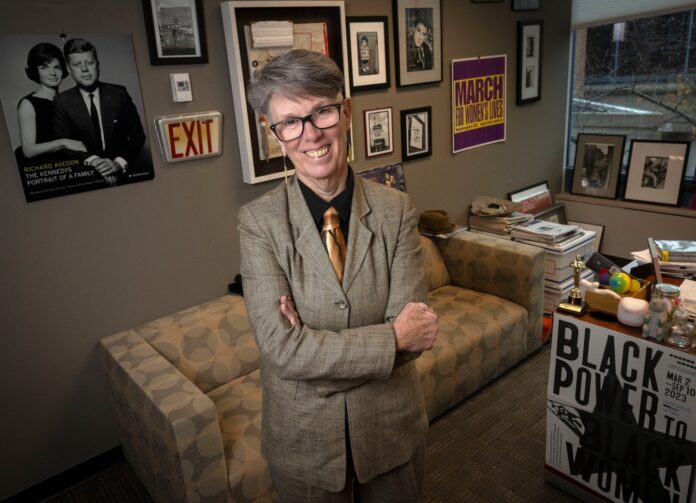
In the quiet, hallowed halls of America’s libraries, a new kind of war is being waged—not with weapons, but with words. And at the heart of this battle stands a figure who has become both a beacon of resistance and a target of vitriol: the librarian. Not just any librarian, but one who has dared to challenge the rising tide of book bans sweeping across the nation. She is being called a “groomer.” A “predator.” A threat to childhood innocence. But what if the real threat isn’t the books on the shelves, but the erasure of thought itself?
The Librarian as a Symbol of Defiance
Librarians have long been the unsung guardians of knowledge, the gatekeepers of curiosity. But in an era where information is both weaponized and commodified, their role has evolved. They are no longer mere custodians of dusty tomes; they are frontline soldiers in the fight for intellectual freedom. The librarian in question—a woman whose name has become synonymous with resistance—has refused to bow to the demands of those who seek to purge libraries of anything that challenges their narrow worldview. Her crime? Ensuring that diverse voices, including those of women, LGBTQ+ individuals, and people of color, are not silenced.
To call her a “groomer” is not just an insult; it is a deliberate distortion of her mission. It is an attempt to frame her advocacy for inclusive literature as something sinister, as if the act of providing a child with a book about a same-sex family is an act of corruption. But what does it say about a society that equates empathy with danger? The librarian’s detractors are not protecting innocence—they are enforcing ignorance.
The Weaponization of Fear
Book bans are not a new phenomenon, but their current resurgence is fueled by a calculated campaign of fear. The rhetoric is familiar: “These books are indoctrinating our children.” “They are promoting harmful ideologies.” The language is designed to provoke outrage, to make parents believe that their children are under siege from forces they cannot control. But the truth is far less dramatic—and far more insidious. The books being targeted are not about grooming. They are about representation. They are about giving young people the tools to see themselves in the stories they read, to understand that their experiences matter.
Consider the irony: the same people who decry “woke” culture are the ones most eager to dictate what children can and cannot read. They claim to be defending tradition, yet their actions reveal a deep-seated fear of change. They are not protecting the past; they are trying to freeze it in time. And in doing so, they are stripping future generations of the opportunity to think critically, to question, to grow.
The librarian’s detractors would have us believe that books are dangerous. But what is truly dangerous is a society that would rather ban a book than confront an uncomfortable truth.
The Feminist Underpinnings of the Fight
This battle is not just about books. It is about power. And at the heart of that power struggle is feminism. The librarian’s defiance is a feminist act because it challenges the patriarchal structures that seek to control not just women’s bodies, but their minds. When a woman is called a “groomer” for advocating for inclusive literature, it is a direct attack on her authority, her expertise, and her right to shape the narratives that define her community.
Feminism has always been about reclaiming agency—over our bodies, our voices, our stories. The librarian embodies this spirit. She is not asking for permission to exist. She is demanding that her existence be recognized, her work be valued, and her right to do her job without harassment be respected. The attacks against her are not just personal; they are political. They are an attempt to silence a woman who refuses to be silenced.
And yet, for all the vitriol directed at her, she persists. Because feminism is not just a movement of resistance; it is a movement of resilience. It is about standing firm in the face of opposition, about refusing to let fear dictate the terms of engagement. The librarian’s fight is a feminist fight because it is about more than books. It is about the future of women’s voices in the public sphere.
The Cost of Silence
Every book that is banned is a story that is erased. Every voice that is silenced is a perspective that is lost. The cost of this erasure is not just intellectual; it is social. When we remove books from shelves, we send a message to young people that their experiences do not matter. We tell them that their identities are not worthy of representation. We tell them that curiosity is dangerous.
But the librarian’s fight is a reminder that silence is not an option. It is a call to action. It is a demand for accountability. It is a refusal to accept a world where fear dictates what we can and cannot know. The librarian is not just fighting for books. She is fighting for the right to imagine a different future—a future where every voice is heard, every story is told, and every child is given the tools to think for themselves.
The attacks against her are not just an assault on her character; they are an assault on the very idea of progress. And that is why her fight matters. Because the books she defends are not just stories. They are lifelines. They are the threads that connect us to each other, to our histories, to our possibilities. To ban them is to sever those threads. To defend them is to weave a stronger, more inclusive world.
A Call to Arms
This is not a fight that can be won by one person alone. It is a collective struggle. It is about standing up to those who would rather ban than engage, who would rather silence than listen. It is about recognizing that the fight for intellectual freedom is not separate from the fight for social justice. It is about understanding that every book that is saved is a step toward a more equitable world.
The librarian’s story is a reminder that resistance is not passive. It is active. It is loud. It is unapologetic. And it is necessary. So the next time you hear someone call a librarian a “groomer,” ask yourself: what are they really afraid of? The answer may surprise you. Because the real danger is not the books on the shelves. It is the fear of what those books might teach us.
And that, dear reader, is a fear we cannot afford to indulge.