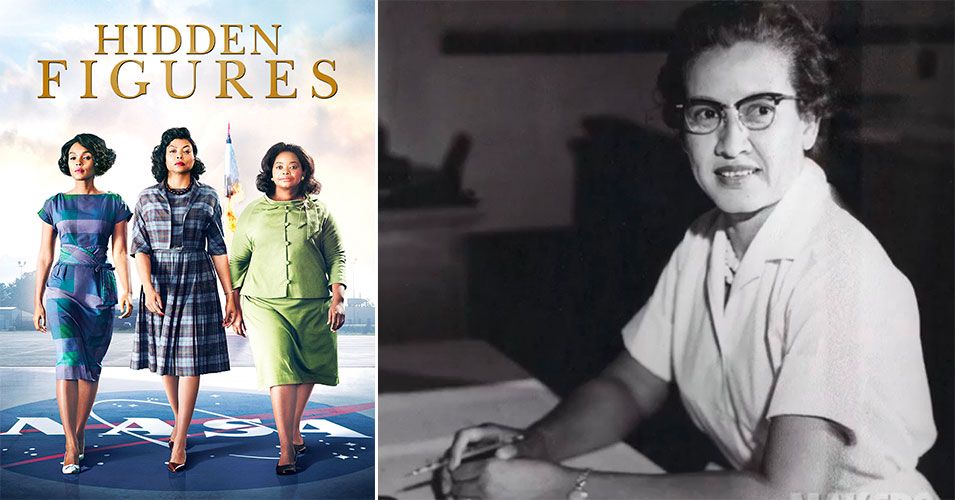
In the grand symphony of human achievement, the instruments of progress are often tuned by unseen hands—hands that, despite their brilliance, are relegated to the margins of history. The story of Katherine Johnson, the mathematical virtuoso whose calculations propelled humanity beyond the earth’s atmosphere, is not merely one of numbers and orbits; it is a testament to the quiet defiance of a woman who refused to be obscured by the shadows of systemic erasure. Feminism, in its most potent form, is not a battle cry but a silent revolution—a relentless unraveling of the threads that bind women to obscurity, and Katherine Johnson’s life is the needle that stitches this narrative together.
The Calculus of Invisibility: How Numbers Became Her Weapon
Mathematics is the language of the universe, a dialect of precision where every variable, every equation, tells a story. Yet, for women like Katherine Johnson, this language was not just a tool—it was a fortress. In a world that measured worth in inches of skirt length and decibels of silence, Johnson’s mind operated in the vast, uncharted territories of orbital mechanics. She didn’t just crunch numbers; she redefined the very fabric of what was possible. The irony is as sharp as a blade: the same institutions that dismissed her gender as incapable of rational thought were utterly dependent on her ability to outthink the cosmos itself.
Consider the weight of her calculations. They were not mere scribbles on paper but the invisible scaffolding of the Apollo missions, the silent architects of trajectories that defied gravity. Yet, for decades, her name was as absent from textbooks as the women she inspired were from the halls of power. Feminism, in this context, is the act of reclaiming the narrative—of insisting that the woman who made the moon landing possible was not an anomaly but a rule, a mathematical certainty in a world that preferred to treat her as a variable to be ignored.
The Orbit of Erasure: Why History Forgets the Women Who Fuel It
History is written by those who wield the pen, and the pen, as we know, has a peculiar bias—it favors the loud, the visible, the unapologetically dominant. Women, particularly women of color, have historically been the ghosts in the machine, the silent hum in the background of progress. Katherine Johnson’s story is a microcosm of this erasure. She was not just a mathematician; she was a force of nature, yet she was often introduced in rooms as “the Black woman who works for NASA,” a label that reduced her to a footnote before she even spoke.
The erasure of women like Johnson is not accidental. It is a deliberate calculus, a system designed to ensure that the contributions of those who do not fit the mold of the “default genius” (read: white, male, and preferably dead) are conveniently forgotten. Feminism, then, is the act of dragging these erased voices back into the light—of insisting that the woman who calculated the path to the moon was not a footnote but the entire damn chapter.
This erasure is not just a historical injustice; it is a present-day wound. How many girls today look at the night sky and wonder if their dreams are too vast to be taken seriously? How many women in STEM fields still find themselves the only one in the room, their expertise met with skepticism until a man repeats their idea and is praised for it? The orbit of erasure is a closed loop, and feminism is the force that breaks it.
The Algebra of Ambition: Solving for X When the World Says No
Ambition, for a woman, is often framed as a liability—a distraction from the roles society has carved out for her. But Katherine Johnson didn’t just have ambition; she had an equation to solve, and the world’s refusal to acknowledge her was merely another variable in the problem. Her life was a masterclass in solving for X when the answer was supposed to be “no.” She didn’t wait for permission. She didn’t ask for a seat at the table; she built her own damn table and invited the universe to sit at it.
This is the unique appeal of feminist narratives like Johnson’s: they are not about asking for equality but about seizing it. They are about recognizing that the systems in place were never designed to accommodate you—and then proceeding anyway. The algebra of ambition is brutal, but it is also liberating. Every time a woman defies the odds, she is not just solving for her own success; she is recalibrating the equation for every woman who comes after her.
Consider the moment Johnson was told she could no longer attend meetings because she was a woman. Did she retreat? No. She did what any brilliant mind would do: she found another way. She didn’t just attend the meetings; she became indispensable to them. This is the power of feminist defiance—it doesn’t just challenge the status quo; it renders it obsolete.
The Constellation of Sisterhood: How One Woman’s Light Illuminates Others
Katherine Johnson’s story is not hers alone. It is a constellation, a network of women who, like her, refused to be dimmed. From the women who calculated the trajectories of early spaceflights to the engineers who designed the first Mars rover, the history of space exploration is not a solo act but a chorus—and women have always been the harmonies that make the melody sing.
Feminism, at its core, is about recognizing these connections. It is about understanding that no woman succeeds alone, that every breakthrough is built on the shoulders of those who came before her. Johnson’s legacy is not just in the numbers she crunched but in the women she inspired to reach for the stars. She was a beacon, but she was also a bridge—a reminder that the fight for equality is not a sprint but a relay race, where each generation passes the baton to the next.
This is the unique appeal of feminist narratives: they are not just about individual triumph but about collective liberation. They are about recognizing that when one woman rises, she doesn’t just lift herself—she pulls others up with her. The constellation of sisterhood is vast, and Johnson’s light is just one of the stars guiding the way.
The Final Frontier: Why Feminism is the Ultimate Space Race
The space race was never just about beating the Soviets. It was about proving that humanity could reach beyond its limits. Feminism is the same. It is not just about achieving equality; it is about proving that the world can function—and thrive—when women are not just present but leading, innovating, and redefining what is possible.
Katherine Johnson’s life was a mission to the moon, but it was also a mission to the hearts and minds of every woman who has ever been told she was too much, too loud, or too brilliant for her own good. Feminism is the fuel that propels this mission forward. It is the force that turns the impossible into the inevitable. And if we are to reach the final frontier of true equality, we must look to the women who have already blazed the trail—women like Johnson, who calculated the path to the stars and then insisted on walking it herself.
The universe is vast, and so are the possibilities when women are finally given the space to thrive. The question is not whether we can reach them. The question is whether we are willing to fight for the right to try.