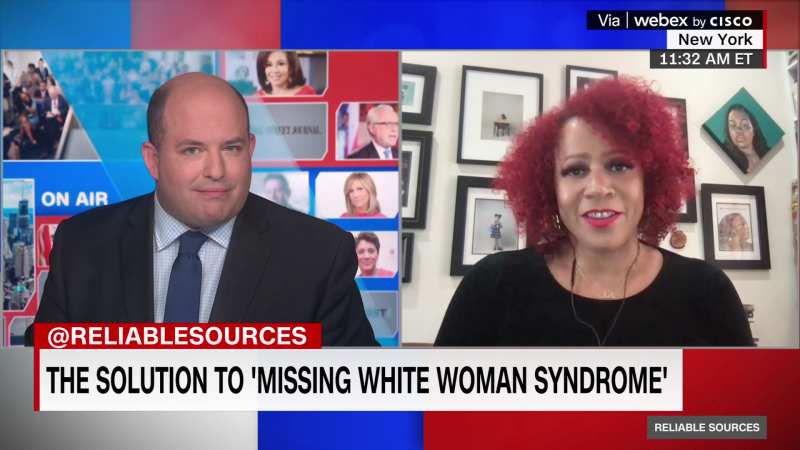
What if one of feminism’s biggest battles isn’t just about equality, but also about who gets to be seen as worthy of rescue? Could the very movement that champions justice and representation be inadvertently caught up in the pernicious grip of a phenomenon known as the “Missing White Woman Syndrome”? Let’s unravel this thorny paradox where race, media obsession, and feminist ideals collide in a dance both perplexing and provocative.
The Enigma of “Missing White Woman Syndrome”
At its core, “Missing White Woman Syndrome” describes a curious pattern in media coverage where missing white women receive an outsized amount of attention compared to missing persons of other races, genders, or socioeconomic backgrounds. It’s a spectral bias, an invisible thread woven through newsrooms that prioritizes certain victims as more sympathetic, more tragic, more newsworthy. The spectacle unfolds with an eerie regularity: elaborate profiles, wall-to-wall coverage, social media storms, and hashtags that galvanize entire communities. But why does this happen? What socio-cultural forces prop this insidious hierarchy of empathy?
Feminism’s Conundrum: Ally or Accomplice?
Feminism’s foundational ethos is rooted in advocating for all women’s rights—yet here lies a provocative tension. When the movement amplifies stories aligned with “Missing White Woman Syndrome,” it risks marginalizing women of color, trans women, and those from less privileged walks of life. Is feminist advocacy complicit in perpetuating the same racial and classist disparities it seeks to dismantle? The uncomfortable truth is feminism sometimes mirrors societal biases rather than uprooting them, raising a critical challenge: how can it reconcile the demand for inclusivity with the gravitational pull of media and cultural preferences that favor whiteness?
Media’s Role: The Gatekeepers of Visibility
One must not underestimate the media’s gargantuan influence in sculpting public perception. News organizations are driven by ratings, page views, and shares. Sensationalism is currency. Missing white women, often embodying certain cultural ideals—youthful, attractive, middle class—fit neatly into a marketable narrative. Their stories are packaged as haunting mysteries with happy endings—or not—which boosts engagement. Meanwhile, disappearances involving marginalized communities are relegated to lesser coverage, lost in a sea of indifference. This media myopia perpetuates societal biases by dictating whose stories are told and whose remain footnotes, a stark reflection of systemic inequities.
Intersectionality: The Overlooked Dimensions
Intersectionality insists that identities are complex, multi-layered, and interdependent. A black woman’s experience, for instance, is shaped not only by gender but also by race, class, and history of systemic oppression. When feminism adopts a monochromatic lens, focusing primarily on the plights of white women, it ignores these nuanced intersections. This omission diminishes the lived realities of countless women whose struggles are compounded by factors like racism, poverty, and transphobia. Addressing “Missing White Woman Syndrome” means expanding feminist discourse to genuinely embrace intersectionality—not as a buzzword, but as an operative principle guiding advocacy and representation.
The Societal Fallout: Who Gets Left Behind?
The implications extend far beyond newsroom headlines. When society dramatises the disappearance of certain women while overlooking others, it sends a message about whose lives are valued. This selective empathy fosters social alienation, reinforces stereotypes, and fuels systemic neglect. Families of missing persons from marginalized groups often encounter institutional apathy and resource scarcity. Community action and funding are scarce commodities. This imbalance perpetuates a vicious cycle where only a select few are mourned publicly while many suffer in silence. Feminism faces a challenge: how to champion justice that’s truly universal, transcending superficial visibility?
Redefining Feminist Advocacy in Light of This Bias
Could feminism emerge stronger by confronting its own blind spots? The path forward entails a deliberate, unflinching reckoning with racial and class biases embedded within advocacy frameworks. Feminist movements must diversify leadership, amplify marginalized voices, and engage critically with media narratives. Education plays a crucial role—challenging entrenched assumptions, cultivating media literacy, and fostering empathy across divides. By recalibrating priorities, feminism can strive not just for the inclusion of all women, but for equity in visibility and justice. This is no easy feat, but indispensable for a movement that aspires beyond selective salvation.
A Playful Inquiry: Can Feminism Rescue Itself from Its Own Bias?
So here’s the playful yet poignant question: can feminism extricate itself from the shackles of the very syndrome that threatens to undermine its integrity? Is it possible for the movement to champion stories that mainstream media overlooks, to elevate the invisible, and to redress the imbalance in whose experiences command attention? The answer might lie not in abandoning the urgency around missing white women, but in expanding the arena of concern—making advocacy an inclusive crusade that refuses to settle for fragmented feminism. It requires courage, introspection, and a willingness to disrupt comfortable narratives. But in that disruption lies the promise of a feminism that doesn’t just echo societal biases, but dismantles them altogether.