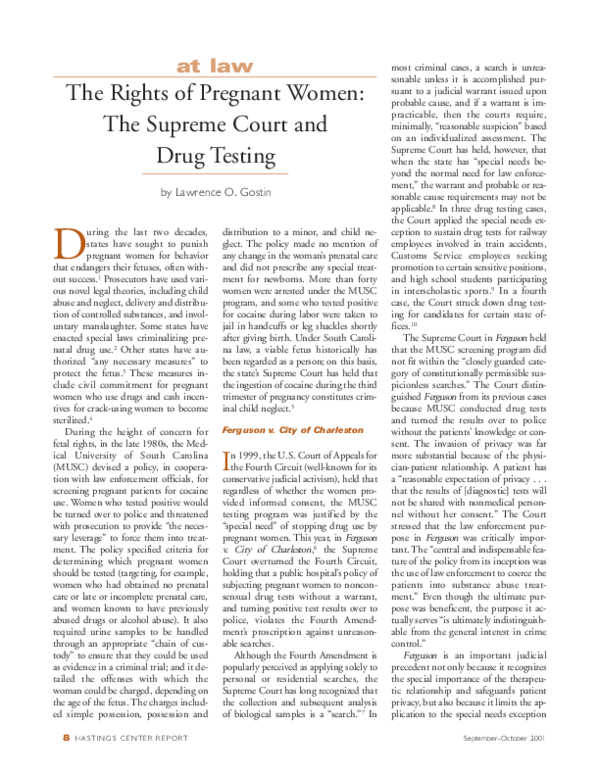
In a contemporary society replete with intricate legal quagmires and deeply entrenched ideological divides, the issue of drug testing among pregnant women has taken center stage in the impending Supreme Court deliberations. This looming case engenders far more than mere legal ramifications; it embodies a cacophony of feminist discourses surrounding autonomy, maternal rights, and public health. The intersectionality of gender, class, and reproductive rights within this subject requires a nuanced exploration that provokes critical thought and amplifies marginalized voices.
Women, especially those navigating the sociocultural maze of pregnancy, find themselves increasingly ensnared by systemic scrutiny and paternalistic imperatives. The blanket rationale offered by proponents of drug testing often hinges on the dubious notion of safeguarding fetal health, yet one must ask: at what cost to maternal rights and dignity? Such an inquiry leads us to explore the multiple dimensions of this debate—ethical, legal, and social—while unearthing the latent consequences that arise from the intersection of drug policy and reproductive justice.
The impending Supreme Court ruling hypothetically sets a precedent for how pregnant women will be treated under the law, positioning them at the crux of a paradoxical societal narrative that simultaneously venerates motherhood and vilifies women who deviate from an idealized maternal blueprint. To delineate the vicissitudes of this debate, we must first understand the sociopolitical landscape surrounding drug testing and maternal rights.
Society’s obsession with the ostensibly “responsible” mother often leads to punitive measures against those who do not conform to the unreasonably high standards imposed upon them. Seen through the lens of feminist theory, drug testing policies can be framed as contemporary vestiges of state control over women’s bodies. This assertion hinges not merely on anecdotal evidence or sentiment; it resonates with the lived experiences of many women who face systemic coercion—whether through criminalization or social ostracization—merely for being candid about their substance use.
Moreover, the legal rationale behind drug testing relies heavily on archaic notions of paternalism, suggesting that the state not only has a vested interest but also an obligation to intervene in decisions deemed detrimental to fetal health. This paternalistic approach diminishes the autonomy of women, treating them as vessels rather than individuals endowed with agency. Feminist critiques articulate that this kind of state intervention magnifies not only the stigma attached to substance use but also fosters a climate of fear, whereby women are reluctant to seek help for fear of legal repercussions.
One must consider the adversities faced by low-income women and women of color, who disproportionately bear the brunt of such punitive legislation. The medicalization of pregnancy interlaces with systemic inequalities that exacerbate existing vulnerabilities. Taking a closer look at these dynamics unveils a troubling correlation: punitive drug testing often compounds societal disadvantages, leading to further marginalization. This raises critical questions regarding equitable access to health care, social support systems, and the pressing need for comprehensive policies that prioritize maternal health without criminalizing the very mothers they aim to protect.
At this juncture, a compelling counterargument may surface: proponents of drug testing could argue that maternal drug use is a tangible threat to fetal welfare, thus warranting state intervention. However, maintaining this stance neglects the breadth of evidence advocating for supportive rather than punitive approaches. A paradigm rooted in compassion rather than criminality provides an avenue for women grappling with substance use to access vital health resources without the added burden of legal repercussions. Such support systems not only foster healthier pregnancies but also contribute to the well-being of families in the long-term.
In the realm of healthcare, conversations surrounding the treatment of pregnant women must shift from a punitive focus to one characterized by understanding and accessibility. The consequences of labeling mothers as “criminals” or “negligent” often serve to isolate them further, perpetuating cycles of stigma and silence. A feminist approach necessitates advocating for comprehensive treatment services that ensure pregnant women can seek assistance without the specter of legal action looming over them.
Another layer of complexity is added by the debate over what constitutes “responsible” drug use during pregnancy. Feminist voices staunchly advocate for reframing the discourse to empower women to make informed decisions regarding their bodies, free from societal judgment. Here, the conversation naturally pivots to reproductive rights—an area wherein the autonomy of women should be unequivocal. The right to make decisions about one’s own body is a cornerstone of feminist advocacy; thus, any attempt to circumvent that autonomy under the guise of protecting fetal health is inherently problematic.
As the Supreme Court gears up to hear arguments regarding this contentious issue, it becomes clear that the implications of their ruling could resound far beyond the immediate case at hand. While the law may be slow to evolve, societal attitudes often shift in concert with judicial decisions. Thus, ensuring that the voices of women—especially those marginalized by race, class, and socio-economic status—are woven into the fabric of this legislative conversation is paramount.
Furthermore, engaging in public discourse surrounding this issue invites us to reflect on broader societal values around motherhood, substance use, and the role of the state in personal health decisions. Would it not be more progressive to cultivate a culture that supports pregnant women instead of chastising them? This represents not just a legal imperative but a moral one—a call to foster a society that embraces compassion over judgement.
As we stand on the precipice of this landmark ruling, let us urge for a judicial outcome that champion the rights of all women while critically dismantling the discourses that enshrine patriarchal control. Intersectional feminism must lead the charge, presenting a robust framework that conceives of maternal rights not as negotiable, but as inviolable. In doing so, we must advocate for policies that reflect a humane understanding of motherhood—policies that ultimately promote the health and well-being of both mother and child while preserving the sanctity of women’s autonomy.
It is time to dismantle patriarchal norms disguised as protective measures and replace them with informed, supportive policies that honor women’s choices. The future of maternal health and gender equality lies in the courage to challenge the status quo and demand a legal landscape that places the rights of women squarely at its core.