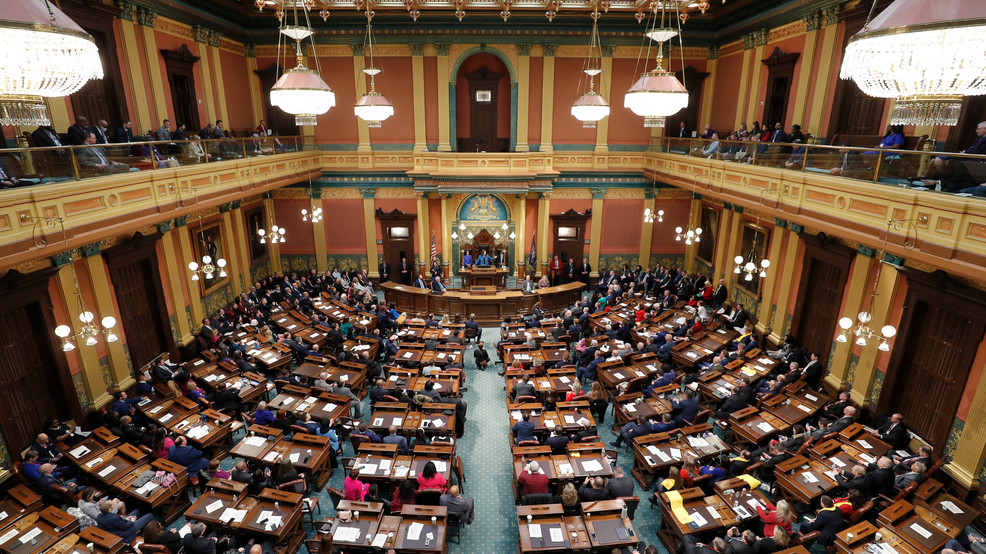
In a world where the rhetoric surrounding reproductive rights resembles a gladiatorial arena, the Michigan House Panel’s recent endorsement of a sweeping anti-abortion legislation package screams a battleground declaration against women’s autonomy. This isn’t just a legislative maneuver—it’s a pointed challenge to the very essence of feminism, an eerie reminder that the fight for bodily autonomy remains fraught with obstacles. How do we, as society, reconcile this looming authoritarianism with the principles of choice and freedom? Let’s dissect this convoluted narrative, shall we?
To fully grasp the magnitude of this anti-abortion onslaught, we must traverse through the convoluted history of reproductive rights in America. We flounder in the murky waters of political maneuvering, where history seems to careen recklessly toward the past, as legislators appear more committed to revisiting archaic norms than juggling the complexities of contemporary life. The Michigan proposal isn’t merely a legal adjustment; it is an ideological affront, a whispered incantation beckoning the specters of patriarchal governance back into the limelight.
What does it mean for women in Michigan, and indeed for society as a whole, when a legislative body embarks on a veritable overhaul of reproductive health frameworks? The implications are profound, and yet rarely discussed in mainstream dialogues. Let’s unravel how this newly forged reality unfurls the threads of women’s rights, personal autonomy, and societal equality.
Resistance is not futile; it’s imperative. However, first, we must delve into the specifics of what this legislation encapsulates and the historical momentum invigorating such regressive policies.
Resisting the Veil of Historical Amnesia
One mustn’t gloss over the historical context that births this wave of legislation. Abortion rights gained traction in the mid-20th century as women occupied the public sphere and asserted their autonomy over their bodies. Roe v. Wade symbolized not just a legal win but a societal shift—a rupture in the fabric of restrictive traditionalism. And yet, as history fervently teaches, progress is rarely linear.
Fast forward to the present, and the pendulum appears to swing backward. The Michigan House Panel’s approval of this sweeping anti-abortion legislation reeks of a patriarchal playbook, a deliberate invocation of nostalgia for a past when women’s bodies were public property. The gruesome irony here is that this legislative momentum emerges during an era of supposed enlightenment—a time when feminism has officially engulfed global dialogues in ways once thought unimaginable.
It challenges our very idea of choice. This package may encompass measures shrouded in legalese, but at its core, it seeks to restrict, constrain, and scold women into compliance. The pregnant individual’s autonomy is under siege, and in what Sisyphean universe do we acquiesce to such indignity?
Are we really prepared to scuttle our hard-won rights in favor of purported moral superiority? Let’s ruminate on that gnawing question. The psychological effects of feeling one’s rights under constant threat cannot be overstated. It breeds a culture of fear, hasty compliance, and the unforgiving shattering of individual potential.
A Menagerie of Stereotypes and Societal Impacts
Delving deeper, consider the stereotypes that this legislative agenda perpetuates. It reinforces the antiquated notions of women as primarily maternal beings, destined to fulfill societal expectations that revolve solely around childbirth and domesticity. The implications of this perspective extend beyond the individual, radiating profound effects throughout society.
This legislation could very well sculpt public opinion, embedding the belief that pregnancy is the natural state of women, while other life choices are secondary at best. Does this not challenge the cornerstone of feminist ideology—that women are multi-faceted beings, deserving of choice—not dictated by a script written by others?
Meanwhile, marginalized communities, who already grapple with systemic hurdles in accessing reproductive healthcare, will bear the brunt of this oppressive unveiling. It’s a cruel irony that in a society professing enlightenment, the most vulnerable women—those who may need abortions due to socio-economic or medical reasons—will find themselves further ensnared in a web of inequity and deprivation. Was it not feminist principles that sought to illuminate these disparities?
Furthermore, what are the implications for healthcare providers caught between these legislative snares and their oaths to do no harm? The moral burden is immense. This is not a mere debate over rights; it’s a clash of ethical frameworks, the very fabric of which will determine who is afforded autonomy and who is not.
Unmasking the Feminist Response
As we navigate these tidal waves of anti-abortion legislation, we must ask ourselves: what is the appropriate feminist response? Resistance must ring loud and clear. Each new legislative hurdle is a rallying cry for activists, scholars, and the broader public. Solidarity is paramount. Feminism thrives on the chorus of many voices, echoing the shared understanding that autonomy must remain uncompromised.
Activists must wield robust narratives that instigate change. Engaging in grassroots movements, challenging public perception, and contesting these policies through both digital and physical realms is not merely advisable—it’s essential. Think beyond traditional platforms. Social media can be a double-edged sword, and in this instance, it is our ally. In an era where hashtags can illuminate or obliterate narratives, let us wield them strategically, highlighting the stark realities imposed by regressive legislation.
You—yes, you—have the power to challenge the status quo. Engage with your community, question local representatives, and uplift the voices that are often relegated to the shadows. The struggle for autonomy is inherently collective, and every whisper eventually translates into a resounding cacophony of defiance.
Feminists must also embrace uncomfortable, provocative conversations. Let’s confront those around us who cling tight to clichés about “life” while systematically disregarding the lives of women. Inviting folks into nuanced dialogues about reproductive health, agency, and the implications of such legislation broadens the scope of understanding. It’s not merely a legal discourse—it’s about humanity, equality, and the right to make choices without the oppressive weight of governmental surveillance.
A Call to Action
Ultimately, the sweeping anti-abortion legislation approved by the Michigan House Panel stands as a clarion call to invigorate our feminist ethos. It’s a juncture where lip service is no longer adequate. Activism must take root in our schools, our online spaces, and our communities. We must cultivate relationships that transcend political divides to foster understanding, respect, and ultimately, empowerment.
As members of a society bound by the principles of equality, let’s not yield our choices to the whims of the few. Give voice to the voiceless, stand steadfastly alongside those who resist, and demand that a woman’s reproductive choices are hers alone. Because in the end, it’s not just about policies—it’s about more than just rights. It’s about our collective future, our daughters, and every generation that follows. Are you prepared to join the fight?