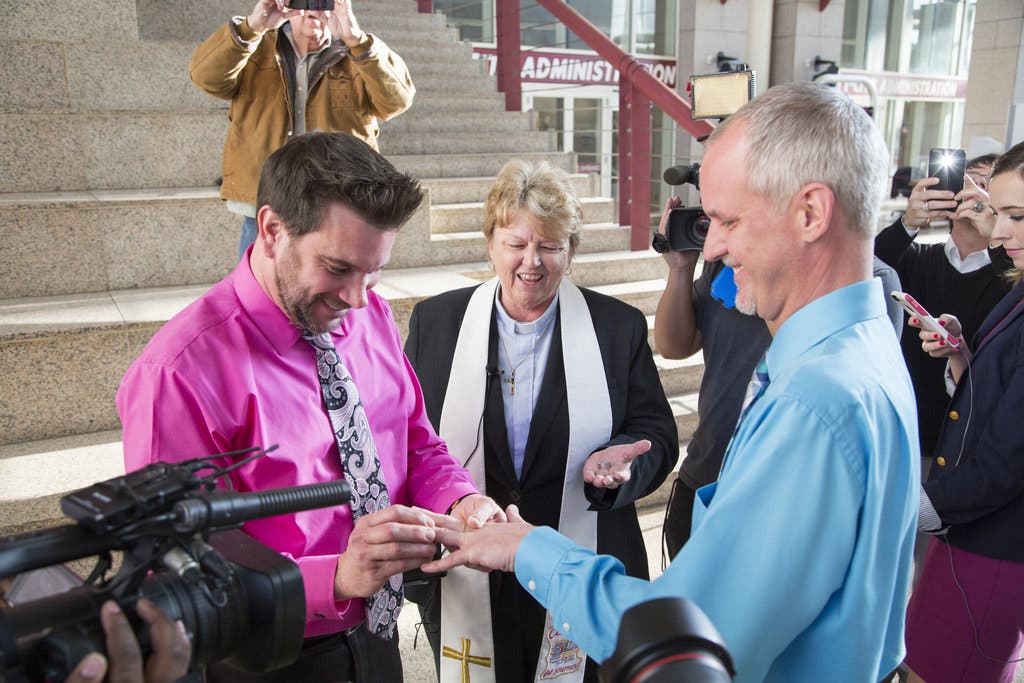
In a landmark moment for LGBTQ+ rights, Alabama has commenced the issuance of marriage licenses to same-sex couples, a dramatic shift in the sociopolitical fabric of a state historically known for its conservative stance on such issues. This vital development does not solely denote the culmination of a legal battle or the dawning of a new era in familial recognition; it uniquely resonates within the broader context of feminism. Witnessing how the fight for same-sex marriage intertwines with feminist advocacy provides an invaluable lens through which we can scrutinize the evolving dynamics of gender, equality, and societal norms.
As we venture into this exploration, it becomes imperative to delineate the multifaceted intersections between feminism and the struggle for marriage equality. Were we to persist in a simplistic analysis, we would risk overlooking the critical nuances that implicate feminism as an ever-evolving framework amid the broader fight for justice within LGBTQ+ communities.
Marriage: A Social Construct Under Pressure
Unlike the idealistic portrayal often pedaled by romanticism, marriage has always been an instrument steeped in social, economic, and political significance. Traditionally, it resembled more of a contract that regulated gender roles rather than a pure expression of love and commitment. Within the confines of patriarchy, marriage has been wielded as a tool for subjugation, perpetuating inequalities and constraining women’s autonomy. The late 20th century witnessed an uprising against these archaic structures, where feminists erupted onto the scene, challenging the very essence of entrenched beliefs surrounding marriage.
The recognition of same-sex marriage represents not merely a formidable leap forward for the LGBTQ+ community but also a profound reconsideration of what marriage can — and should — epitomize within a feminist framework. As Alabama steps into this new light, it invites a reexamination of marriage’s role in societal norms. Herein lies an inherent contradiction: while marriage has been a site of oppression, it simultaneously holds the promise of empowerment, enabling individuals to navigate the world with an anchor of legitimacy.
How can one reconcile this duality? By questioning the motivations that underpin the desire for marriage — especially among feminists. Many argue that the push for marital recognition perpetuates the traditional norm of– normalizing heteronormativity. Yet, such critiques may overlook the potential for redefinition rooted in egalitarian principles. When same-sex couples seek marriage, they endeavor to redefine its purpose, stripping it of patriarchal baggage and infusing it with the values of equality, love, and mutual respect.
Empowerment through Legitimacy
The act of receiving a marriage license holds immense symbolic weight, imbuing same-sex couples with a sense of validation that extends far beyond legal boundaries. Essential rights surrounding adoption, healthcare decisions, and tax advantages are intrinsically linked to marital status — a reality that starkly contrasts with the unrecognized status of those in same-sex relationships prior to this monumental shift in Alabama.
This demand for acknowledgment dovetails with feminist principles that champion autonomy and agency. Empowering individuals through the institution of marriage shifts the landscape, confronting age-old norms that have long sought to marginalize both women and sexual minorities. The validity of their unions, once relegated to the periphery of societal acceptance, emerges within the heart of the mainstream narrative.
Consequently, the issuance of marriage licenses to same-sex couples in Alabama becomes less a matter of legal acquiescence and more a poignant declaration: love transcends boundaries, and families exist in myriad forms. It functions as a radical affirmation of individual agency. To deny the legitimacy of these unions historically perpetuated the false narrative that love is confined by gender, limiting personal freedom and social expression.
The Feminist Lens on Inclusivity and Intersectionality
Amidst these shifts, it is essential to scrutinize the representations of marriage equality and their implications for intersectional feminism. Feminism has often wrestled with the homogenization of its ideals, often sidelining the voices of women of color, LGBTQ+ individuals, and those inhabiting multiple marginalized identities. To vocalize and advocate solely for marriage equality without acknowledging these intersectional struggles renders the movement incomplete.
Moreover, while honoring the milestone achieved in Alabama, it serves as a potent reminder that the quest for equality remains a broader struggle. Many women of color, unaccompanied by the privilege conferred upon whiteness, may face different repercussions when navigating this institution. Thus, the quest for marriage equality must encompass an understanding of systemic racism, poverty, and inaccessibility to legal resources. The feminist discourse surrounding marriage must actively engage these variables, acknowledging the multifarious perspectives that coalesce under the umbrella of gender equality.
In navigating these complexities, we must also interrogate how the legal recognition of same-sex marriage influences societal attitudes toward broader manifestations of love and family dynamics. Contemporary feminism should embrace the multiplicity of relationships, advocating for diverse models of family that resist the confines of binary narratives. Marriage equality is about standing in solidarity with all forms of love, empowering individuals to cultivate their narratives while dismantling oppressive structures.
Bridging the Gap: The Road Ahead
While Alabama’s progressive shift towards marriage equality signifies a substantial victory, it must also serve as a catalyst for broader conversations surrounding gender and power dynamics. The repercussions extend beyond legal formalities; they ripple through communities, challenging societal expectations and invigorating feminist discourse in unexpected ways.
Future campaigns aimed at reinforcing the necessity for intersectionality must elevate the voices of those often relegated to the margins. The narratives of individuals who are untouched by conventional societal templates must be amplified; their stories are not just footnotes but critical blueprints for a reimagined societal structure. A feminist approach insists upon expanding the definitions of family, validating all forms of love, and recognizing the shared commitments that exist beyond romantic unions.
The victory in Alabama signals a pivotal moment, yet the work is far from complete. The fight to dismantle the systemic mechanisms that perpetuate gender inequality — both within and outside the institutions of marriage — rages on. Advocates must ensure that as same-sex marriage gains acknowledgment, so too do the myriad identities woven into feminism’s tapestry.
In summation, as Alabama embarks upon this new chapter in its history, it offers an opportunity to deliberate on the essence of love, legality, and liberation. The struggle for same-sex marriage has conclusively united disparate factions within the feminist movement, illustrating that rights are inextricably linked. While many celebrate this watershed moment with exuberance, we must temper our fervor with an understanding of the work yet to be done. It is not merely about issuing licenses; it is about fostering a world where all love flourishes free from prejudice and discrimination, a world where everyone can legally, and proudly declare: I do.