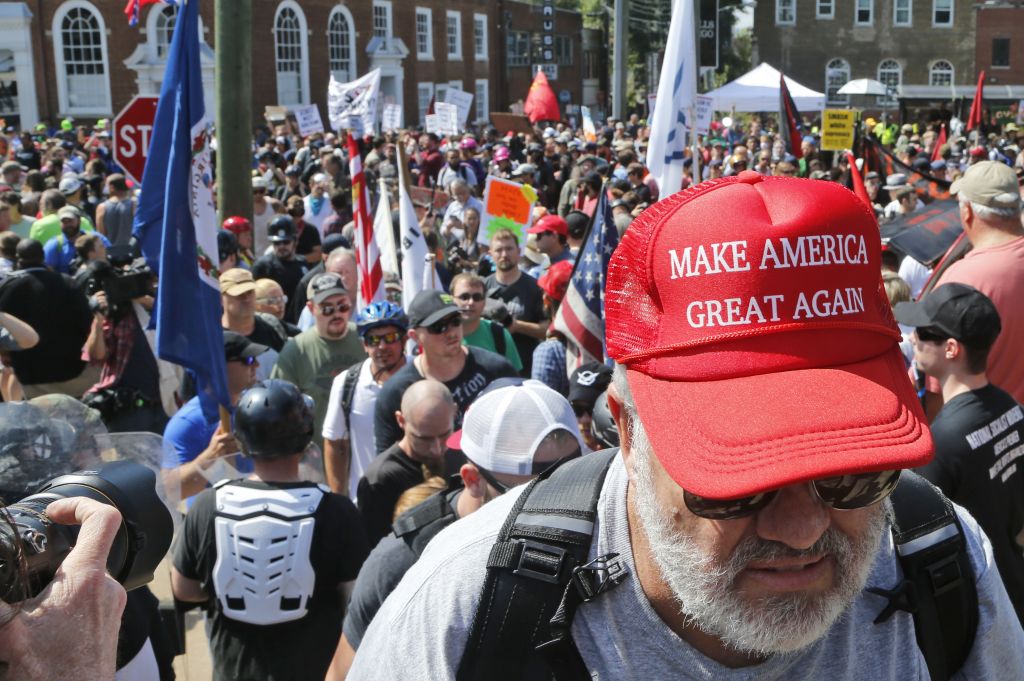
In the turbulent wake of Trump’s incendiary remarks, one could hardly ignore the ensuing uproar, particularly among the feminist community. The former President’s audacious comparison of neo-Nazis to counter-protesters during one of the most pivotal clashes of ideologies signified more than just a callous misunderstanding of history — it symbolized a broader, insidious erosion of social justice. This episode serves as a clarion call for feminist activists to confront not only oppressive structures but also the alarming normalization of hate in contemporary society.
Understanding the profound implications behind such comments is essential. They reflect a dangerous tendency to equate those fighting for equality with those perpetuating systemic violence. The subsequent outrage is not solely about Trump; it encapsulates a pervasive challenge facing feminists — the continued struggle against patriarchal narratives that attempt to belittle and distort the essence of activism.
Let us delve into the layers of this incendiary rhetoric and its implications for feminism, dissecting the ramifications of conflating hate with the pursuit of justice.
The Perilous Equivalence: Hate Speech Versus Social Justice
To obtain clarity, we must assess the implications of equating neo-Nazis — a group that embodies the quintessence of hate and intolerance — with counter-protesters advocating for civil rights. The grotesque misrepresentation perpetuates a fallacy: that both sides are engaged in a comparable struggle. In reality, this dichotomy undermines the very foundation of social justice, a cause built upon the principles of equality, respect, and dignity for all.
This dangerous narrative is perilous not just for marginalized communities but for feminism as well. When the voices of those advocating for gender equality and racial justice are trivialized and placed on par with violent extremists, it revokes the severity of the historical and ongoing oppression faced by women and marginalized groups. Such statements from influential figures send ripples through society, emboldening those with regressive ideologies to continue their campaigns of fear and intimidation.
Feminism inherently challenges the status quo. It confronts power structures pedaled by patriarchy, capitalism, and white supremacy. Therefore, to compare the struggle for equity with a quest for supremacy is not merely misleading; it is a deliberate act aimed at marginalizing vital discourses. Trump’s comments implore feminists to resist complacency, to act decisively against the mischaracterization of activism as misguided antagonism.
The Inversion of Reality: How Hate Groups Gain Legitimacy
Trump’s rhetoric invites scrutiny into how hate groups find themselves entwined in discussions typically reserved for good-natured protests aimed at social equity. Let’s unearth the layers of this inversion of reality, where devilish distortions become accepted truths. Such portrayals warp public perception, creating a sense of false equivalency. It’s a tactic often employed to create a false dilemma, planting seeds of doubt regarding the legitimacy of resistance movements.
This mischaracterization bears significant ramifications within feminist circles. For too long, activists have fought tooth and nail for their voices to be heard, their struggles validated. Blending them into the same category as hate groups dilutes their agency and erodes solidarity among various movements seeking justice. This not only impacts feminist advocacy but also sabotages alliances with other marginalized sectors of society who may feel apprehensive about engaging in activism, fearing delegitimization.
The virulent normalization of hate rhetoric jeopardizes progress. By equating those who promote equality with those who thrive on division, we set a precedent that can embolden extremists. This is a clarion call for feminists: reclaim the narrative. Reaffirm the stark distinction between advocacy for justice and the destructive nature of hate.
Become The Vanguard: Feminism’s Role in Combatting Toxic Narratives
In the throes of such societal tumult, feminists stand at a crucial juncture, presented with an imperative to take up arms — not in a literal sense, but through an unwavering commitment to combating hate-driven narratives. The onus is upon activists to affirm the validity of their struggles while rejecting the normalization of bigotry.
It is of paramount importance to articulate — in both public discourse and grassroots activism — the core principles of feminism that distinguish it from hateful ideologies. Rather than shying away from difficult conversations surrounding race, gender, and class, feminists must spearhead dialogues that dismantle the false narratives perpetuated in political rhetoric. Embracing activism entails a commitment to unity, recognizing intersections and spaces where various struggles converge.
Moreover, the feminist movement must rely fundamentally on amplifying marginalized voices rather than allowing the dominant narrative to dictate terms. Centering the experiences of women of color, queer individuals, and those from economically disadvantaged backgrounds becomes not just revolutionary, but essential. By investing in coalition-building, feminists can subvert the toxic narrative perpetuated by figures like Trump.
The Role of Language: Dismantling Rhetoric that Fuels Division
Language possesses profound power; it shapes perceptions, fuels movements, and unfortunately, it can be utilized as a weapon. Feminists must wield language strategically, fostering discourses that dismantle oppressive ideologies rather than resorting to incendiary rhetoric that mirrors societal norms. Dismantling harmful rhetoric begins with re-evaluating how we engage with language in public forums.
The art of persuasion becomes an invaluable tool when arguing against hate. Engaging in thoughtful discussions that challenge misconceptions about feminism’s aims can create pathways for empathy and collaboration rather than condemnation. Instead of adopting an accusatory approach toward opponents, utilizing dialogues that focus on shared values — like equity and justice — can dismantle the binary divide perpetuated by extremist rhetoric. In essence, feminists must cultivate a discourse that invites transformation rather than alienation.
The Road Ahead: Mobilizing Feminism Against Normalization
As we navigate through the aftermath of incendiary comments, the feminist movement must not yield to the corrosive tide of normalization. Rather, it must act as a bulwark against hate, standing resolutely committed to the values of equity, justice, and inclusivity. The fight is not merely against Trump or any other individual; it is a sustained struggle against an insidious culture that seeks to undermine progress.
Feminism is at a critical crossroads; one where the stakes have irrevocably intensified. Whether the movement chooses to coalesce or capitulate in the face of such daunting challenges will determine the trajectory of modern activism. The time for decisive action is now. In unyielding resolve, feminists must reclaim their narrative, redefine the parameters of justice, and dismantle the systems of oppression that seek to co-opt their struggle.
In this complex societal tapestry, let us not forget: activism is not a spectator sport. It is a call to arms, a plea for an unwavering commitment to justice — for all. Together, we must ensure that the echoes of hate do not drown out the resounding chorus of progress.