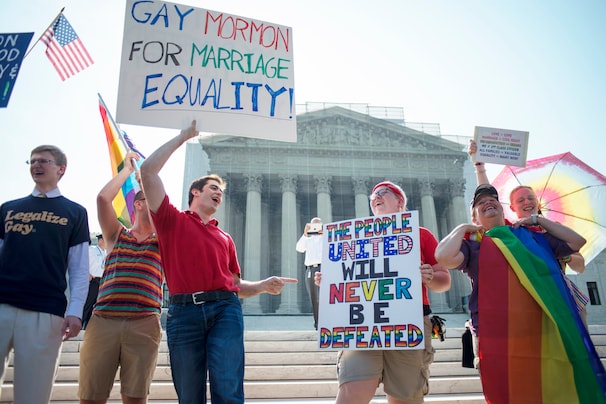
Since the dawn of civilization, marriage has been entangled with power dynamics, societal norms, and, unfortunately, oppressive ideologies. In the pantheon of civil rights struggles, the quest for same-sex marriage equality stands as a testament to resilience against patriarchal oppression. The California Supreme Court’s ruling that invalidated same-sex marriages was a monumental moment—one that shattered hope for equality amidst a kaleidoscope of societal evolution. But what does this mean for the feminist movement and its commitment to inclusivity?
For feminists, the fight for marriage equality boils down to something far deeper than romantic love. It embodies the battle against patriarchal structures that dictate the terms of relational legitimacy. Feminist theory teaches us that marriage has often functioned as a tool of oppression, channeling women into prescribed roles of subservience and dependency. Yet, when LGBTQ+ individuals seek to participate in this institution, it complicates the narrative of what marriage can and should represent. Instead of merely a social contract steeped in antiquated gender roles, marriage can become a platform for advocating equity and redefining social norms. However, the California Supreme Court’s decisions to invalidate these unions throw a wrench into this transformative potential.
The Intricacies of Intersectionality
To grasp the implications of the California Supreme Court’s ruling, one must invoke the lens of intersectionality. This concept is crucial to the feminist discourse, one that examines how various forms of oppression, such as racism, classism, and homophobia, intersect. Invalidating same-sex marriage is not merely a legalistic maneuver; it is a profound affront to the queer community, particularly those who are already marginalized along other axes of identity. How can we claim to fight for women’s freedom when we deny others their right to love and marry freely?
For young feminists, grappling with intersectionality means challenging our preconceived notions of who belongs in the feminist fold. The LGBTQ+ community is a vital part of this movement. Feminism is not merely about securing rights for women; it is about dismantling all forms of injustice. The implications of legal rulings such as the one from California reverberate through an already shaky foundation, questioning the validity of the marriage contract itself. Instead of reifying patriarchal traditions, this should be a clarion call to revolutionize how we perceive partnerships and love.
When the state imposes its will on the personal lives of individuals, it sends a clear message: Some loves are less worthy than others. The impact of this ruling extends beyond the LGBTQ+ community. It resonates throughout society, indicating that love is still conditional, still politicized, and still regulated, feeding into a culture that tells us whom we can love and how authentically we can express our identities. In this light, the California ruling represents not just a setback for LGBTQ+ rights but a retrogressive leap for grassroots feminism as well.
Love is Not a Legal Affair
At its core, the backlash against same-sex marriage is as much about protecting existing power structures as it is about abstract conceptions of love and family. Love transcends regulation, and yet society continues to tirelessly work to box it into traditional molds. The California Supreme Court’s invalidation of same-sex marriages underscores this audacious hypocrisy. For young feminists, this invites an essential question: Should we strive for acceptance within these outdated frameworks, or redefine what it means to love?
The feminist movement has been accused of being insular, focusing primarily on issues that affect cisgender, heterosexual women. The prominence of the LGBTQ+ rights movement challenges feminists to expand this scope. The overriding aspiration should not merely be the right to marry within a conventional framework, one that continues to enforce oppressive norms, but rather to cultivate an environment where love—regardless of form—can flourish without state intervention. Perhaps it is time to envision a society where partnership is celebrated for its intrinsic value, not its adherence to regressive legal standards.
So, how do young feminists reconcile this dilemma? By engaging in radically inclusive dialogues that advocate for a complete rethinking of what love and partnership mean. Seek out artists, writers, and thinkers who push boundaries and explore alternative pathways to commitment. Promote spaces that are welcoming to all forms of love, transforming the narrative from one of validation through legality to one of acknowledgment through value. This can cultivate a community where all relationships are honored, ultimately making the quest for marriage equality more reflective of a genuine embrace of diversity rather than an institutional validation of existing norms.
Reclaiming the Narrative
As the tumultuous waves of the California Supreme Court’s decisions ripple through the fabric of modern society, the task of reclaiming the narrative falls squarely on the shoulders of young feminists. The very act of invalidating same-sex marriages must act as a catalyst for a broader discussion about love, identity, and social constructs. Feminism’s ultimate goal should be to dismantle the patriarchal scaffolding that upholds these legal frameworks.
This is a call to action: Educate yourself and others on the intricacies of love as it intersects with gender, sexuality, and societal expectations. Engage in conversations that challenge traditional notions of relationships and that question why love is subjected to legal scrutiny in the first place. Why should our personal lives be a matter of state interest? Why should love—regardless of its manifestation—ever be tied to the constructs of legality?
Reclamation is an act of insurgency against historical oppression and an evolution in our understanding of what constitutes a family. Young feminists can lead this insurgency. Disrupting conventional narratives provides the opportunity to weave inclusive stories that acknowledge not just the fight for same-sex marriage but the broader struggle for love and dignity. In a landscape marred by confusion and outdated perceptions, feminists must forge a new path forward powered by empathy, radical inclusivity, and an unwavering commitment to justice.
Thus, the California Supreme Court’s ruling serves not only as a political maneuver but as a rallying point for young feminists to galvanize the movement towards a more inclusive, equitable, and celebratory vision of love that transcends legal limitations. Embrace this complexity, and let it propel the feminist movement into the future, where love knows no bounds and partnership is celebrated in all its multifaceted glory.