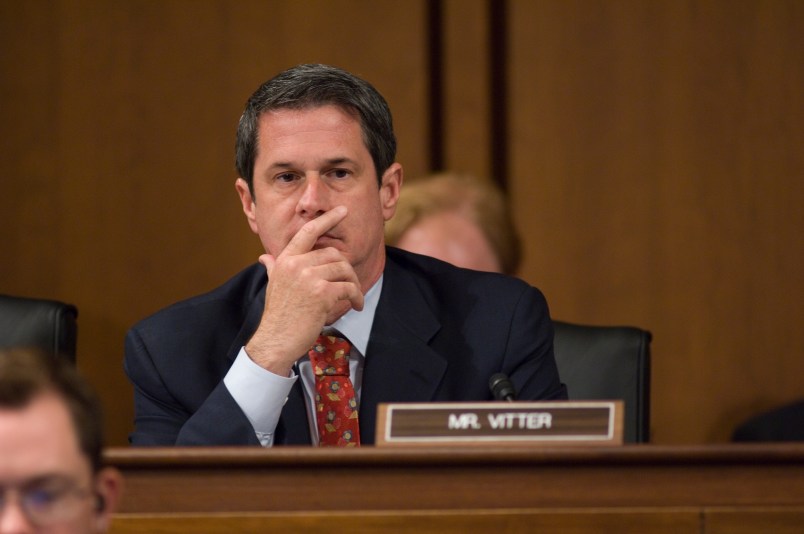
When it comes to the intersection of politics and personal conduct, few scandals resonate as profoundly as those involving violence and sexism. Recently, Senator David Vitter found himself at the center of controversy regarding a former staffer accused of violent assault. Instead of confronting this issue head-on, Vitter chose to downplay the severity of the situation. This avoidance is emblematic of a larger problem within our political framework—an environment where misogyny and violence against women are often trivialized, excusing troubling behavior while ignoring its broader implications.
Is it not fun to play devil’s advocate? Let’s dissect Vitter’s response and, in doing so, challenge our understanding of accountability in political leadership.
The Double Standards of Accountability
Let’s ponder this question: why do we afford some individuals the luxury of evasion while condemning others for their misdeeds? Vitter’s flippant dismissal of the staffer’s violent conduct exemplifies a baffling double standard. Here lies a troubling paradox. Male politicians, particularly those in the conservative sphere, often benefit from a protective cocoon. Their transgressions are swept under the rug, while female victims are left to grapple with their trauma in an unforgiving public eye.
This discrepancy should incite indignation, yet it appears to be a perennial facet of the political domain. When female leaders face allegations—whether substantiated or not—they are scrutinized with an unparalleled intensity. They become scapegoats for societal frustrations and derision. Meanwhile, Vitter, often perceived as a ‘family man’, sidesteps the rippling repercussions of violence, perhaps believing his persona allows him immunity from accountability. The notion of escape for men stands in stark contrast to the plight and demonization faced by women.
The Culture of Silence surrounding Assault
Underneath the surface of these incidents lies a grim reality: the culture of silence that perpetuates violence against women. When political figures such as Vitter trivialize violent assaults, are they not endorsing a societal narrative that encourages women to remain silent? The act of speaking out, of presenting one’s pain, becomes an arduous task fraught with judgment and stigma. Vitter’s nonchalance risks reinforcing the very societal structures that silence victims, allowing the cycle of violence and discrimination to thrive.
This is not merely a matter of one man’s failure to acknowledge a wrongdoing—it encapsulates a systemic problem. Rigorous discussions require the deconstruction of our societal fabric, which often prioritizes power dynamics over the lived experiences of women. We must ask ourselves: is a politician’s dignity worth more than a woman’s safety? Unfortunately, the people keep electing leaders who evade accountability, perpetuating the cycle of silence that gives rise to violence.
Rhetoric Versus Reality: Women’s Voices in the Fray
If we take a step back, we witness a paradox that has plagued feminism. While contemporary discourse imbues feminist ideals within mainstream rhetoric—think of #MeToo and the push for equality—the reality often falls woefully short. The narrative around women’s experiences is all too frequently reduced to sound bites, platitudes, and empty promises. Vitter’s response signifies a dismissal not merely of responsibility, but of the collective anguish born from violence against women.
When a public figure sidesteps the responsibility of addressing domestic violence, what message does that send? It suggests that, as women, our voices can be ignored. That our trauma is secondary to political theatrics. Vitter’s behavior must galvanize a response. We must demand a political landscape in which silence is untenable and accountability is non-negotiable. The messages that patriarchal leaders like Vitter send are dangerous, yet they also create a rallying point for advocates and activists. Their dismissive antics provide fertile ground for discourse on the very nature of assault and the silence that enables its perpetuation.
Confronting Toxic Masculinity
Toxic masculinity rears its ugly head in the political arena, and Vitter’s cavalier attitude towards violence is an acute manifestation of this phenomenon. The cavalier dismissal of a staffer’s violent behavior hints at a larger problem—a societal endorsement of aggression as a masculine trait. By downplaying assault, Vitter not only trivializes the act but perpetuates the notion that violence is a natural extension of male behavior. This must be challenged with unflinching recognition.
The truth is, defining masculinity as inherently violent or domineering disenfranchises men as much as it does women. It is time for men to confront this toxic dogma and become allies in dismantling it. Ironically, the political realm (and the often-loud mouths who inhabit it) has the potential to be a powerful agent for change—or a resounding echo chamber for outdated ideologies.
Toward a Future of Empowerment
What is the solution, you ask? Simply put, it is time for a radical shift. The culture of silence surrounding women’s voices must give way to a more empowering paradigm. Vitter’s lackluster response to allegations is a clarion call for those who value justice. We must demand more from our leaders—not just in terms of rhetoric but in tangible policies and attitudes that support victims of violence. The time for half-hearted apologies and denial of responsibility is over; the responsibility lies with all of us to hold these leaders accountable.
In this post-Vitter world, we must instigate productive conversations about violence, power, and the unquestionable value of women’s experiences. We ought to challenge leaders who perpetuate silence with the simple belief that silence is complicity. We should encourage a culture where men are equally involved in the dialogue surrounding accountability, amplifying the cry against violence while embracing vulnerability and emotional literacy.
In this era of upheaval, we owe it to ourselves and future generations to foster an environment that is dismissive of violence in all its guises. The political realm can either continue down the path of reiterating damaging tropes or embrace the nuanced complexities inherent in the human experience, valuing and validating all who have suffered. The narrative can change, but only if we reject complacency and demand that our leaders navigate the murky waters of accountability with transparency.
In the end, Vitter’s flaccid response has illuminated the cracks in our societal foundation regarding violence against women. We must take this as an opportunity to build a more equitable future, one where voices are elevated over egos. So, dear reader, I challenge you to raise your voice, hold the powerful accountable, and ensure that the politics of silence can no longer thrive in a world demanding proactive and affirmative change.