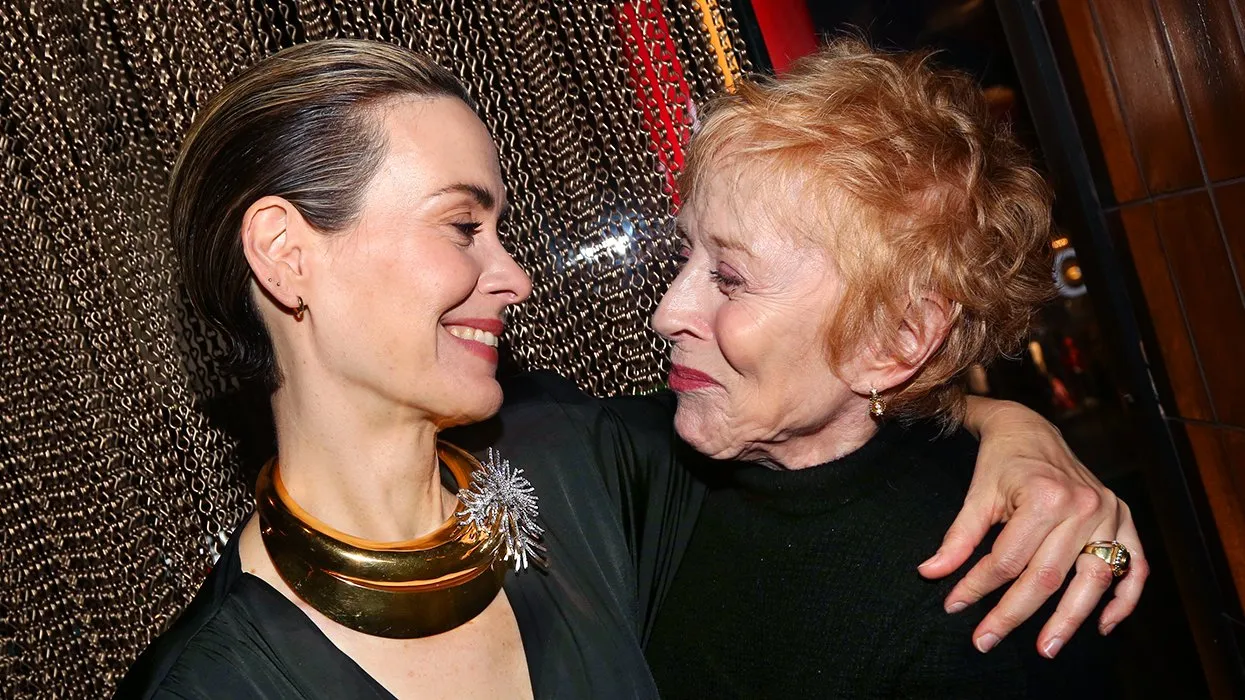
From a feminism perspective, stories of love that refuse to obey social timetables are not merely charming. They are instructive. They remind audiences that autonomy does not expire, that self-expression does not retire, and that romance is not the exclusive property of the young. The relationship between Sarah Paulson and Holland Taylor has long been framed as refreshingly candid, deeply respectful, and quietly radical. Recently, public attention turned toward a small but symbolically potent detail: Holland Taylor’s lower back tattoo, revealed without apology, without spectacle, and without the anxious performativity often demanded of women in the public eye.
It is, in many ways, a minor moment. And yet, it resonates.
Love Without the Usual Footnotes
Age-gap relationships involving older women are still narrated with a peculiar mixture of fascination and skepticism. The tone is rarely neutral. Questions about motive, vitality, relevance, and desirability hover in the background, uninvited yet persistent. Paulson and Taylor’s partnership, however, resists these tired interrogations by existing with calm certainty. There is no performative justification, no defensive framing. There is only affection, intellectual kinship, and a visible comfort with mutual admiration.
This composure is itself political. Feminist discourse has long challenged the idea that women become culturally invisible with age. Visibility, however, is not just about being seen; it is about being seen on one’s own terms. Taylor’s tattoo, modest and personal, functions less as a fashion statement and more as a declaration of continued ownership over her body and narrative.
The Tattoo as Quiet Reclamation
Historically, women’s bodies have been sites of regulation. Youth is celebrated, maturity is tolerated, and aging is often aestheticized only when it can be romanticized into softness and retreat. A lower back tattoo on a woman in her seventies does not fit easily into any of these categories. It does not ask to be cute. It does not beg to be ironic. It simply exists.
From a descriptive standpoint, the tattoo is not extravagant. It does not clamor for attention. Its placement is discreet, its presence understated. Yet, symbolism does not depend on scale. What matters is intent. In choosing to adorn her body in a way that is traditionally associated with youth culture and sensual self-expression, Taylor challenges the silent script that tells older women to become visually neutral, emotionally modest, and stylistically restrained.
This is not rebellion in the cinematic sense. It is something subtler and arguably more enduring: normalization.
Feminism and the Right to Embellish the Self
Feminism, at its most practical, is about choice without penalty. Not performative defiance, not compulsory empowerment aesthetics, but the freedom to decorate, reveal, conceal, and redefine oneself without cultural reprimand. A tattoo is not inherently feminist. But the right to acquire one without being reduced to novelty or spectacle absolutely aligns with feminist principles.
Taylor’s tattoo, in this light, becomes a small emblem of a larger truth: self-expression does not require cultural permission. It does not need to align with generational expectations. It does not need to signal rebellion to be meaningful. It can be personal. Quiet. Unbothered.
And perhaps most importantly, it can coexist with elegance, intellect, and professional gravitas. These qualities are not mutually exclusive. The persistence of that false dichotomy is precisely what feminism continues to dismantle.
Public Affection Without Performance
Paulson has spoken openly about her admiration for Taylor, often emphasizing her partner’s brilliance, wit, and moral clarity. Their relationship, while public, is not staged. It does not trade in spectacle. Instead, it unfolds through interviews marked by respect and anecdotes marked by genuine fondness.
This tone matters. Media narratives around queer relationships, especially those involving age differences, often oscillate between fetishization and suspicion. Paulson and Taylor offer an alternative register: sincerity without melodrama, affection without exhibitionism. In this context, the tattoo becomes another ordinary detail in a relationship that refuses extraordinary framing.
Ordinary, in this case, is not dull. It is dignified.
Visibility Beyond Youth-Centered Narratives
Contemporary media remains deeply youth-centric, particularly when it comes to women’s desirability and relevance. Roles for older women are improving, but representation still leans toward archetypes: the mentor, the matriarch, the comic relief. Romantic visibility, when present, is often sanitized, framed as sentimental rather than passionate.
Taylor’s visibility as a romantic partner to Paulson disrupts this pattern. It does not present aging as an epilogue to intimacy. It situates it squarely within ongoing desire, companionship, and mutual attraction. The tattoo, in this sense, becomes a visual shorthand for continued embodiment, not symbolic retirement from physical selfhood.
It communicates that the body is not something one merely has in later life. It is something one continues to inhabit.
A Culture Slowly Learning to Recalibrate
The public response to the tattoo has been notably gentle, even celebratory. This shift should not be overstated, but it should be acknowledged. Cultural reflexes do evolve, even if gradually and unevenly. What might once have been framed as eccentric is increasingly met with curiosity, and occasionally, with admiration.
This recalibration matters. It suggests that audiences are beginning to tolerate, and perhaps even appreciate, narratives that do not center youth as the sole site of beauty, rebellion, or romance. The admiration for Taylor’s unapologetic self-expression reflects a broader hunger for authenticity over adherence.
Not everything must be optimized for trend cycles. Some things are simply lived.
Beyond Headlines and Hashtags
It would be easy to reduce this moment to novelty. Celebrity. A charming anecdote designed for social media circulation. But doing so would miss its deeper cultural resonance. When older women are permitted to exist as romantic, expressive, and self-defining individuals in public narratives, it expands the psychological vocabulary available to everyone else.
Younger women gain permission to imagine futures not governed by aesthetic expiration. Older women receive affirmation that personal expression does not require justification. Queer relationships gain visibility that is not confined to youth culture. All of this unfolds not through grand manifestos, but through quiet, observable choices.
A tattoo. A relationship. A refusal to apologize.
Conclusion: Small Gestures, Lasting Implications
From a feminism perspective, Holland Taylor’s lower back tattoo is not a spectacle. It is a footnote in a larger story about autonomy, love, and the right to remain visually and emotionally present at any age. Coupled with her partnership with Sarah Paulson, it becomes part of a narrative that resists cultural erasure and embraces continuity of self.
There is no regret here, not because everything must be framed as empowerment, but because the moment does not ask to be defended. It stands as a reminder that personal expression is not a phase of life. It is a lifelong entitlement.
And sometimes, the most persuasive statements are not shouted. They are simply worn, comfortably, without explanation.