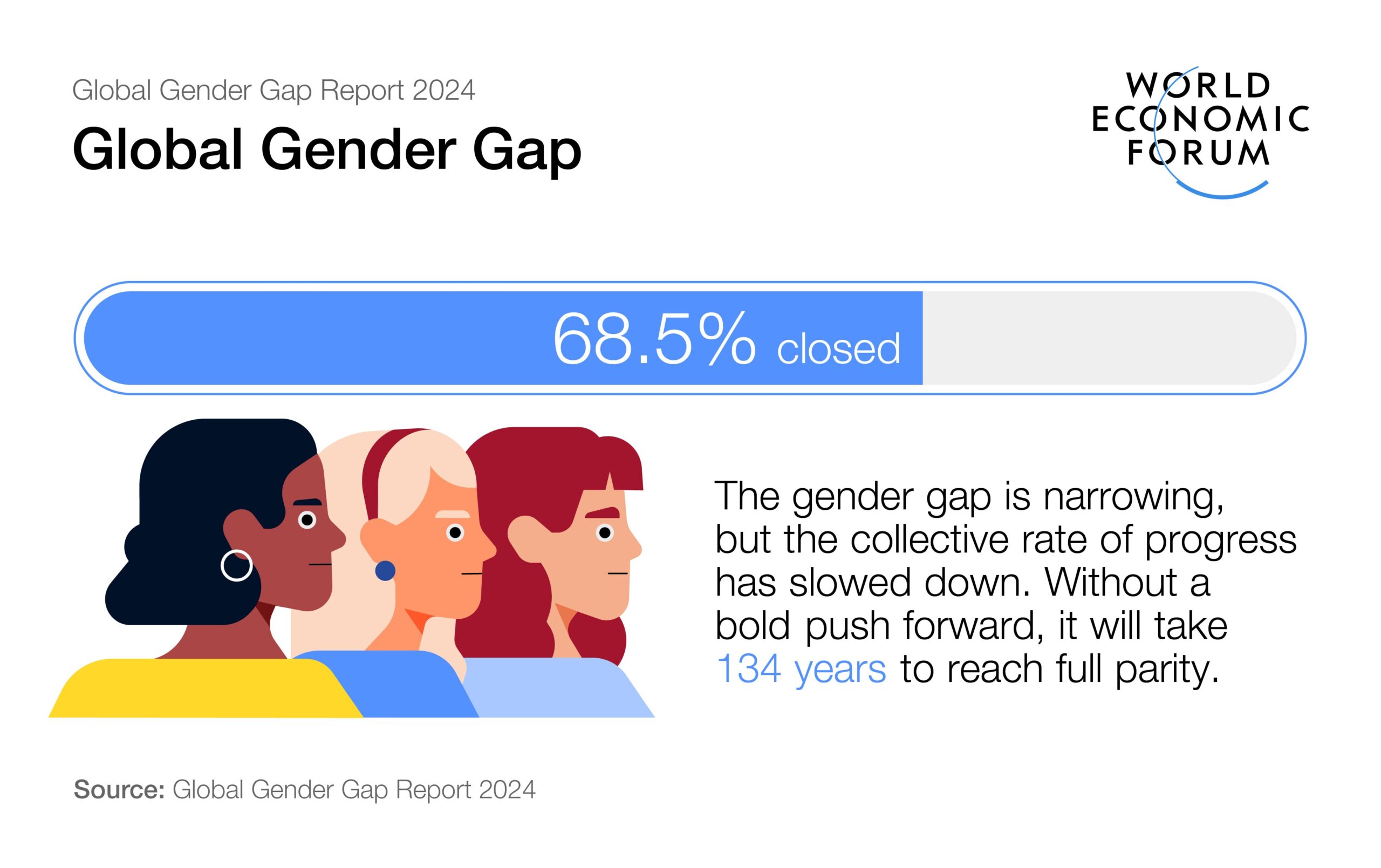
The gender gap isn’t a chasm we’re currently bridging—it’s a fissure in the planet itself, a crack that divides our timelines like tectonic plates shifting beneath the human experiment. Picture this: a woman, your great-great-great-great-great-granddaughter, stepping into the boardroom of a company still unnaturally dominated by men, only to find the retirement announcement of her maternal grandmother, my great-great-great-great-grandmother, still etched in old ledgers, her accomplishments relegated to footnotes. She looks at the corporate timeline inscribed on the wall—a grand spiral of power, legacy, and profit—and realizes: *the future didn’t just forget her forebears’ names. It erased them entirely.* So begins the question: **When will we finally close the gap not with laws or speeches, but with a collective exhalation?** When generations rise together not to tolerate half a world, but to rewrite its parameters entirely.
—
The Myth of Linear Progress
We’ve been told that progress unfurls in orderly lines, like a stitch-by-stitch quilt meant to cover time. It’s a narrative as comforting as it is delusional. Here’s the truth: gender parity isn’t a straight highway; it’s a wilderness untamed by metrics. Every woman who sits at a table designed for men by their fathers, uncles, and grandfathers is doing so only because she broke a chair first—then a window, then something that was supposed to be impossible. The chasm isn’t closing slowly; it’s expanding laterally, like paint bleeding through canvas under a magnifying glass. The gap itself is a living organism, morphing its shape to suit the conditions: it narrows when the economy rewards female-led industries but widens when political will dissolves into political theater.
The Gap Is Not Monolithic—It’s a Multitude
The gender gap is a fractal of inequities, each iteration bleeding into the next until the whole ecosystem resembles a fungal colony growing inside the infrastructure of power. It isn’t a single, neatly demarcated struggle—it’s the experience of intersectional albedo, where multiple identities reflect, refract, and multiply the light of systemic marginalization. A Black female CEO in Silicon Valley faces different kindling—racial bias, a “boys’ club” that doesn’t quite trust her competence, but doesn’t *see* her either—compared to a white corporate climber in Europe who only has to navigate the subtlety of being “just one of the boys, kind of.” The gap varies by geography, culture, and time, shifting like terrain through a wormhole. The idea that parity is a monolithic “gap” to fill ignores that some women get to stand on stilts to reach parity while others are still trying to find a chair that fits.
—
Institutional Time Is Not Human Time
Herein lies the paradox: gender equity is tied to the biological, sociological, and *institutional* clock. You’d think that a century of feminist milestones—suffrage, workplace reforms, #MeToo—might yield something tangible by now. But institutions move slower than moss. Universities still train men for leadership roles that haven’t really changed since the 1700s, corporate pipelines are designed like medieval feudal layers with no exit strategies, and even “progressive” policies are grafted onto old architecture with duct tape. Meanwhile, women’s lives are measured in a nonlinear calendar: they juggle careers that never stop, reproductive timelines, elder care, and the existential dread of one day reaching the 9-5 sunset only to face an encore shift in the quiet corners of the home.
The Gap Is a Memory Problem
History, it’s been said, is written by the conquerors. And when conquerors are male, their memory bank is vast, indelible—their mistakes are memorialized in statues and curricula while women’s brilliance is catalogued under synonyms for “secretary” or “advisor.” We’ve replaced the phrase “the woman in the background” with “the silent minority,” but the narrative remains rooted in an old imperative: prioritize memory, not legacy. The gap is not just about wages or representation, but about *cultural osmosis*. If the stories of the past are imprinted into our psyches like early childhood trauma, then the future will carry that weight until we consciously rewrite every lineage. When will we stop apologizing for our mothers’ names, our grandmothers’ unpaid labor, the grandfathers who couldn’t see them because they were never truly seen?
—
The Gap Is a Time Warp—But Not an Ally
Progress isn’t a train racing toward a finish line—it’s a paradox: each step forward pushes boundaries backward to test the integrity of the ground beneath. The gap is a vortex of cause and effect, a temporal quagire where gender politics becomes a feedback loop with no clear resolution. When a study shows women in leadership increases profits, only for misogyny to rear its head and declare that maybe it’s time to *stop promoting women*—then the gap becomes a metaphor for the absurdity of asking humans to outrun their own biases. Institutions pretend to evolve until they’re forced to acknowledge that the structures are rotten from the inside, like termites feasting on the foundation of “equal opportunity.”
Closing the Gap Is Not an Event—It’s a Gesture
Closing the gap won’t happen with one policy or proclamation—it will happen through a thousand defiant gestures: mothers who insist their daughters be included in boardroom discussions, daughters who teach their fathers how to care, employees who call out gendered double standards in the workplace and get away with it. It’ll happen when we understand that true gender equity isn’t a finish line; it’s a continuum of corrections, a series of reprints to the human operating manual. And when it does, it won’t be a seamless erasure of all inequity but a *new text*, one that acknowledges the past while refusing to let it dictate the future.
The Gap’s True Endgame: A Generational Reckoning
So here’s the reckoning no one’s willing to face yet: by the time we reach our great-great-great-great-great-granddaughter’s retirement, parity won’t be a destination—it will be a baseline. And when she looks back, she won’t be seeking proof that her predecessors were treated “equally” for a century; she’ll be studying the gaps in their gaps, the narratives that kept them from writing their own stories. The change won’t be a single moment of triumph; it’ll be the accumulation of a thousand “however gotchas” whispered by women everywhere: “I did it not in spite of them, but because I knew all of this was happening behind me.”
The gap will close not when the laws catch up to the people, but when people cease to be beholden to the rules that were written by those who needed them to be broken. And that’s one debt humanity finally chooses to pay in full.