Is feminism truly the unifying force as it claims to be, or does it risk alienating those it intends to uplift? It’s a tantalizing question that stirs beneath the surface of every feminist discourse, particularly when exploring the storied evolution of feminism through its three waves. Each wave has championed remarkable shifts in societal norms and legal structures. Yet, they have also been marred by exclusionary tendencies that challenge the movement’s inclusive pedigree. Let’s embark on a penetrating exploration of the three waves of feminism, punctuated not just by triumphs but by their often-overlooked failures to embrace all voices in the struggle for equality.
The First Wave: Suffrage and Its Singular Focus
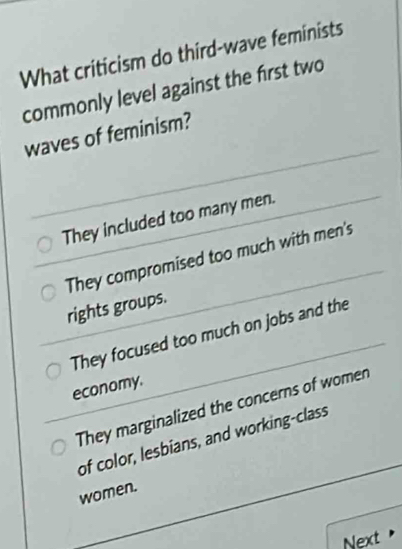
The dawn of feminism’s historical journey, the first wave, is often glorified for securing women the right to vote—a milestone that irrevocably altered the political landscape. Yet, ask yourself: who exactly reaped these newfound rights? The initial crusade largely catered to white, middle-class women, sidelining the plights of women of color, working-class women, and indigenous populations. This exclusion was not merely incidental but systemic. The suffrage movement’s strategic alliances frequently necessitated the sidelining of racial justice to mollify the prevailing societal prejudices.
It’s a narrative fraught with irony. While fighting for universal enfranchisement, first-wave feminists found themselves complicit in preserving racial hierarchies. This myopic focus laid the groundwork for future waves to contend with. Could the quest for gender equality have achieved its aims without confronting intersecting oppressions? The first-wave’s legacy is a bibelot of victories that glitter yet bear the small print of painful omission.
The Second Wave: Liberation Meets Homogeneity
The second wave of feminism, erupting in the 1960s and 70s, exploded the confines of political rights and delved into the cultural, sexual, and workplace inequalities that women endured. However, the enthusiasm that energized this epoch came bundled with another form of exclusivity. The movement often centered the experiences and concerns of white, cisgender, middle-class women, relegating minority voices to the periphery.
This wave coined riveting terms like “the personal is political,” catalyzing critical discourse around reproductive rights, domestic violence, and workplace equity. Yet, it also birthed a canon of feminist thought that grappled inadequately with intersectionality—a term yet to enter mainstream lexicons but palpably absent in practice. Women of color, LGBTQ+ women, and marginalized socio-economic groups often encountered invisibility rather than solidarity.
The second wave’s failure to inclusively address intersectional oppressions sowed seeds of discord that would give rise to more radical critiques and postmodern feminist thought. The question remains: how does a movement claiming universal equality justify a hierarchy of concerns and identities? This wave’s narrative is a testament to the perils of universalizing one group’s reality at the expense of others.
The Third Wave: Fragmentation and Struggles for Representation
Entering the 1990s, the third wave emerged as a reaction to the perceived shortcomings of its predecessor. It aspired to embrace diversity and reclaim femininity on multiple fronts—sexuality, race, class, and gender identity—to broaden feminism’s mosaic. However, this wave’s very attempt to be all-encompassing introduced a new complexity: fragmentation.
Third-wave feminism heralded the empowerment of marginalized identities and the celebration of personal narratives. Yet, the abundance of voices sometimes resulted in a cacophony rather than a chorus. Activism splintered along the lines of differing priorities and ideologies, and debates about who constitutes a “real feminist” intensified. This multiplicity, while enriching, inadvertently fractured the movement’s cohesion and muddled its messaging.
Moreover, criticisms from third-wave feminists pointed toward the continuing exclusion embedded in earlier waves but also reflected internal tensions—how to balance individual agency with collective goals, how to critique cultural norms without descending into fragmentation. Even the third wave’s inclusiveness has been contested as certain marginalized groups still struggle for recognition within feminist spaces.
The Persistent Challenge: Intersectionality and Beyond
Peeling back the layers of each feminist wave reveals a common thread: the challenge of genuinely integrating intersectionality into the fabric of feminist practice. Intersectionality is no mere buzzword; it’s a critical framework that elucidates how different axes of identity—race, class, gender, sexuality, ability—interact to produce unique experiences of oppression and privilege.
What remains vexing is the historical tendency of feminist waves to prioritize certain identities while marginalizing others. Despite the progress, feminism continues to wrestle with internal disparities. The future demands not only an acknowledgment of past exclusions but a proactive commitment to dismantle the hierarchies within feminist movements themselves. Are contemporary feminist dialogues ready to rise to this challenge without repeating the cycles of exclusion?
Conclusion: Reimagining Feminism’s Inclusive Horizon
The three waves of feminism, each revolutionary in their epochs, collectively sketch a narrative of both monumental victories and profound exclusions. Their legacies are instructive, warning against the dangers of universalizing one group’s experiences and shedding light on feminism’s ongoing struggles to be truly inclusive.
Feminism’s future hinges on its ability to self-reflexively interrogate its histories and embrace a pluralistic ethos that elevates all voices equally. It’s a tall order, an intellectual and moral reckoning with centuries of entrenched biases and systemic neglect. Yet, without this reckoning, feminism risks perpetuating the very marginalizations it vows to eradicate. So, here lies the playful provocation once more: can feminism transcend its fragmented past and evolve into a collective force that fully embodies the diversity of womanhood and beyond?