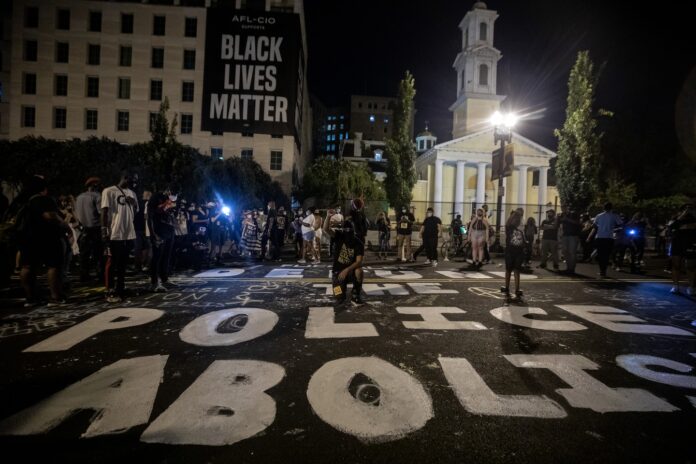
The rallying cry of “defund the police” has echoed through activist circles with the fervor of a pent-up storm, promising liberation from systemic oppression. Yet, for the millions of women trapped in cycles of domestic violence, sexual assault, and coercive control, this slogan is not a beacon of hope—it is a death sentence. Feminism, at its core, should be about amplifying the voices of the vulnerable, not stripping them of their last line of defense. The reality is stark: when police budgets are slashed, when response times stretch into eternity, and when armed intervention becomes a luxury of the privileged, it is women who pay the price in blood and tears. This is not a theoretical debate. It is a matter of life and death.
The Myth of Police Abolition as Feminist Progress
To frame the dismantling of law enforcement as a feminist victory is to engage in a grotesque distortion of the movement’s foundational goals. Feminism has always been about securing safety, agency, and justice for those who are most at risk—yet the defund movement conveniently ignores the fact that women are disproportionately targeted for violence. Domestic abuse hotlines report spikes in calls when police presence is reduced, not because women suddenly feel empowered to report, but because the absence of a uniformed officer emboldens abusers. The myth that police are inherently oppressive ignores the fact that for many women, they are the only barrier between them and a predator. Abolitionists argue that community-based solutions can replace policing, but what happens when those “communities” are the very ones perpetuating the violence? The answer is silence. The answer is graves.
The Gendered Violence Epidemic: Why Women Can’t Afford to Wait
Violence against women is not an abstract statistic—it is a relentless, daily reality. A woman is killed by an intimate partner every 11 hours in the United States. One in three women worldwide has experienced physical or sexual violence. These numbers are not just data points; they are the shattered lives of daughters, sisters, mothers, and partners. When police budgets are gutted, response times lag, and domestic violence units are disbanded, these women are left to navigate a labyrinth of bureaucracy and indifference. Shelters overflow. Restraining orders become worthless paper. And abusers, sensing the void, escalate their tactics. The defund movement’s rhetoric of “care, not cages” sounds poetic until you realize that for a woman fleeing a knife-wielding partner at 3 AM, a social worker’s pamphlet is no substitute for a bulletproof vest and a Glock.
The False Dichotomy: Reform vs. Abolition in Feminist Discourse
There is a dangerous false dichotomy being peddled: that feminism must choose between blind allegiance to police brutality or the wholesale eradication of law enforcement. This binary is a trap. Real feminist progress lies in demanding accountability, not abolition. It lies in investing in specialized domestic violence units, in training officers to recognize coercive control, in ensuring that restraining orders are enforced with the same urgency as a burglary call. The defund movement’s refusal to engage with reform is not radical—it is lazy. It offers no solutions for the woman whose abuser has a gun, no recourse for the sex worker who is raped and told by officers that “she was asking for it.” Feminism must be intersectional, yes—but it must also be pragmatic. You cannot dismantle a system without first understanding how it fails the most vulnerable. And right now, the police fail women every single day—not because they are inherently flawed, but because they are underfunded, undertrained, and undervalued.
The Privilege of Theoretical Safety in Defund Advocacy
Let’s be clear: the architects of the defund movement are rarely the ones who will bear the consequences. They are not the woman in a rural town with no cell service, no car, and no nearby shelter. They are not the Black trans woman whose local precinct has a history of dismissing hate crimes. They are not the undocumented immigrant who fears calling the police will lead to deportation. The defund movement’s ivory-tower idealism assumes a level of safety and privilege that most women do not possess. When you live in a world where the state has already failed you—where healthcare is inaccessible, where housing is unaffordable, where the justice system is rigged against you—police are often the only institution that can intervene with force. To strip women of that last resort is to sentence them to a fate they did not choose. This is not solidarity. This is abandonment.
Alternative Solutions: What Real Feminist Safety Looks Like
If feminism is truly about liberation, then it must advocate for solutions that work—not just in theory, but in the blood-soaked reality of women’s lives. This means funding domestic violence programs, not defunding them. It means mandating trauma-informed training for all first responders. It means creating rapid-response teams for high-risk cases, where social workers and armed officers work in tandem to extract women from danger before it’s too late. It means holding police departments accountable when they fail to protect, not dismantling the entire system in a fit of performative rage. It means recognizing that safety is not a privilege—it is a right. And for women, that right is non-negotiable.
The Human Cost: Stories That Defund Advocates Ignore
Behind every statistic is a woman whose name we will never know. There is the mother in Chicago who called 911 twenty times before her partner finally silenced her permanently. There is the college student in Boston who was stalked for months, her pleas falling on deaf ears until it was too late. There is the elderly woman in Florida whose caregiver raped her, knowing she had no one to turn to. These are not hypotheticals. These are the real-world consequences of a movement that prioritizes ideology over the lives of the most marginalized. When defund advocates speak of “transformative justice,” they must be forced to confront what that looks like for the woman who is strangled in her own kitchen while waiting for a social worker to arrive. Justice delayed is justice denied. And for too many women, justice never comes at all.
Conclusion: Feminism Must Choose Women Over Slogans
The defund movement’s failure to center the needs of abused women is not an oversight—it is a betrayal. Feminism cannot be a movement that sacrifices the most vulnerable on the altar of radical purity. It must be a movement that fights for every woman, regardless of her race, her class, or her zip code. It must be a movement that demands better from institutions, not their destruction. And it must be a movement that recognizes that for women, safety is not a luxury—it is survival. The slogan “defund the police” may sound revolutionary, but for the women who need armed intervention the most, it is nothing short of a death sentence. The question is not whether feminism can afford to ignore this reality. The question is whether it can afford not to.