

















From a feminism perspective, the medium of comics has evolved from entertainment into an influential site of cultural commentary. Once perceived as peripheral to serious political discourse, comics are now widely recognized as a powerful narrative form capable of articulating complex social realities. Women creators, in particular, have embraced comics as a vehicle for exploring intersectional feminism—an analytical framework that examines how gender intersects with race, class, sexuality, disability, culture, and migration status.
Through visual storytelling, women are translating theoretical language into accessible, emotionally resonant narratives. In doing so, they are not only expanding the boundaries of feminist expression but also democratizing political education.
Comics as a Hybrid Language of Thought and Feeling
Comics operate at the intersection of text and image, allowing creators to communicate both intellectual argument and emotional experience simultaneously. This dual capacity makes the medium especially suited to intersectional storytelling, where layered identities cannot be reduced to singular explanations.
A single panel can juxtapose internal monologue with external reality, exposing contradictions between how women are perceived and how they experience themselves. Facial expressions, body language, and symbolic imagery often convey what words alone cannot articulate. Silence, too, becomes communicative—empty spaces, fragmented layouts, and disrupted sequences mirror experiences of marginalization and exclusion.
For women navigating multiple systems of inequality, this visual grammar offers a way to represent complexity without flattening nuance.
Translating Theory into Everyday Experience
Intersectional feminism originated in academic and legal scholarship, yet its most urgent implications unfold in ordinary life. Comics bridge this gap by situating abstract concepts within relatable contexts: workplace interactions, family expectations, public harassment, immigration encounters, and healthcare systems.
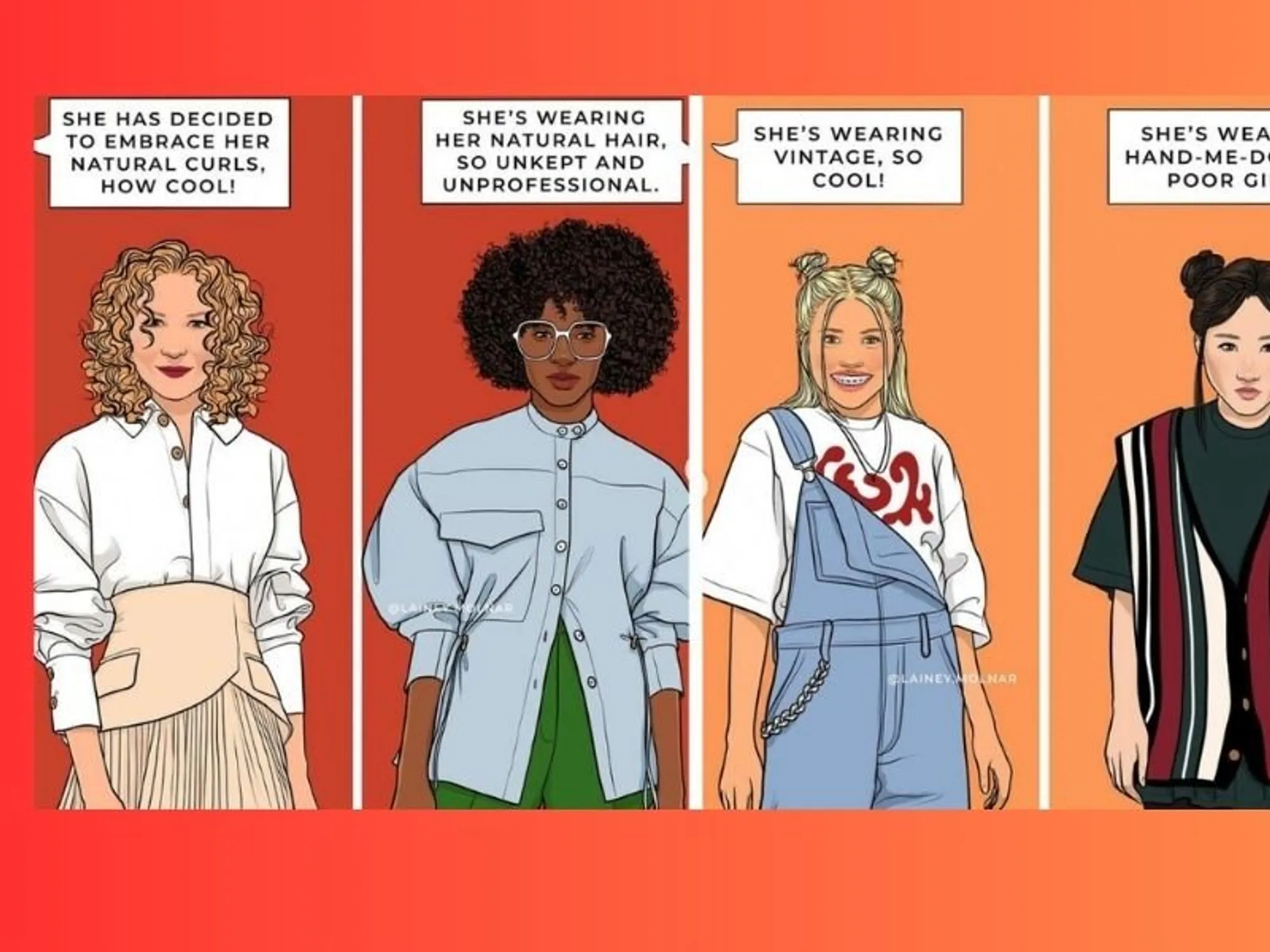
Rather than presenting theoretical definitions, women cartoonists often depict moments of accumulation—microaggressions layered upon structural barriers. A character may experience racial stereotyping at work, gendered expectations at home, and economic precarity in public services, all within the span of a few pages. The reader witnesses not isolated incidents, but interlocking pressures.
This narrative strategy fosters comprehension through recognition. Readers do not merely understand intersectionality; they observe it in motion.
Accessibility as Political Strategy
One of the most significant contributions of feminist comics is their accessibility. Academic discourse, while essential, is not always available to broad audiences due to linguistic, educational, or cultural barriers. Comics circumvent these limitations by communicating through visual narrative, humor, and familiar social situations.
This accessibility is not accidental. Many women creators explicitly frame their work as educational, aiming to reach readers who may not engage with scholarly texts or policy debates. The format encourages sharing across social media, classrooms, and community spaces, amplifying reach beyond traditional publishing channels.
From a feminist standpoint, accessibility is not a stylistic preference; it is a political commitment to inclusivity in knowledge production.
Humor as Resistance and Survival
Humor occupies a central role in many intersectional feminist comics. Satire, irony, and absurdity are used not to trivialize injustice, but to expose its contradictions. Humor allows creators to critique oppressive systems while preserving emotional resilience.
Laughing at oppressive dynamics can function as a form of psychological defiance. It reframes victimhood into agency, transforming pain into narrative control. For women whose experiences are often minimized or dismissed, humor becomes a rhetorical tool that demands attention without surrendering dignity.
This balance between levity and gravity is particularly effective in comics, where visual exaggeration and timing intensify comedic impact while sustaining critical intent.
Visualizing the Unseen and the Internalized
Intersectional oppression is not always overt. It is frequently embedded in institutional routines, social etiquette, and internalized self-perception. Comics excel at making these invisible mechanisms visible.
Through metaphorical imagery—characters shrinking in crowded spaces, speech bubbles crowding out personal thoughts, or shadows representing internalized fear—artists externalize psychological states shaped by social conditions. Such visual metaphors translate emotional labor into concrete form.
This visualization fosters empathy. Readers are not simply told that certain experiences are exhausting or alienating; they are shown the cumulative weight of navigating multiple social expectations simultaneously.
Challenging Dominant Cultural Narratives
Mainstream media has historically privileged singular narratives of womanhood, often centered on white, middle-class, heterosexual experiences. Feminist comics disrupt this homogeneity by presenting plural realities that resist universalization.
Women of color, queer women, disabled women, and migrant women use comics to narrate stories that are frequently absent from commercial publishing. These narratives do not seek validation through assimilation. Instead, they assert cultural specificity as essential to feminist analysis.
By foregrounding difference rather than smoothing it into generalized themes, these comics challenge the assumption that solidarity requires sameness. They propose instead that coalition is built through recognition of distinct, interconnected struggles.
Community, Collaboration, and Digital Platforms
The rise of digital publishing has transformed how feminist comics circulate. Online platforms enable creators to bypass traditional gatekeepers, fostering decentralized networks of production and distribution. Social media, webcomics, and independent zines have become crucial sites of feminist cultural exchange.
These spaces encourage dialogue between creators and audiences, blurring the boundaries between artist, activist, and educator. Feedback loops allow stories to evolve in response to community engagement, reinforcing the relational nature of feminist praxis.
Collaboration is also common. Anthologies featuring multiple artists highlight the diversity of intersectional experiences while emphasizing collective voice over individual authorship. This communal orientation aligns with feminist values of shared authority and mutual amplification.
Institutional Recognition and Ongoing Barriers
Despite growing recognition of comics as legitimate cultural commentary, women creators continue to face barriers in funding, distribution, and critical reception. Intersectional feminist work, in particular, is often categorized as niche, limiting access to mainstream platforms.
However, increased inclusion of graphic narratives in academic curricula, museums, and literary festivals indicates shifting perceptions. Comics are no longer confined to entertainment categories; they are increasingly acknowledged as sociopolitical texts.
Yet recognition must extend beyond symbolic inclusion. Sustainable support for women creators requires structural investment, equitable publishing practices, and representation in decision-making spaces.
Feminism Perspective: Why the Medium Matters
From a feminism perspective, the use of comics to articulate intersectional realities reflects a strategic expansion of political language. Feminist movements have always relied on storytelling, but visual narrative adds a dimension of immediacy and affect that complements traditional advocacy.
Comics do not replace policy analysis or activism. They supplement them by cultivating public consciousness, shaping cultural attitudes, and validating lived experience. They invite readers into complex conversations through accessible entry points, lowering the threshold for engagement.
In this way, comics function as both art and intervention.
Conclusion: Drawing New Pathways for Feminist Expression
Women’s use of comics to explore intersectional feminism represents a significant evolution in how social justice narratives are communicated. By blending visual artistry with political insight, creators transform personal experience into collective knowledge.
These stories do more than document inequality. They reimagine who gets to speak, how they speak, and whose realities are deemed worthy of cultural attention. They affirm that feminist discourse does not belong solely to academic institutions or policy arenas, but also to sketchbooks, digital panels, and shared screens.
In a media landscape saturated with fleeting content, intersectional feminist comics offer sustained reflection through accessible form. They remind audiences that complexity can be rendered with clarity, and that resistance can be drawn, one deliberate line at a time.