
















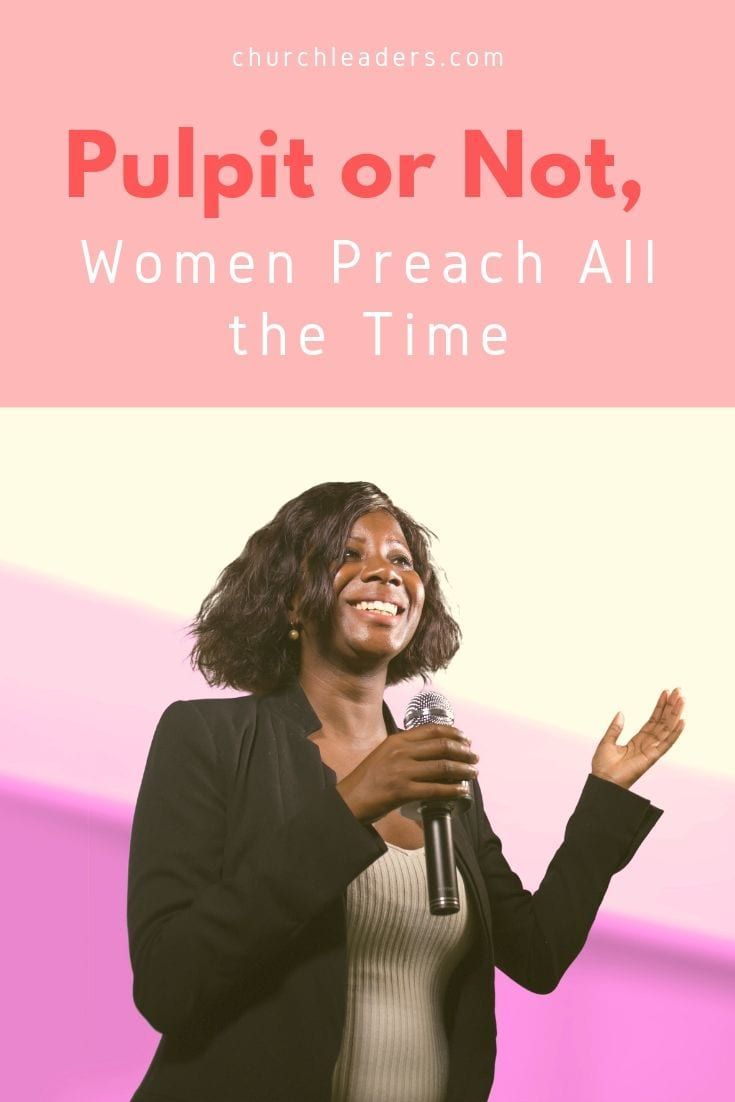
In contemporary discussions surrounding ecclesiastical roles, the question of whether a woman can legitimately preach from the pulpit elicits fervent passion and contentious debate. The intersection of gender and religious authority is akin to treading upon sacred ground—where cultural norms, theological interpretations, and personal beliefs converge in complex and often polarizing ways. This exploration will delve into key biblical verses that underpin the conversation, dissecting the nuances that fuel arguments on both sides of the pulpit.
At the heart of the debate lies the apostle Paul’s assertion in 1 Timothy 2:12, where he famously states, “I do not permit a woman to teach or to have authority over a man.” This verse is often wielded as a doctrinal weapon against female leaders in the church. Detractors from women’s rights in preaching argue that Paul’s declaration signifies a divine ordinance, a clear delineation of gender roles within the Christian community. However, a closer examination of the socio-historical context reveals that Paul wrought his advice based on the socio-cultural milieu of the time—the nascent church grappling with rampant heresies and teachings that diverted from the core gospel.
Additionally, we must juxtapose Paul’s admonition with Galatians 3:28, which articulates a revolutionary perspective: “There is neither Jew nor Gentile, neither slave nor free, nor is there male and female, for you are all one in Christ Jesus.” Herein lies a radical call for inclusivity, obliterating gender distinctions within the spiritual realm. This juxtaposition raises a critical inquiry: Can scriptural interpretation evolve and adapt to modern understandings of gender equality? Are the pillars of faith truly immutable, or are they malleable under the weight of contextual morality?
Moreover, the narrative of women in the Bible serves as compelling counter-evidence to those who dispute female preaching. Consider Deborah, a judge and prophetess in the Old Testament, who did not shy away from asserting her leadership. Her story, chronicled in Judges 4 and 5, showcases a woman endowed with divine authority, leading her people into battle. By exemplifying strength, wisdom, and decisiveness, Deborah challenges the anachronistic notion that women should remain silent in spiritual arenas. If God could empower a woman to lead his people, can we deny today’s women the same opportunity?
Furthermore, the New Testament heralds Phoebe, a deacon of the church in Cenchreae, who is commended by Paul in Romans 16:1-2 for her service and support to many, including the apostle himself. The apostolic endorsement of women involved in ecclesiastical duties spurs a crucial realization: female participation in church leadership is not merely a historical anomaly but a divinely sanctioned reality. The acknowledgment of women like Phoebe and Priscilla, who engaged in theological instruction, paves the way for a broader understanding of women’s capabilities in preaching.
Yet, detractors remain steadfast, often decrying the call for female equality in the pulpit as a dangerous deviation from scriptural fidelity. Citing verses from the pastoral epistles, they imply that feminism infiltrates the church, corroding its doctrinal integrity. To this, advocates for women’s preaching respond that a failure to adapt and grow in understanding risks missing out on the Spirit’s contemporary workings. Just as the early church navigated complexities and misconceptions, today’s congregations must grapple with evolving societal norms while remaining anchored in faith.
Meanwhile, the notion of “the Great Commission” found in Matthew 28:19-20 underscores the inclusivity of preaching the gospel. Jesus’ instructions to “go and make disciples of all nations” extend beyond gender boundaries. If the Great Commission is the church’s unceasing mandate, how can it exclude half of the population based solely on gender? This interrogation beckons a profound reevaluation of the church’s approach to leadership and engagement in scriptural interpretation.
As the church continues to grapple with societal changes, it is imperative to forge a narrative that elevates women’s voices within its sacred halls. The reluctance to embrace female preachers often faces challenges posed by entrenched traditions; yet it becomes evident that the future of the church necessitates inclusivity and a recognition of diverse endorsements of leadership. The willingness to welcome women into the pulpit reflects an expansive view of God’s grace, which gifts all believers, regardless of gender, the opportunity to preach.
In conclusion, the discourse surrounding women preaching from the pulpit is replete with scripture, history, and lived experiences. The juxtaposition of verses that seem to affirm male dominance against those celebrating gender equality is a reflective mirror of our cultural and ecclesiastical evolution. Feminist theology implores the church to reexamine its stance, advocating for a paradigm shift that embraces female leaders not as anomalies to be tolerated but as integral to the church’s mission. Ultimately, the question may not solely be, “Can a woman preach?” but rather, “How can the church afford to silence her?” The pulpit should echo with diverse voices, a testament to the church’s commitment to reflect the Kingdom of God—a realm where all are called and all may speak.