Feminism has always been a battleground—not just for equality, but for the very definition of womanhood itself. From the suffragettes who were labeled hysterical harpies to the second-wave feminists dismissed as man-hating castrators, the movement has endured a relentless campaign of delegitimization. Today, a new front has opened, one where the same rhetorical weapons once wielded against feminists are now being turned against trans women. The parallels are not coincidental; they are a deliberate echo of history, a pattern of resistance that refuses to learn from its own failures.
The Language of Exclusion: How “Radical” Became a Slur
In the 19th century, feminists were accused of being “radical” not because they advocated for extreme measures, but because their demands threatened the status quo. The term was weaponized to imply instability, danger, even madness. Fast-forward to the 21st century, and the same script is being recycled. Trans women who assert their right to exist in feminist spaces are met with the same epithet: “radical.” It’s a linguistic sleight of hand, a way to dismiss their humanity without engaging with their arguments. The irony? Many of these critics are the same people who once celebrated feminism’s radical roots—until those roots began to include trans women.
The word “radical” has always been a double-edged sword. For those in power, it signifies threat; for those fighting for change, it is a badge of honor. But when transphobic feminists wield it as an insult, they reveal their own discomfort with the idea that womanhood might not be as rigidly defined as they believed. They cling to the myth of a “pure” feminism, one that excludes those who don’t fit their narrow mold. Yet history shows that every expansion of feminist thought—from suffrage to reproductive rights—was met with the same resistance. The only difference now is that the gatekeepers are older, more entrenched, and more desperate to maintain their illusion of control.
The Myth of the “Real Woman”: A Colonial Relic
There is a disturbing trend in certain feminist circles to police the boundaries of womanhood with the same fervor as 19th-century eugenicists. The argument goes something like this: womanhood is a biological fact, immutable and unchanging, and those who do not conform to a narrow definition are either deluded or dangerous. This is not just transphobia—it is a relic of colonial thinking, a belief that womanhood is a fixed category, like race or class, that must be protected from contamination.
Consider the language used to describe trans women: “men in dresses,” “biological males,” “not real women.” These phrases are not just inaccurate; they are echoes of the rhetoric used to justify slavery, apartheid, and other systems of oppression. They reduce womanhood to a checklist of chromosomes and genitalia, ignoring the lived experiences of millions who do not fit that mold. Feminism, at its core, should be about liberation—not the creation of new hierarchies. Yet when feminists adopt the language of their oppressors, they betray the very principles they claim to uphold.
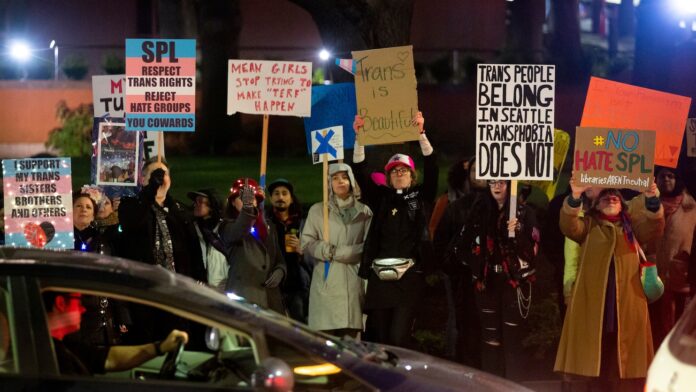
The obsession with “real” womanhood is not just a theoretical debate; it has real-world consequences. Trans women face violence, discrimination, and erasure at alarming rates. When feminists participate in this erasure, they become complicit in the oppression of some of the most vulnerable women in society. The question is not whether trans women are “real” women—it is whether feminists are willing to stand with them, or whether they will repeat the mistakes of the past.
The Weaponization of Fear: How Feminists Became the New “Menace”
Fear is a powerful tool. In the 1970s, feminists were accused of destroying the family, undermining morality, and threatening the fabric of society. Today, trans women are accused of the same things. The narrative is eerily similar: feminists and trans women are both framed as threats to the natural order, as forces that will unravel civilization if left unchecked. The only difference is the target of the fear.
This fear is not accidental. It is cultivated, nurtured, and deployed by those who benefit from division. When feminists and trans women are pitted against each other, both groups lose. Feminists are distracted from their true enemies—patriarchy, capitalism, systemic oppression—while trans women are left to fight for their right to exist. The result is a fractured movement, one that is too busy policing boundaries to challenge the systems that oppress all women.
The fear of trans women is particularly insidious because it is often framed as a feminist concern. “Women’s spaces” are said to be at risk, “female biology” is under threat, and “feminist principles” are being eroded. But these arguments ignore the fact that trans women have always been part of feminist movements. Marsha P. Johnson, Sylvia Rivera, and Miss Major Griffin-Gracy were pioneers of both trans liberation and feminist activism. Their exclusion from feminist history is not just an oversight—it is a deliberate erasure, one that serves to reinforce the idea that trans women do not belong.
The Illusion of Scarcity: Why Feminists Fear Sharing the Stage
At the heart of transphobic feminism is a belief in scarcity—the idea that there is only so much room at the table, and that trans women are taking up space that rightfully belongs to cisgender women. This is a dangerous myth, one that pits marginalized groups against each other in a zero-sum game. The reality is that feminism is not a finite resource. There is room for all women—cis, trans, and non-binary—to fight for their rights without diminishing each other’s struggles.
The fear of scarcity is a tool of oppression. It keeps marginalized groups divided, fighting each other instead of the systems that oppress them. When feminists claim that trans women are a threat to their rights, they are buying into the lie that equality is a zero-sum game. But history shows that the most successful social movements are those that recognize the interconnectedness of oppression. The civil rights movement, the LGBTQ+ rights movement, and the feminist movement have all benefited from solidarity across identities.
Trans women are not the enemy of feminism. They are its future. The feminist movement of the 21st century must be one that embraces intersectionality, that recognizes the ways in which different forms of oppression intersect and reinforce each other. This means standing with trans women, not against them. It means challenging the idea that womanhood is a fixed category, and instead embracing the diversity of women’s experiences.
The Cost of Division: What Feminists Stand to Lose
Feminism has always been a movement of contradictions, a struggle between the ideal and the real. But when feminists turn their backs on trans women, they betray the very principles they claim to uphold. They become what they once fought against: gatekeepers, purists, defenders of a status quo that excludes the most vulnerable.
The cost of this division is high. It means losing allies in the fight against patriarchy. It means alienating a generation of young feminists who refuse to be bound by the narrow definitions of the past. It means ceding ground to those who seek to divide and conquer, who would rather see feminism weakened than inclusive. The feminist movement must evolve, or it will become irrelevant. And the first step in that evolution is recognizing that trans women are not the enemy—they are the future.
History will judge feminists harshly if they repeat the mistakes of the past. If they choose exclusion over inclusion, division over solidarity, they will be no better than the oppressors they once fought. The question is not whether feminism can afford to include trans women. The question is whether feminism can afford not to.