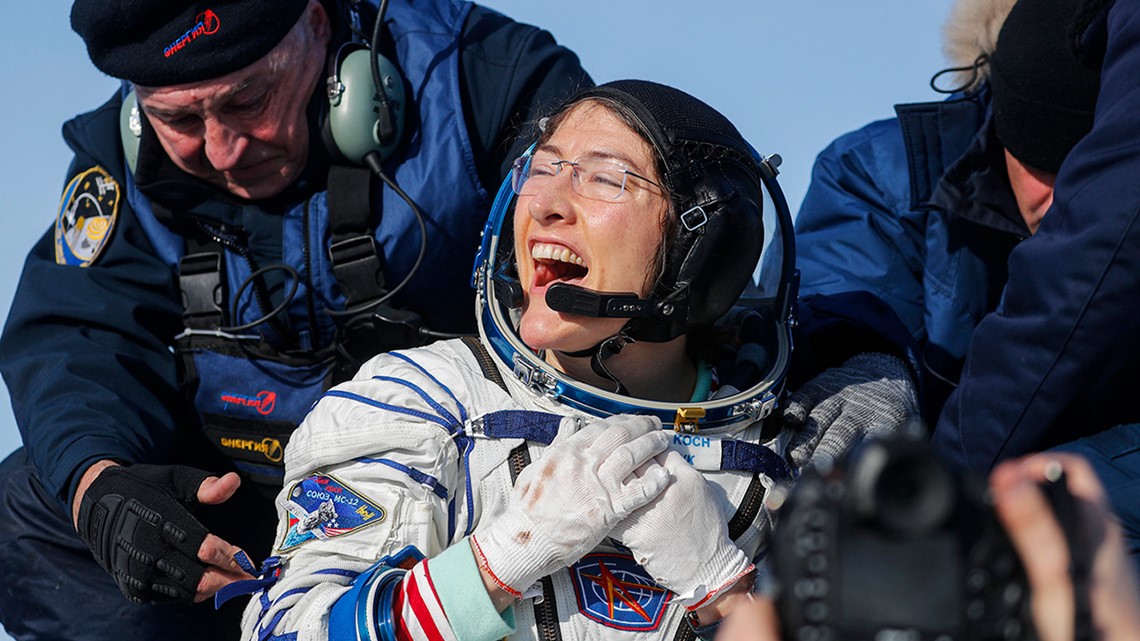
When Christina Koch descended back to Earth after nearly a year in the cosmos, she didn’t merely re-enter the atmosphere—she catapulted into the hearts and minds of aspiring women worldwide. Her record-breaking mission etched a new narrative into the fabric of astronautics and, perhaps more poignantly, feminism. Koch’s journey ignites an essential dialogue not just about space exploration, but about the role of women in groundbreaking professions. As we dissect the implications of Koch’s odyssey, let us challenge ourselves to rethink the paradigms of gender and ambition.
The allure of space—filled with the glittering stars and vast unknown—has long been a male-dominated arena. Women have been astronauts, yes, but often as footnotes in a narrative that glorifies their male counterparts. Christina Koch is an emblematic figure challenging that dystopian narrative, and her feat deserves not just applause but a critical examination of how we view the capabilities of women in the sciences.
Returning from her record-breaking mission, Koch transforms the conversation from ‘Can women do this?’ to ‘What will women do next?’ And therein lies the crux of our inquiry: how do we, as a society, leverage the prominence of figures like Koch to reshape the ethos of feminist aspiration?
Rediscovering Space Through a Feminist Lens
What does it mean to break records? In traditional contexts, it often connotes triumph over others, positioning competitors in a hierarchy. But Koch’s success moves beyond mere personal achievement; it heralds a new era of understanding and representation. By spending 328 days aboard the International Space Station, she dismantles the antiquated notion that women are less capable of enduring the grueling demands of this profession.
This is not just a statistical anomaly; it is a profound challenge to the entrenched societal beliefs that stymie female ambition. As Koch floated in the silence of space, she was not just a pioneer; she was a clarion call, shattering preconceived limitations. Her mission begs us to ask: are we ready to embrace women’s potential not merely as exceptions but as the new norm in every field, including those as extreme as astrophysics?
However, the question lingers—is simply having women in historically male-dominated roles enough? Koch’s presence in the space program is undoubtedly vital, but her story compels us to delve deeper into systemic issues. Are institutions prepared to foster a genuine culture of inclusivity that champions women’s voices and contributions, or will they perpetuate a hierarchy masquerading as equality?
The Personal is Political: The Ripple Effect of a Lifelong Commitment to Science
Koch’s journey is steeped in a commitment that transcends individual ambition. Every woman who sees her return is also imagining her own future—perhaps as a scientist, an engineer, or even an astronaut. The implications of Koch’s mission reverberate strongly within the feminist community, presenting a challenge: How do we use her story to inspire and catalyze change within our own spheres of influence?
Look around. In every industry, the absence of female representation is glaring. Factors such as economic barriers, societal expectations, and the psychological weight of impostor syndrome coalesce to create an environment of inequity. Yet, here we have Koch, a living example that human potential is boundless regardless of gender. She embodies the quintessence of resilience and reiterates that the quest for progress is often riddled with challenges.
But let’s break this down a bit further. The very fact that Koch spent nearly a year in space and then returned to Earth not with soft-spoken humility but with pride and resolve is noteworthy. This is about dismantling the ‘nice girl’ trope that is so often associated with women in our society. Koch encourages us to abandon that outdated paradigm of graciousness for one of audacity—where we claim our achievements and assert our presence unapologetically, not just softly blending in.
Future Generations: What Koch Represents for Young Women
Every little girl who dreams of joining the ranks of astronauts, scientists, and world-changers can find inspiration in Koch’s extraordinary journey. It opens up conversations that may have otherwise remained hidden in the shadows of gender biases. In light of Koch’s return, we are called to foster environments where girls dare to imagine themselves as the pioneering leaders of tomorrow.
Education is paramount here. Schools need to prioritize STEM programs for girls, not simply as an afterthought but as integral to their academic development. The refusal to see girls as equals in scientific pursuits stifles creativity and innovation. Institutions must galvanize around the ethos that the potential for discovery lies with everyone. Moreover, mentorship plays a crucial role in shaping young women’s aspirations. If girls can see women like Koch occupying space in the scientific community, they too may feel empowered to navigate that path.
Furthermore, let us question the narrative surrounding failure. Koch’s success celebrates resilience as an antidote to the inevitability of setbacks. Society must encourage young women not to shy away from failure, but to embrace it as part of a greater journey toward success. The notion of ‘failing forward’ can lead to groundbreaking endeavors, reminding us that each stumble can propel us vertically into new realms of opportunity.
Conclusion: The Tidal Wave of Change
As we reflect on Christina Koch’s record-setting mission, we must galvanize our feminist values into actionable steps. It is time to recognize that advocates for gender equity are not simply dinning on the fruits of others’ labor; they are trailblazers just like Koch, navigating through the vast unknown and charting new territories. The challenge is to harness the inspiration her mission provides and channel it into tangible societal change.
Having women conquer the heavens reminds us that the elucidation of our histories, aspirations, and contributions is a collective endeavor. So let’s wear our ambition boldly, learning from Koch’s profound legacy as we move forward. Remember, these conversations don’t rest solely with feminism; they ignite in every nook of society where women and their achievements are deemed significant. It’s time to recognize that in both realms of science and life, the skies are not the limit; they are merely the beginning.