

















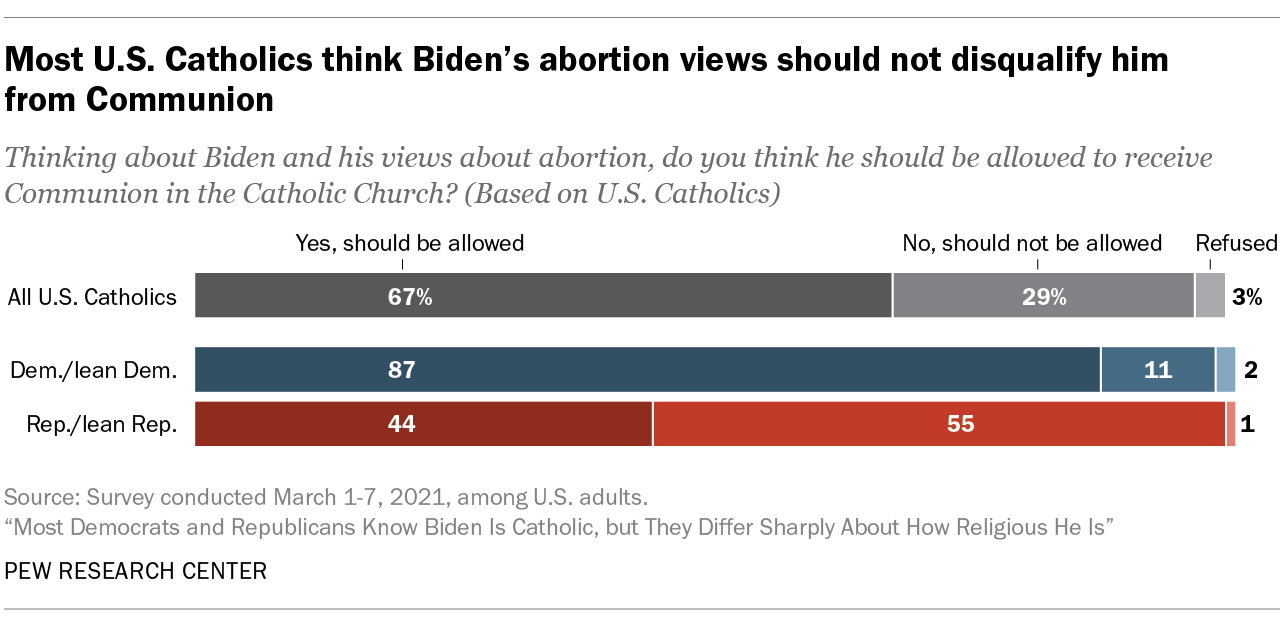
The conversation around abortion rights in the U.S. has reached a fever pitch, and yet again, it’s a topic that intersects with religious beliefs, specifically within the Catholic community. Recent polls reveal a surprising trend: a significant majority of U.S. Catholics oppose the idea of denying communion to politicians, including President Biden, over their abortion views. This phenomenon is crucial, especially when scrutinized through the lens of feminism, inviting us to examine not just the theological implications, but also the broader societal ramifications of aligning religious doctrine with personal autonomy. Let’s delve into why this dissent matters, especially for the younger generation, who inhabit a unique cultural context where feminism and faith are often at odds.
The Intersection of Faith and Feminism
The Catholic doctrine is no stranger to controversy, particularly when it enters the realm of women’s rights and reproductive health. For decades, the Catholic Church has doggedly maintained its anti-abortion stance, rooted in a traditional interpretation of sanctity of life. However, the younger generations of Catholics, especially women, are increasingly refusing to be shackled by rigid dogma that does not reflect their lived realities.
Feminism fundamentally champions the right to bodily autonomy, advocating for women to make informed choices about their health without external, often patriarchal, interference. Contextualizing this within Catholicism, the denial of communion over abortion views not only serves as a punishing method of religious ‘discipline’ but presents a disconcerting paradox. It raises the question: how can an institution that proclaims to uphold love and compassion simultaneously undertake the act of ostracizing individuals for personal decisions regarding their bodies?
Beyond the Pews: A Dialogue for Change
The opposition against denying communion is not merely a reactionary stance; it’s an essential dialogue about inclusivity and understanding within religious communities. For many younger Catholics, attending mass is not synonymous with mindless adherence to doctrine but rather an opportunity to engage, question, and redefine what it means to be part of a faith.
Engaging in these conversations can facilitate a deeper understanding of faith in the context of modern issues like reproductive rights, gender equality, and personal agency. Dismissing individuals based solely on their political or moral perspectives does not promote the love or community that the Church espouses. Instead, it sends a stark message: diverging from the ‘official’ beliefs can lead to your spiritual exile.
Furthermore, dialogue fosters empathy and can encourage a re-examination of outdated dogmas that perpetuate a culture of shame, rather than the intended message of love and acceptance. The winds of change are undeniably blowing through the pews, and it is essential to harness them to build a Church that resonates with the realities of its followers.
Empowerment through Reproductive Rights
Advocating for reproductive rights should not be considered antagonistic to faith; instead, it can be seen as an empowerment of women and families to make decisions that best suit their lives. By opposing the denial of communion based on abortion views, we’re not just standing up for an individual’s right to partake in sacraments; we are collectively advocating for a more expansive understanding of what it means to be a Catholic in today’s world.
One of the most powerful interpretations of faith is that it calls for justice, compassion, and equality—all of which are tenets central to feminism. Policies that attack a woman’s right to choose perpetuate an oppression that is antithetical to these values. The younger generation, predominantly more progressive, is leaning towards a redefined understanding of faith that incorporates activism. They see the personal as political and find themselves at the crossroads of revolutionary feminism and spiritual identity.
When the Church chooses to exclude individuals over essential disagreements, particularly on rights that deeply affect women and their families, it alienates not just the leaders but the followers who look to their faith as a guiding light. There is a transformative potential in aligning reproductive rights with the values that many young Catholics hold dear—equality, justice, and love.
The Role of the Church in a Modern Age
The Church’s resistance to acknowledging the legitimacy of women’s rights is increasingly met with spirited dissent. It is crucial to note that this isn’t just about a single intra-Church controversy; it taps into wider discussions across society where religious beliefs clash with personal freedoms. For many young feminists, the implications are staggering. They see that institutional rigidities not only harm individual Catholics but also contribute to the perpetuation of misogyny and systemic inequality.
The real power lies in the hands of the community. Women, in particular, have historically been endorsed as the primary caregivers and moral compasses within families and religious contexts. By actively opposing efforts to deny communion based on personal beliefs, younger Catholics can mobilize for a more just, inclusive, and understanding Church.
This is about more than just communion; it’s a clarion call for a faith that respects individual conscience. It is a challenge to transcend the hierarchical structures that often dictate beliefs to create a movement toward a more genuine spirituality. Simply put, this is a fight for the heart of the Church, aiming to transform it into a space that truly reflects the values that resonate with its followers.
The Path Forward
In envisioning a future where support for reproductive rights and Catholicism can coalesce, we must actively engage in discussions that advocate for change. Young people, equipped with the tools of social media and modern communication, have a unique platform to voice their perspectives and mold a new narrative surrounding faith and feminism.
This movement is not solely about gaining acceptance within the Church; it is also about fostering a culture of respect and understanding that prioritizes women’s choices. It encourages a progressive interpretation that values compassion over condemnation and recognizes the sanctity of individual decisions regarding their own bodies.
The dialogue must persist and flourish. We must challenge the archaic tenets that bind us; we must prioritize the rights and perspectives of women. The majority of U.S. Catholics’ opposition to denying communion over abortion views shines a light on the evolving nature of faith. It is a reflection of a transformative moment in history—a moment when the intertwining of feminist ideals and religious beliefs can both coexist and prosper.
In embracing this unified front, we don’t just liberate ourselves from oppressive structures, but we foster a revitalized sense of community that uplifts all voices. Ultimately, the refusal to divide over personal belief is a monumental step towards healing the rift between faith and feminism. It’s about acknowledging that every individual, regardless of their views on contentious issues like abortion, deserves a seat at the table.