

















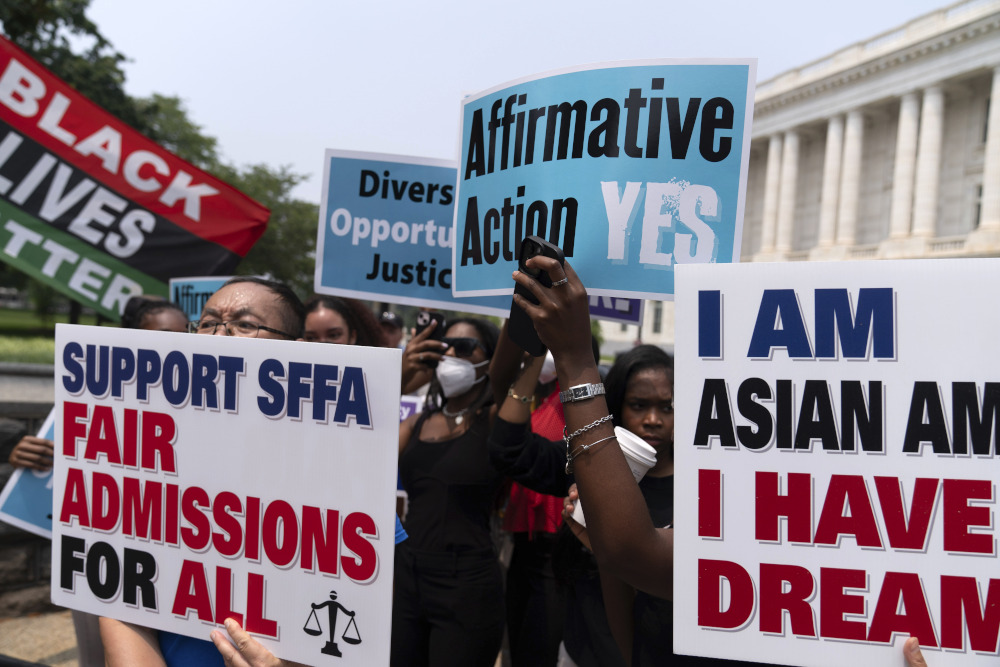
Republicans in Congress have embarked on a renewed assault on affirmative action, an issue that reverberates through the very heart of feminist discourse. By framing this legislative offensive within the entrenched ideological dichotomies of race and gender, they’ve sparked a contentious dialogue about equity, justice, and the moral fabric of American society. Affirmative action is not merely a policy; it is emblematic of our struggle for a society that genuinely values every individual’s potential. This article aims to dissect the implications of this renewed offensive on affirmative action from a feminist perspective, questioning whether the GOP’s approach truly embodies the core tenets of equality and fairness.
As they march forward, waving flags of purported meritocracy and colorblindness, it becomes crucial to unravel the complexities tied to these notions. Does meritocracy, as championed by these lawmakers, genuinely promote equality—particularly for historically marginalized groups? Or is it merely a facade that serves to justify the status quo, perpetuating systems of oppression? The forthcoming analysis endeavors to expose the intricacies of this debate while highlighting the unique position of women, particularly women of color, who are so frequently caught in its crosshairs.
Framework of the Attack: Where Gender and Race Collide
The recent Republican initiative to dismantle affirmative action reflects deep-seated anxieties about demographic shifts and an evolving understanding of privilege. This move is not just about education or employment opportunities—it is intrinsically linked to the narrative of race and class in America. As much as it attempts to project an altruistic ethos of equality, the backlash against affirmative action often cloaks itself in the guise of fairness. In Republican rhetoric, affirmative action is depicted as a mechanism that inherently discriminates against white individuals, particularly white men, thereby inciting further polarization in the national discourse.
This framing offers a simplistic lens, one that conveniently ignores the historical context of systemic racism and sexism. The various intersectional layers of inequality faced by women, particularly those of color, cannot be distilled into a narrative of “reverse discrimination.” Instead, these layers reveal a complex tapestry woven from centuries of inequity and exclusion. Feminism must resist the urge to collapse under the weight of simplistic binaries. Rather, it must challenge the reductive logic that encourages complacency among those who have long benefited from institutional privilege.
As the Republican efforts gain momentum, we must rally together to interrogate the implications of such actions on the very fabric of feminism. Affirmative action has historically opened doors for marginalized women, enhancing their access to education and career prospects that were otherwise systematically denied. Thus, the potential dismantling of these protections strikes at the heart of feminist progress. The stakes are alarmingly high—not just for marginalized communities, but for the broader societal commitment to equity.
Meritocracy: The Illusion of Fairness
In the discourse surrounding affirmative action, the glorification of meritocracy surfaces as a central tenet of the argument against such policies. This ideal posits that individuals should be rewarded solely based on their abilities and accomplishments, devoid of any consideration for their race or gender. At first glance, this sounds appealing, a rallying cry for a society that champions hard work and talent. But the question remains: who determines merit? And at what cost?
Feminism encourages the interrogation of these very parameters, urging a recognition that meritocracy itself often operates within a framework that has historically favored white, affluent men. The façade of impartiality under a meritocratic system curtails the voices of those whose potential has been systemically suppressed. Women, particularly women of color, find themselves navigating a labyrinth fraught with obstacles, from implicit biases to access disparities. In reframing the discussion, we must center these voices and experiences, thus cultivating an expansive understanding of what constitutes merit.
It is not enough to assert that we live in a post-racial or post-sexist society. The realities of economic disparity and social marginalization continue to thrive, often relegating the most vulnerable to the periphery. When the GOP champions meritocracy as an antidote, what they really advocate for is the preservation of a status quo that disregards the lived experiences of countless individuals historically denied their rightful place in society.
The Victims of the Republican Assault: Women of Color in the Crossfire
The ongoing assault on affirmative action has profound implications for women of color, who straddle the intersection of race and gender. For these women, affirmative action has not been an act of favoritism; it has been a lifeline. Dismantling these institutional supports will inevitably exacerbate existing inequalities, perpetuating cycles of disenfranchisement and economic instability.
The potential repercussions extend beyond mere access to education or job opportunities—it jeopardizes the very principles of inclusion and diversity that affirmative action was designed to uphold. Through this lens, the Republican policies appear alarmingly regressive, positioning themselves against the empowerment of marginalized groups and aligning with a narrative that seeks to maintain existing power structures.
In stark contrast to the GOP’s limited perspective, feminism demands a holistic understanding of empowerment. It is not enough to just dismantle barriers; rather, there must be a concerted movement toward creating a supportive ecosystem that nurtures talent among underserved communities. The silence that accompanies the Republican narrative perpetuates stereotypes and furthers the divide between genders and races, stalling progress at a time when cohesion and understanding are desperately needed.
Reimagining Affirmative Action in a Progressive Framework
As the conversation regarding affirmative action evolves, it becomes imperative to reimagine its form and implementation through a progressive lens. The dialogue surrounding women’s rights must vocalize a stronger commitment to intersectionality within affirmative action policies. Instead of viewing these programs as temporary measures or contingencies, we must advocate for them as indispensable components of social reform.
Affirmative action must be reframed not as a concession to identity politics but as an essential vehicle for progress that genuinely recognizes the obstacles faced by marginalized communities, particularly women of color. A progressive framework acknowledges that equity does not equate to sameness. It demands tailored approaches that elevate the voices of those historically pushed to the margins.
Moreover, it is critical to focus on the tangible outcomes of affirmative action. The success stories of women of color who have benefitted from such initiatives should be amplified, serving both as inspiration and proof of its efficacy. These narratives are not merely anecdotal; they demonstrate the transformative potential of policies designed to promote equity and justice in a society that desperately needs to recalibrate its moral compass.
In sum, the renewed Republican assault on affirmative action cannot be viewed in isolation. It stands as a reflection of deeper societal tensions and a stark reminder that the struggle for social justice is far from over. Feminism must not merely oppose these regressive policies; it must ignite passionate dialogues that challenge the underlying assumptions and narratives shaping our socio-political landscape. The need of the hour is a radical reimagining of affirmative action as a catalyst for empowerment rather than a source of division, ensuring that women of color—and all marginalized groups—are elevated to their rightful places as co-authors of a more equitable and just society.
We stand at a crossroads. The decisions we make today will reverberate through generations. The question remains: will we choose to embrace a future that uplifts all voices, or succumb to the fear-mongering tactics that seek to suppress them? The time to act is now. The dawn of a new era in equality and justice is within our grasp, if we only dare to seize it.