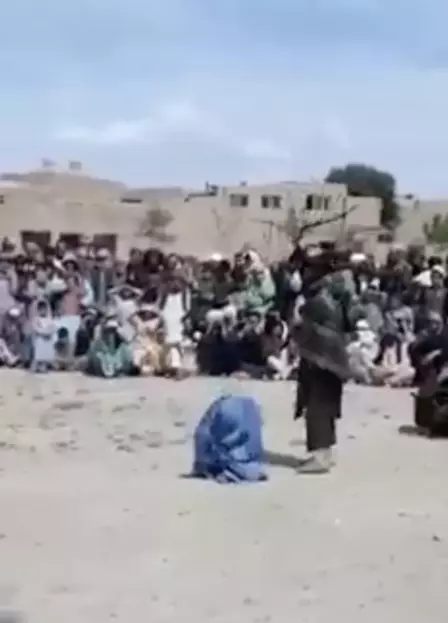
In the agonizing landscape of contemporary gender politics, the gruesome spectacle of public lashings in Afghanistan haunts those who dare to grapple with the essence of feminism. The Taliban’s barbaric treatment of women, exemplified by a recent incident where a woman was lashed for alleged adultery, starkly highlights the intersection of patriarchal power and institutionalized misogyny. This treatment is not merely an act of cruelty; it is a carefully orchestrated message about female agency—a message that reverberates through the fabric of a society that claims to uphold the sanctity of moral rectitude while simultaneously subjugating half its population.
Each lash is more than a physical punishment; it is emblematic of a broader ideological battle that twists the very principles of human rights into a weapon against women. The narrative crafted by regimes like the Taliban is one that shrouds oppression in a cloak of cultural authenticity, suggesting that such acts of violence are somehow rooted in a righteous moral order. Yet, what emerges from this is not an assertion of moral clarity but a sinister farce where the oppressors masquerade as protectors of virtue, leaving women to navigate a dangerous terrain where their bodies become battlegrounds for honor and disgrace.
The infliction of 40 lashes is not merely punitive; it serves as a stark reminder of the extrinsic violence embedded in the Taliban’s approach to female behavior, where notions of sexuality and familial honor become intertwined in an accusatory narrative. The act is a representation of how physical punishment is weaponized against women, designed to elicit not only pain but also fear—a fear that reinforces the patriarchal dressing of societal norms. This incident compels a re-evaluation of the “honor” narrative that the Taliban purports to safeguard: whose honor is truly at stake here, and at what cost?
The embrace of such draconian measures reveals the intrinsic flaws in the framing of women’s autonomy. The Taliban’s regressive ideology positions women’s rights as negotiable commodities, subject to interpretation through the warped lens of a certain interpretation of Islamic law, rather than as inalienable human rights. The act of publicly lashing a woman for alleged adultery not only disregards her individuality but actively seeks to obliterate her autonomy, casting her into the abyss of shame and irrelevance. This poses a dire question to feminists around the globe: how do we confront and dismantle such oppressive structures while nurturing a genuine dialogue about cultural nuance and respect for autonomy?
The Taliban’s performative cruelty towards women reflects a more insidious dynamic that persists even in ostensibly liberated societies. It serves as an unsettling reminder that misogyny does not require a uniform face. Instances of public shaming, victim-blaming, and the ongoing societal scrutiny faced by women for their sexual choices are not relegated to regions marked by conflict or conservatism. Such ideologies find their unofficial champions across various strata of global society. The echoes of the lash resonate in the hushed whispers that pass judgment on women who dare to express their sexual independence, challenging us to confront the uncomfortable truth that systemic misogyny takes on myriad forms.
Understanding the moral underpinnings of the Taliban’s actions necessitates delving deeper into the cultural bedrock that informs such draconian measures. The very notion of “adultery” is steeped in patriarchal interpretations that uphold male-centered narratives of control. The Taliban’s judicial system, which operates in direct contravention of universal human rights principles, espouses a moral framework that places a woman’s worth inextricably tied to her sexual conduct. It raises a crucial inquiry: How do we escape the snare of moral absolutism that not only condones but actively encourages the silencing of women’s voices and experiences?>
A feminist lens demands that we critique not only the immediate violence of the lash but also the pervasive ideologies that sustain such actions. These are ideologies perpetuated through cultural stories, religious dogmas, and social norms that dictate acceptable behavior for women. The examination of such ideologies should compel us to forge alliances with those who uplift women’s rights within these cultures while being steadfast in our denunciation of violence in all forms. Feminism is not an export; it is a deeply rooted aspect of human dignity that transcends geographical boundaries. As such, we must seek to center the voices of Afghan women themselves in our discourse, amplifying their stories, struggles, and aspirations.
By highlighting the voices and narratives of women in Afghanistan, we begin to dismantle the monolithic portrayals of women as merely victims. This incident ought to incite outrage but equally compel us to engage meaningfully with Afghan women’s own narratives—cultivating empathy and fostering solidarity rather than perpetuating a savior complex. When we depict these women merely as victims of an oppressive regime, we risk overshadowing their resilience, agency, and capacity to lead their own liberation movements. The resistance against the Taliban’s harsh regime has already begun, with women leading the charge in advocating for rights and freedoms often overlooked by the external world.
Ultimately, the tragedy of this public lashing transcends geographic boundaries. It serves as a call to action for feminists everywhere to galvanize against systems that enable misogyny in its many forms. It invites us to reflect on our own complicity within different constructs of patriarchy, urging us to forge a coalition that transcends ethnic, cultural, and national lines. In doing so, we must remember the essential truth that the fight against misogyny—be it from the Taliban or in our own backyards—cannot be won if we continue to affix the labels of “us” and “them.” We are all part of this struggle—a struggle that seeks not just to alleviate suffering but to create a world where every woman, regardless of where she stands, can assert her right to exist, to speak, and to thrive.
This clarion call for multi-faceted feminist engagement not only challenges us to address the grotesque acts of violence in places like Afghanistan but also beckons us to scrutinize our entrenched beliefs and assumptions. It is through such a commitment to solidarity that we can begin to rewrite the narrative—one that emphasizes not just survival but the celebration of women’s multifarious identities, experiences, and stories around the globe. The time has come to rise against the lash, not merely to mourn its implications, but to foster an evolution of thought and action that empowers women in every corner of the world.