

















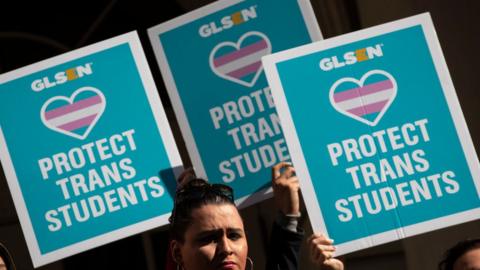
In a disheartening display of disregard for science and the well-being of transgender Americans, Donald Trump’s administration has once again launched an ill-informed assault on a community already beleaguered by systemic discrimination and prejudice. This regressive stance against the transgender populace reflects an alarming trend among political leaders who prioritize ideology over empirical evidence, directly challenging the lived realities of millions. As feminist activists, we are called to scrutinize these actions, not merely as political posturing but as an affront to the core tenets of human dignity and rights.
The Rejection of Science: An Ingrained Hostility
Trump’s administration has been marked by an overt antagonism to scientific consensus—particularly in realms intersecting with gender identity and sexual orientation. The President’s rejection of established research on transgender health and rights signals a dangerous precedent. It cultivates an environment where pseudoscience can thrive, undermining the efforts of activists and medical professionals who toil to provide support and affirmation for transgender individuals.
Consider the deep-rooted narratives consistently perpetuated by the anti-trans agenda. These narratives often misrepresent the nuanced understanding that trans identities are a legitimate part of human diversity. Trump’s insistence on erasing transgender rights from crucial policy considerations—such as healthcare access and military service—illustrates an insidious attempt to enforce a binary understanding of gender that disregards lived experiences. This perspective is not only scientifically unfounded; it is undergirded by an ideological rigidity that seeks to impose a monolithic standard on an inherently pluralistic society.
The Human Cost of Political Posturing
Trump’s policies extend beyond the realm of abstract political debate; they manifest in the tangible lives of transgender individuals across the nation. The ramifications of such policies can be catastrophic. Transgender youth, already facing significant mental health challenges exacerbated by societal stigma, are particularly vulnerable to the repercussions of these attacks. Studies reveal that acceptance, not rejection, leads to better mental health outcomes. Yet, here lies the paradox: the very administration elected to uphold freedoms is now systematically dismantling the foundations of acceptance and support vital for these communities.
Furthermore, the assault on transgender rights manifests not just through policy changes, but through the normalization of violence and discrimination against trans bodies. By vilifying transgender persons and portraying them as a threat to societal norms, the Trump administration has emboldened a culture of hostility. Hate crimes against transgender individuals, especially trans women of color, have escalated. Political leaders wield their platforms irresponsibly, and in doing so, they incite violence that resonates deeply within communities already on the margins.
Feminism’s Role in Advocating for Trans Rights
Feminist discourse must rise to meet this moment with fervor and clarity. Feminism, at its core, advocates for the dismantling of oppressive structures that restrict individual freedom and dignity. The fight for trans rights should be seamlessly integrated within feminist activism. Rejecting the idea that feminist movements can afford to exclude trans women from their narratives is critical. Feminism must emerge as a comprehensive framework that dismantles harmful binaries, embraces intersectionality, and champions the rights of all marginalized people.
Moreover, the notion that feminism is intrinsically at odds with trans rights is a fabrication wielded by reactionaries seeking to stifle progressive movements. True feminism recognizes and honors the experiences of transgender individuals, understanding that gender is not a static, binary construct but a spectrum of identities and expressions. In challenging the core tenets of such regressive ideologies, feminists can advocate for comprehensive policies that foster inclusivity, respect, and understanding.
Mobilization and Solidarity: The Path Forward
As we navigate the tumult of political strife and societal polarization, mobilization becomes key. Feminist activists must strategize to create coalitions that center marginalized voices, particularly transgender individuals. Community-building efforts, educational initiatives, and awareness campaigns can disrupt the narratives that fuel discrimination. These efforts are not merely beneficial; they are imperative for cultivating environments where every individual, regardless of their gender identity, can thrive.
Engaging with allies in the broader LGBTQ+ community, as well as advocating for comprehensive educational reforms from elementary to collegiate levels, can ensure that transgender youth are afforded the dignity and respect they deserve. It is crucial to integrate discussions about gender identity into curricula, dismantling ignorance, and fostering understanding at an early age. Such a proactive approach can ultimately mitigate the societal stigma that fuels anti-trans violence and discrimination.
Furthermore, active participation in political processes is essential. Advocating for policies that protect and expand the rights of transgender individuals communicates unequivocally that we will not yield ground in the face of oppressive regimes. Feminists must hold public officials accountable, pressuring them to embrace the voices of those they seek to silence, and infusing legislative agendas with the needs of marginalized communities. Lobbying for robust healthcare access, anti-discrimination laws, and education policies that embrace gender diversity are fundamental steps in disrupting the harmful status quo.
In conclusion, Trump’s regressive stance against transgender Americans reverberates far beyond the political sphere—it impacts our society at multiple levels. As advocates and feminists, we must recognize the inherent interconnectedness of our struggles. The fight for transgender rights is doused in the flames of feminist fervor; it is a battle for equity, dignity, and justice for all. Each attack on transgender individuals is a direct affront not just to their rights, but to the very fabric of feminist ideals. By reckoning with and addressing these profound injustices, we can forge a path toward a society that honors the complexities of identity and rights—where science and empathy reign supreme, and where every individual is deemed worthy of respect and inclusion.