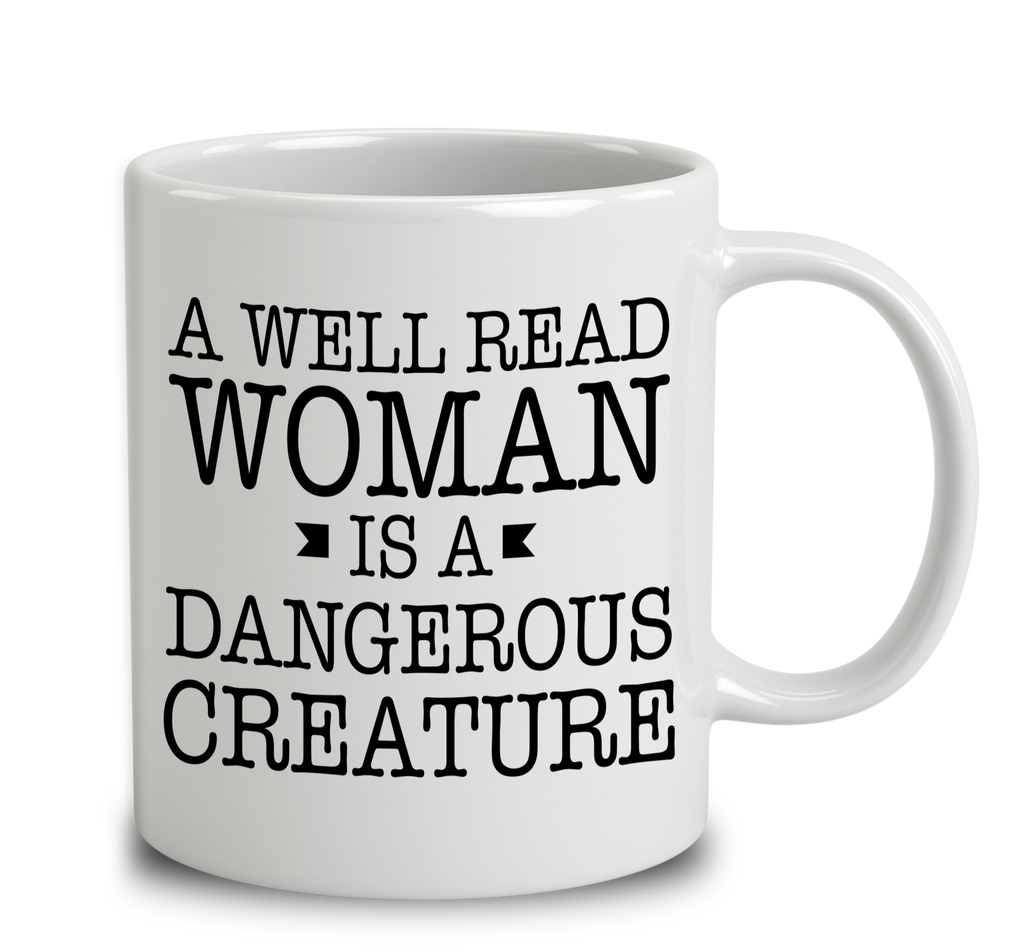
In the realm of empowerment and consciousness, few declarations resonate as profoundly as the aphorism, “A Well-Read Woman Is a Dangerous Creature.” This phrase, cleverly inscribed on a mundane object—a mug—transforms the ordinary into the extraordinary, elevating the act of sipping morning coffee into a deliberate proclamation. It serves as a provocative metaphor that beckons us to delve into the nuanced implications of literacy, autonomy, and feminine prowess. But what does it mean to be a “dangerous creature” in a societal landscape fraught with gender bias and antiquated narratives?
At first glance, the combination of a well-read woman and the notion of danger may seem incongruous. However, juxtaposing literacy with the term “dangerous” reveals a profound truth about power dynamics. Historical precedents elucidate this dangerous synergy: women who embrace their intellectuality often fracture societal norms. Consider the venerated trailblazers of feminist literature, authors who have boldly wielded their pens like swords, challenging the status quo while crafting narratives that are simultaneously personal and universal. Their words resonate, igniting critique and challenging complacency.
The act of reading cultivates critical thinking, sparks creativity, and fosters a sense of agency. It equips women with the intellectual armamentarium necessary to navigate, dissect, and ultimately dismantle patriarchal structures. A well-read woman embodies a repository of knowledge, an arsenal from which she draws insight to contend with the myriad challenges posed by a world that often seeks to silence her voice. In this context, “dangerous” transfigures from a pejorative to a badge of honor.
Moreover, the metaphor extends beyond individual capabilities; it speaks to the collective potential of literate women to incite change. Every enlightened woman contributes to a tapestry of resistance against systemic oppression. She wields her book not just as a source of knowledge but as a rallying cry. While she sips from her mug adorned with the audacious declaration, she unwittingly partakes in a legacy of female insurgency.
Let’s journey further into the delightful complexities of this phrase. It’s not merely about the danger a well-read woman poses to outdated ideologies; it’s also about the intellectual intimacy that reading cultivates. Literature becomes a portal through which women explore diverse experiences, fostering empathy and understanding of the human condition. In immersing herself in the narratives of others—those who share her struggles and those who do not—a well-read woman develops a panoramic worldview that is both nuanced and profound. This ability to empathize, to step into the shoes of the ‘other’, fortifies her character and amplifies her voice in advocacy.
But let us not be naïve. The path of enlightenment paved by the act of reading is strewn with resistance. Confronted with the condescension of those who prefer the status quo, a literate woman may be deemed too assertive, too opinionated, or worse—too dangerous. This societal backlash underscores the necessity of solidarity among women. As more women elevate their voices through books, mentorship, and discourse, they forge a formidable coalition that stands resolutely against contemptuous dismissal.
Moreover, we must not overlook the role of intersectionality in this vibrant narrative. The phrase “A Well-Read Woman” cannot be confined to a homogenous interpretation. To be truly empowering, the movement must encapsulate the diversity of female identities influenced by race, sexuality, class, and ability. The odyssey towards enlightenment is distinctly unique for every woman, coloring her experience with shades of struggle and triumph. This plurality of perspective ensures that the “danger” of the well-read woman is multilayered and rich in complexity.
The seductive allure of this phrase is that it challenges women not just to read, but to read with intention. It beckons them to engage with material that provokes thought, ignites passion, and ultimately leads to action. It is a clarion call to delve into feminist literature, social theory, history, and beyond—an eclectic repertoire bursting with revelations that can incite contractions of the heart and mind.
In drawing to a conclusion, the mug embellished with the inscription “A Well-Read Woman Is a Dangerous Creature” serves as a clarion call to embrace the audacity of knowledge. It’s not merely a catchy slogan, but rather a potent reminder that education and empowerment are irrefutably intertwined. The danger of a well-read woman lies not in her ability to disrupt social norms but in her potential to engender transformation and provoke discussion. Each sip taken from that mug symbolizes a detonation of ignorance, a refusal to acquiesce, and an affirmation of self. The metaphor encapsulates the quintessence of feminine strength: audacity sourced from knowledge, empathy culled from reading, and resilience forged through community. Embrace the danger; for every well-read woman is a tempest waiting to shake the world awake.