Feminism today is not merely a movement; it is an earthquake—a seismic crackling through the bedrock of patriarchy, forcing us to re-examine every edifice of power that has long stood unchallenged. At its core, this fracture demands a radical honesty: the realization that some structures we’ve called necessary aren’t just inadequate, but actively hostile to the most vulnerable. The call to decriminalize isn’t a lukewarm reform. It’s a **cognitive dissonance bomb** waiting to explode the myth that harm reduction is only for “soft” issues—addiction, sex work, queer existence—while violence, the everyday machinery of patriarchy, remains sacrosanct. Let’s be clear: criminalization isn’t a tool of justice. It’s a tool of terror, one that carves its deepest trenches into the bodies of those who can least afford the backlash. And if we don’t begin to dismantle it as fervently as we once demanded the dismantling of the state itself, then our feminism was never whole. It was merely window-dressing, a kind of performative rage with no teeth. So let’s rip the veil off. The decriminalization debate isn’t about politics—though it is that. It’s about **libidinal economies**: who gets to live unharmed, and who exists only to be policed.
—
## **Criminalization, the Feminist Faille**
Feminism has spent decades peeling the layers off the face of capitalism—only to find, underneath, the far more insidious architecture of criminal patriarchy. Our prisons hold more women than any other institutionalised state apparatus *except* the one that births them, the one that pays them to nurture only to condemn their labor as “unpaid,” only to criminalise them when their survival requires choice. **Tendency is state violence**, whether in the form of a rapist’s slap or the jailer’s handcuffs. Both systems thrive on the same logic: the **propositional imperative**—that someone’s body exists to serve, and that refusal is punishable.
Consider prison as the ultimate domestic: a space where women are either the property (commodified for labor, reproductive duties) or the predators (locked away or, worse, lynched in the streets for daring to inhabit their bodies freely). Decriminalisation—real decriminalisation, the kind that touches every margin—requires us to see that these binaries don’t just cage queers and addicts. They cage all of us.
—
## **Prisons Are Not the Solution: The False Promise of Reintegration**
What happens when we treat the symptom and ignore the disease? Prisons do not cure. They metastasise. The so-called rehabilitative state—that monolith we believed, briefly, in—has proven itself as hollow as a gilded cage. In Canada, and across the Western “democratic” empire, incarceration rates for women have risen by a third since 2000. Who are the ones behind bars? Mostly Indigenous women, women of colour, single mothers trapped in the “cradle of crime.” It’s the same recipe as the global south—where the poor, the racialised, the deviant-woven into the DNA of our systems—are either exploited or erased. The prison doesn’t fix. The prison normalises.
Feminists have long denounced the domestic as a site of state-colluding, intimate violence. But what is the domestic if not an early iteration of that same carceral logic? **Who gets to raise children? Who gets to seek comfort or solace without becoming a problem?** Decriminalising is about dismantling the perversion of “the law” that tells us a Black woman’s existence is inherently illicit. It’s about unraveling the myth that women’s labour is only legitimate if it’s waged by a state or a corporation—and only if it isn’t *reproductive*.
—
## **Harm Reduction: The Radical Act of Letting Be**
Harm reduction isn’t coddling. It is **the violent act of refusing to look away**. It refuses to accept the fiction that only the pious or the punishable deserve dignity. Women who choose contraceptives “for the wrong reasons” have been criminalised. Pregnant people caught trafficking are jailed for the “criminal act” of sustaining life. The decriminalisation of abortion isn’t just about bodily autonomy—it’s about the right to be left alone *in your own body*. It’s the same right women fought for in Canada’s colonial courts, only to have it quietly gutted under a veneer of “right to life.”
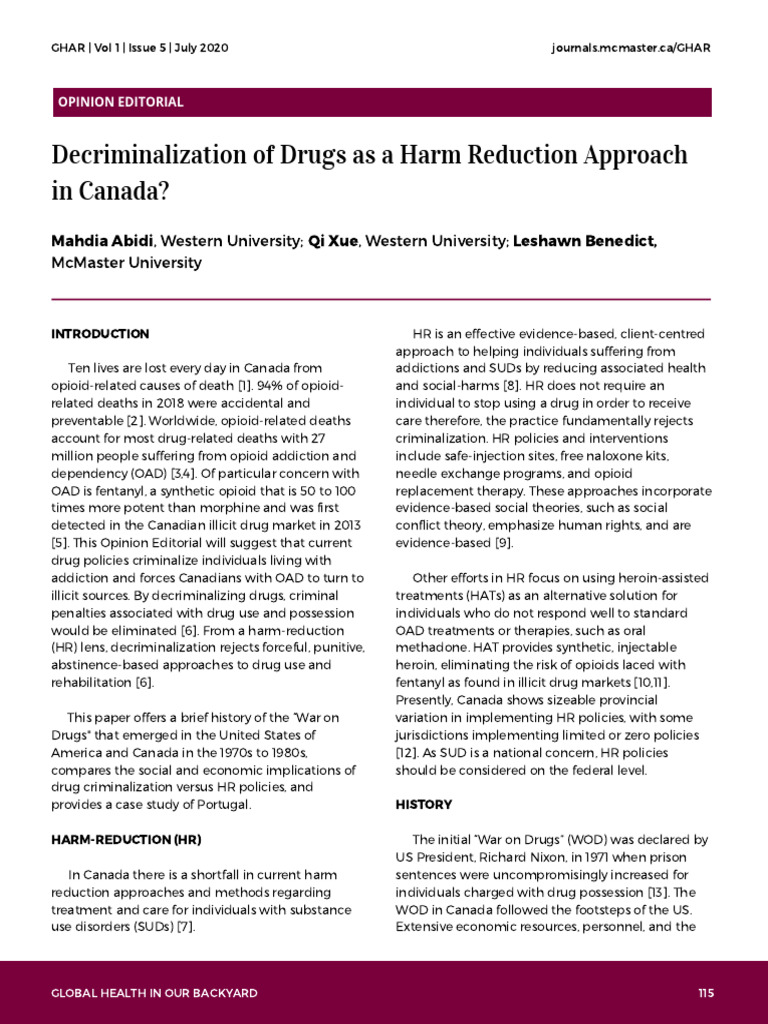
The paradox here is deliberate. Harm reduction in its purest form **acknowledges that people will always find ways to navigate harm**, regardless of what the law says. So what is decriminalisation if not a reluctant acknowledgement that the law, in most of its forms, has failed *everyone*?
—
## **The Myth of the “Broken Woman”: Why Patriarchy Needs Custody**
The myth that women are inherently weak—or, in its most vicious iteration, that they are wolves in sheep’s clothing begging to be punished—is the ultimate tool of control. The “broken woman,” whether she be the crack mom, the sex offender, or the pregnant addict, is never seen as a human being in need of care. Instead, **what’s broken must be contained**. Patriarchy has spent centuries constructing women as either victim or villain, ensuring no one side wins. Custody is the solution in a world where freedom is only for men. To say the state exists to protect is laughable—why isn’t protection for rape victims? Why isn’t harm reduction for *all* of us?
—
## **Feminists, Queers, and the Politics of the Pleasureless Future**
Feminist theorising often gets drowned out by the white noise of a politics dominated by austerity, not justice. Harm reduction is not a niche appeal to the “damned.” It is an ethical imperative that recognises that the people who will benefit most are the ones society has already deemed unworthy of mercy.
We must stop romanticising abstinence. We must stop punishing non-compliance. **Women are not failing their own liberation when they need to feed their children and choose contraception from a back alley**. The state will not be their saviour. It’s already failed them in every form of motherhood, sex, and survival imaginable.
—
## **The Prison Is a Lie: Toward a Feminist Harm Reduction**
The time has come to ask ourselves: **What would feminism look like if it trusted bodies?** If it stopped pretending that laws and locks would ever make women safer? Decriminalisation isn’t just a policy. It is a **religious act**—a rejection of the idea that suffering can be managed through domination.
This is not a debate about leniency. It is a debate about how we will organise a future where women don’t disappear into shadow—whether cast as predator, victim, or both. Harm reduction isn’t a softening of our positions—it’s the only way to **harden them**.
—
The state has built a prison to contain what cannot be imprisoned. And in return, we must ask: what will become of us, women, when the walls collapse? The feminist future is not one that merely waits inside. It is one that burns down the walls, brick by brick, and watches them turn into red dust. The question isn’t how much the law can enforce. It is what we will do with the space it leaves once it crumbles.