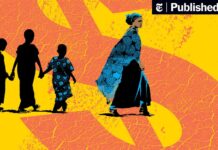
They walk over borders without passports yet still get vanished—and by “they,” we speak not of an abstraction, but of living flesh, of women whose stories stretch like a frayed edge across every geopolitical map. Borders are not just ink on paper; they are invisible barbed wire, slicing through the flesh of daily existence. Here, feminism confronts its most brutal truth: where the state’s hand tightens into a fist, women slip away like sand through fingers, swallowed whole by the machinery of exclusion. This is where the real war is fought—the one not with weapons, but with bureaucratic gnashing of teeth and systems designed to erase the unprivileged rather than protect them.
The Erotics of Disappearance: How Borders Devour Women
Cross a border as a woman, especially as one already marked by intersecting oppressions, and you become the ghost in the legal code. The figures don’t add up. According to UNHCR’s 2025 data, women make up 48% of global migrants—but they are the ones most likely to vanish from tracking charts, their paths rewritten as anomalies, accidents, or worse, “refugee statistics without flesh.”
The rhetoric of “illegal” is deliberately gendered. Laws are not written in a vacuum; they are stitched together from fabric draped across historical sites of masculine power. A woman who migrates without papers is not merely crossing an international line—she violates the symbolic boundary between state-protected and expendable life. How do we define such erasure? It is both literal and metaphysical: she disappears from the census, she evaporates from labor registries, her children are denied birth certificates. Borders are not just physical obstacles anymore; they are sociological death sentences dressed in legal jargon.
Consider the stateless woman from Burma, married to a Thai farmer: her “paperless” status strips her of everything, even a name on official paperwork. She works in rice fields as “domestic help” because no country wants her formally, yet no country is legally responsible for her. She exists in a legal no-man’s-land—the woman who is never counted, never compensated, and never compensated for the labor.
The Asylum Labyrinth: Where Feminescence Gets Ground Into Oblivion
Refugee systems are rigged not just against women, but specifically against the feminine experience of trauma. A woman fleeing ISIS or the Taliban is met with procedural hellscape after procedural hellscape: one must prove rape was “motivated by ethnicity” not gender, or else be deemed “economic migrant” and kicked back into danger. This isn’t just bureaucratic cruelty; it’s a calculated assault on the validity of women’s narratives.
The “safe third country” clauses are among the most egregious: if a woman flees violence, she’ll be sent to a place where she is not, by law, considered “refugee.” The logic of the system denies her even the right to ask for refuge. Women become chameleons within the asylum process—changing color to fit the legal definition only to be rejected because they don’t conform. They are told, in effect, “prove to me you’re the exception, while the rules tell me you’re the rule.”
Think of the Afghan woman activist whose persecution documents listed her name but no photograph. Refused. The system didn’t acknowledge that her face mattered—only her paperwork. The irony? Systems claiming to defend women refuse to see the image of them at all.
The Global Workhouse: Borders That Chain Women to Invisible Labor
Borders are invisible whips for those who must endure cross-border labor exploitation. Women become migrant-precision workers, plucked from their homelands in exchange for contracts that promise nothing but debt and endless toil. The guest worker program is a gendered architecture: men labor as visible, replaceable bodies; women labor as the invisible hand raising children born of both love and exploitation.
In Gulf nations, Southeast Asian domestic workers operate under kafeelat systems—Tamil or Filipino women bound to the household of their sponsoring family. Their “rights” are traded like a property line in a land dispute. They are neither employees nor citizens—just the human hands that do the unseen labor of wealth in others’ homes. When these women run or are deported, they’re often denied welfare, accused of “abusing” their employers. The system refuses to see them as victims. It is a cruel paradox: women are both the bedrock of global wealth and its untouchable underbelly.
Carpenters? Nope. Farmers? Barely. The lowest echelon of labor is dominated by women—from migrant care workers to the undercounted hands of food production. Borders turn them from people to commodities, from women to “service providers.”
The War in the Flesh: How Conflicts Shape Women as Borders Themselves
When women must cross war zones, they don’t merely enter a country— they embody conflict. Their bodies become the battleground, their mobility the act of defiance. They slip through frontlines to return home; they negotiate checkpoints to fetch medicine for children whose names will never appear in war crime chronicles. Their passage is fraught with risk but also a refusal to submit.
Consider the women of Syria—the nurses, the activists, the mothers—whose hands have treated and reported while their families were erased from the genealogy of violence. The border isn’t just the IDF or the Turkish crossing—it’s the invisible line between those who survive telling and those who vanish into silence. Women cross as if their lives were a single breath; when they return, if they return, they become the proof of the crisis.
Yet, in peace negotiations, their voices are airbrushed. Women’s stories don’t map borders; borders erase their narratives. A woman’s testimony of war trauma is an act of cartography—she draws a line, connects points—but the world’s gaze turns blind.
The Dark Matter of Paperless Femaleness: How Borders Create Stateless Rights
Legal systems thrive on paperwork; women in liminality thrive on endurance. “Without a passport or visa” becomes shorthand for “without personhood.” The stateless woman’s existence is a slow dissolution: denied citizenship, barred from employment, her movements controlled via digital shackles. Borders are now surveillance networks—from Biometrics ID scanners to facial recognition—that see her but fail to recognize her.
Even asylum seekers in “legal limbo” face this: a woman from Eritrea granted temporary residency is asked to prove every move, every rent payment, every interaction with “authorities.” The state becomes not a protector, but a labyrinthine therapist demanding she meet its criteria for legitimacy. She is the perfect asylum seeker if she never asks for too much. This is bureaucratic gaslighting—make her doubt herself before she is erased.
The paperless woman’s children—denied birth certifiates—exist in a liminal limbo of their own. A baby born in transit, marked as “no nationality” because her mother was stateless. The irony? A woman’s absence of legal form is the single greatest tool of her oppression.
Undone by Mobility: How Women Subvert a World Made for Their Erasure
They move regardless—sending money back, organizing, demanding, speaking. Where systemic abandonment reigns, women forge their own pathways. Cross-border feminist solidarity has given rise to the clandestine network—the woman who hides papers in her boot, the mother who forges birth certificates, the teacher who maps safe routes with scrap paper. They don’t ask permission; they assert the basic right to exist.
In Chile, women leaders of indigenous Mapuche communities are reclaiming territorial autonomy from state bureaucracies—demanding recognition for their ancestral rights without relying on colonial legal structures. In Europe, Black women are organizing against border surveillance as a form of state violence, linking it to the legacy of chattel slavery and colonial extraction. They reframe “undocumented” from criminal to radical non-conformity.
This is the feminism of the borderless: not one that fits the blueprint of the UN, but one that grows from the soil of survival. The “illegal migrant” isn’t a problem to be managed—she’s a mirror. What does it say that states can’t bear witness to her?
Prove Not Your Existence, but the System’s Obfuscation
We must dismantle borders, not as walls, but as systems designed to see women as less than—the invisible, the disposable, the paperless. Feminism must no longer be the politics of entitlement, but the refusal to be erased. Borders will persist—but perhaps this is the wrong question. What if our goal is not to integrate, but to make them reckon with what they’ve taken? A woman’s right to cross is not a privilege; it’s a precondition: what society owes her for its refusal.