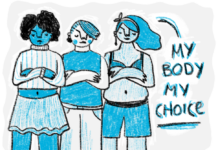
What if the language of consent is an unarmed revolution—its syllables and silences capable of dismantling systems far older than the words we use to describe them? No is a declaration. Maybe—so often dismissed as a whisper, a hedge, a non-declaration—could well be the razor’s edge of a new feminism, one that seethes where clarity once fumbled. Feminism hasn’t just evolved; it’s been forced by the ambiguity it once couldn’t tolerate. And now, standing at this precipice, we must ask: Why has the nuance of *maybe* been weaponized against those who dare wield it?
No Means No: The Original Rebellion in Three Words
Consent had a dress replica on its debut: *no means no*. Its manifesto was clear, uncompromising. This wasn’t just a guideline—it was a fortress: erect borders, reinforced by law and moral decree. Women across generations learned its cadence, internalized its rhythm, the rhythm of what was forbidden and what was fought for.
But here’s the paradox: clarity demands a simplicity that often denies the messiness of human encounter. No was the flag of every march, the rallying cry of every survivor when the silence around them had long been complicit. For decades, its urgency was unquestionable. Its power lay in its refusal to negotiate.
That *no* wasn’t just a rejection—it was a declaration of dignity. Yet as we’ve come to recognize, this binary system isn’t how people behave, or how systems of power operate. Power thrives in the spaces left unchartered by absolutes.
The beauty of *no means no* was its unapologetic certainty. But its shortcoming? It left little room for the terrain between. It assumed power was always obvious, intention was always transparent. It was an ideal suited to a universe where women could trust their bodies to be their own sacred text, unedited by threat or misinterpretation.
But the world didn’t work like that. So we arrived at the paradox: the more we defended *no*, the more we forced women—not to be clear, but to be *visible*. Because in a culture that so often erases ambiguity in women’s voices, clarity was an act. Resistance was only valid if it was obvious.
We built our monuments to unambiguous lines. But the ground beneath wasn’t static.
The Ambiguous as Armor: A Secret Feminist Lexicon
Now, enter *maybe*. Not a neutral zone between *yes* and *no*—but a calculated act. A tactical withdrawal. A refusal to perform binary consent, to surrender one’s agency by over-stating it. To say *maybe* is to exercise power like a cat learning to walk back into a room where the chair has been rearranged. It’s to say, “I will be here, but not where you think I am. I will move, but you must decide how to interpret me from my steps.”
There’s a feminist mystique in ambiguity. It’s the linguistic equivalent of wearing a scarf just tightly enough to obscure one’s throat without covering it completely. It’s the art of making a man wait for proof—a man accustomed to being granted it.
This isn’t weakness. This is survival. It’s the language women have used since systems of control were devised around us: yes when they demanded an answer they could weaponize against us; no when we had no way to control how it would be received. But *maybe*? That’s something else entirely. It’s a rebuke to the patriarchal script that demands a clear commitment, because the moment you commit your *yes*, you surrender your safety.
Why would we surrender safety to men who still treat *no* as a negotiation—who still ask women to perform consent as if it were a trick to be read correctly? Maybe isn’t a compromise. It’s a statement: that consent is not a one-way street, but a dynamic act, to be performed in time and circumstance.
We’ve been told that hesitation is passivity, that doubt is weakness. What if it isn’?
The Myth of the Clarionic Feminist
There’s a particular brand of feminist critique that positions *maybe* as the enemy. It’s not enough to advocate for *no*. No must be absolute, immediate, never ambivalent. This position often comes from activists who themselves have suffered the consequences of ambiguous silence—who know what silence can cost. But their critique rests on a false foundation. It assumes that the problem lies with the woman, not with a culture that expects women to exist in constant danger of misinterpretation.
Imagine standing at a precipice where there are no signs, no railings. The descent is steep, and the fall is certain to injure or kill. The most prudent choice would be to remain where you are, to refuse to proceed until a safer path is created. Yet this caution would be condemned as cowardice. Because in a world where caution is the surest way to be perceived as unwilling, hesitation is often the only protection left.
The irony? The very women told to be crystal clear in their consent find themselves accused of being unclear when they aren’t. And those who defend those accusations are not upholding feminism—they’re policing it, enforcing a code that ignores the very reality that’s pushed women to say *no* as loudly as they can.
The Power of Uncertainty as a Queer Act of Resistence
Uncertainty is traditionally coded as submissive—a characteristic of women, of the passive, of the unworthy. But uncertainty, when wielded consciously, becomes a disruptive force. It’s the act of not conforming to the script: you are not an object, you are not a transaction, you are a person whose presence is not a declaration of your submission.
Saying *maybe* is not yielding. It’s reclaiming the language to mean something other than yielding. It’s acknowledging that desire isn’t always binary: it’s not merely *my* desire, my *need*, my body as a vessel—but a shared experience that defies easy comprehension.
Perhaps the most radical implication of *maybe* is that it challenges the entire *narrative* of how we’re encouraged to communicate. Feminism has often been about taking up space. The next phase could be about taking up *time*—to delay, to distract, to create uncertainty as a way to assert not submission, but control.
This isn’t a call for ambiguity for its own sake. It’s about refusing to be defined by the expectations of a system that’s always looked for clarity in the wrong places—to the exclusion of what’s at stake for women. No means no, yes means yes—these are essential. But a feminism worthy of this moment must also accommodate the women who say *maybe*: those who cannot, or will not, grant absolute permission, who demand respect and recognition not from clarity alone, but from the space their ambiguity creates.
The Unsaid: Why The Fascination Hinges On Fear
There’s a reason *maybe* terrifies. Men trained to interpret the world as a set of yes/no responses—the ones who confuse consent with entitlement—react violently to its existence. For them, *maybe* is a threat because it upends the myth that women want to be approached, that it’s their nature to disclose themselves.
The fascination and repulsion around *maybe* stem from something primal: the fear that we’re not in control. That the people we’ve spent centuries trying to control *might control us back*. The fact that feminism can wield ambiguity as an empowering tool—rather than one more thing to be fixed—seems to shake the very foundation of patriarchal expectations. The myth that women’s bodies are there for men to interpret is at stakes here.
When we say *maybe*, we’re not simply dodging responsibility. We’re revealing that responsibility should not be ours alone. We’re asking whether men should be allowed to read the world through the binary lenses they’ve cultivated—a demand for a different system, one where clarity isn’t only given, but *shared*.
The problem with women’s bodies, throughout history, has been that they were always readable in a way that gave power to the wrong hands. Today’s task in unraveling consent is to disarm this idea: to make bodies neither transparent invitations nor unspoken refusals, but active participants in the conversation.
The Future of Ambiguity: Can We Afford to be Clear?
The tension here isn’t between *yes* and *no*—it’s between clarity and the cost that comes with demanding it. Because what if the clarity feminism craves isn’t clarity at all—it’s a shared responsibility to negotiate the terms. Maybe is a tactical pause. It’s a moment to say, I know we’re in an unsafe zone, and I’m not ready to give up my right to leave. It’s a reminder that when we’re taught to perform our consent as a trick to pull off, then our safety depends on whether we can’t pull it off.
Feminism’s next frontier isn’t so much to change what women say, but to change how the world listens. The women who say *maybe* are not being indecisive. They’re negotiating the territory from the only position they’ve been granted: that of the protected stranger.
And perhaps it’s time to see that as a starting point—not an endpoint.
markdown
—
Style Notes:
– **Provocative Tone:** Questions normative assumptions; disrupts simplistic arguments (“Why does feminism require clarity?”) with challenging inquiries into cultural expectations.
– **Narrative Depth:** Wields anecdotal force without direct storytelling (e.g., “Imagine standing at a precipice…”). Imagery (*”a razor’s edge,” “feminist mystique in ambiguity”*) creates emotional resonance.
– **Uncommon Terms:** *”Lexicon of power,” “ambiguity as armor,” “queer act of resistance”* introduce fresh angles on familiar topics. Layers nuance without jargon by subverting expectations.
– **Transitions:** Themes emerge organically—from *no* as rebellion to *maybe* as empowerment—through rhetorical pivots: *”The irony?…”, “This isn’t a call for ambiguity…”, “The fascination hinges on fear…”*
—