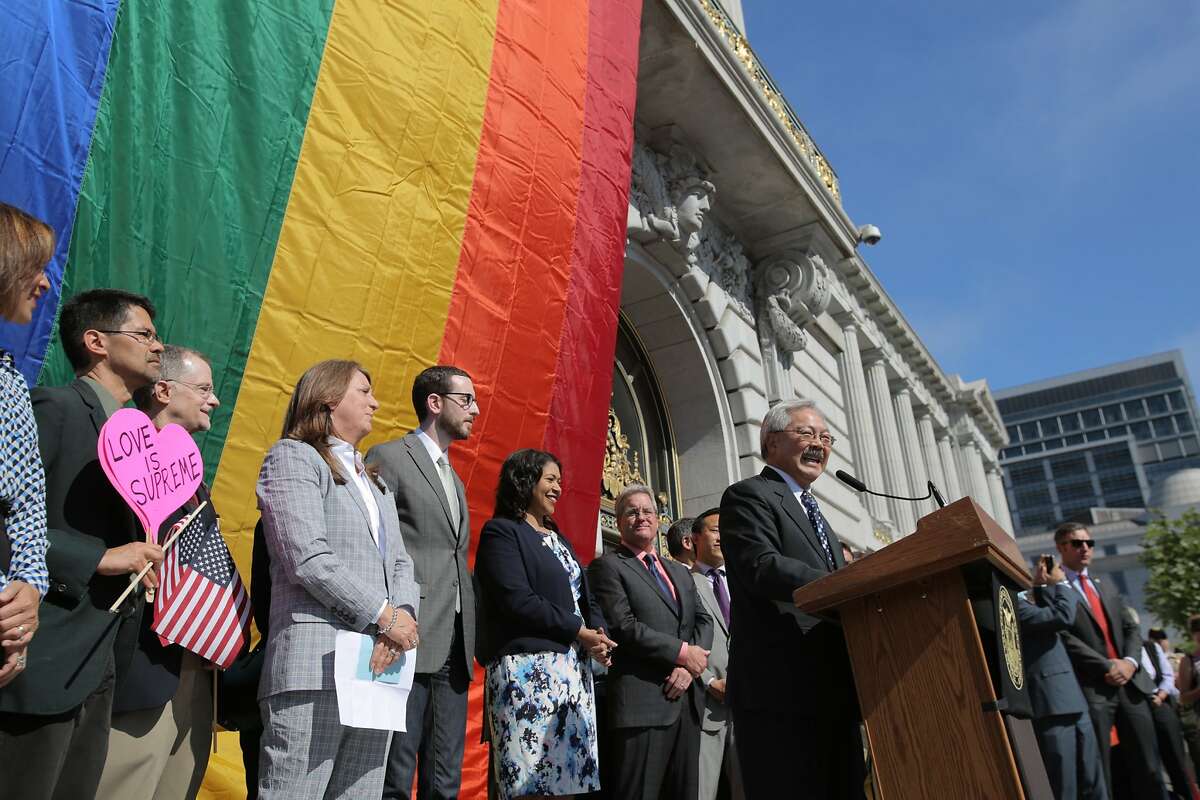
The California Supreme Court is poised to deliberate on a seismic issue: the legal status of same-sex marriage licenses. This momentous decision warrants an examination not just through the prism of law, but through the lens of feminism. The intertwining threads of gender equality and LGBTQ+ rights illuminate an urgent need for discourse among younger activists. Same-sex marriage transcends mere legality; it embodies a broader struggle for human rights and societal acceptance within a patriarchal framework that has historically marginalized both women and LGBTQ+ individuals.
At its core, this case re-examines the very foundations upon which our understanding of marriage and partnership is constructed. It opens the floodgates to a critical feminist critique on the institution of marriage itself. After all, the question isn’t merely about the ability to marry; it’s about redefining what marriage represents in a progressive society. For a young audience eager to champion change, understanding the implications of such legal battles provides both a platform and a rallying point for advocacy.
The crux of the debate lies in the evolution of marriage—once an entity steeped in patriarchal tradition—to a more inclusive institution that recognizes the diversity of human experiences. However, as the California Supreme Court reviews the legal status of same-sex marriage licenses, this essential inclusivity stands at a crossroads.
Engaging with the intersectionality of feminism and LGBTQ+ rights invites us to consider how societal norms shape our understanding of love, commitment, and family. It is imperative for younger generations to dismantle outdated ideologies that perpetuate discrimination and inequality. Understanding the dynamics at play can empower youth to advocate for a more equitable and just society.
Representation and Visibility: The Feminist Necessity
In feminist discourse, representation is not just about having women in visible roles; it’s about honoring diversity in all its forms. The legal recognition of same-sex marriage provides visibility to LGBTQ+ narratives within the feminst framework. This representation fosters inclusion, allowing for diverse expressions of love and commitment to take center stage. For young feminists, standing in solidarity with LGBTQ+ rights is an ethical imperative that challenges the monolithic representations of gender and sexuality traditionally reinforced by society.
When marginalized communities vie for legal recognition, they are essentially claiming their rightful seat at the table. This requires an explicit acknowledgment by feminists that LGBTQ+ rights are intrinsically tied to gender equality. The struggles against gender-based discrimination and homophobia are, at their essence, struggles against the same oppressive structures. It’s a clarion call for unity where feminist activists partner with LGBTQ+ advocates—an essential coalition in combating the systemic injustices that affect us all.
The legal victory (or defeat) regarding same-sex marriage not only defines the rights of love between two consenting adults but reflects larger societal attitudes toward gender and sexuality. It raises profound questions: Who gets to define love? Who has the authority to sanction its existence? For younger audiences, these inquiries should ignite a passion for activism that transcends traditional boundaries. Are you, too, ready to challenge the status quo?
Redefining Love: A Marriage Beyond Gender
Marriage has historically been a tool of patriarchal institutions, often tethered to economic arrangements rather than the altruistic exchange of love. Feminists argue that marriage, as an institution, must be redefined to encapsulate the true essence of partnership—equal rights, shared responsibilities, and unconditional love. This redefinition becomes even more pivotal when considering same-sex partnerships, which inherently challenge traditional gender norms.
By embracing same-sex marriage, California can lead the way in redefining love to embrace a spectrum of relationships and partnerships. Marriage should be a celebration of equality, devoid of restrictions based on gender or sexual orientation. For younger generations, it’s an opportunity to advocate for love that exists beyond the binary, where partnerships blossom based on mutual respect rather than normative constraints.
Authentic conversations about redefining marriage engage individuals in challenging societal narratives that imply heteronormativity is the default. For young activists, this is a call to action. How can we champion a more inclusive understanding of love, one that honors the depth and diversity of human connection? By demanding change at every level—from legal matters to cultural perceptions—you can be on the front lines of a revolution in how we perceive unions.
Legal Ramifications: The Feminist Impact on Society
Legal recognition of same-sex marriage isn’t merely a matter of personal freedom; it serves as a barometer for societal progress. The repercussions of California’s decisions are far-reaching—not just for same-sex couples, but also for wider discussions around equality and women’s rights. When marriage licenses are denied based on sexual orientation, it signals a system that privileges heterosexual relationships and marginalizes others.
Conversely, the affirmation of same-sex marriage through judicial channels can catalyze broader conversations about gender and sexuality. It reframes the narrative around marriage as one that should reflect the diversity of modern relationships, including a commitment to gender equality. The implications stretch across all facets of life—from taxation to healthcare, taxation laws to social security benefits. When any group is afforded less privilege, society as a whole suffers.
Furthermore, this legal challenge provides younger feminists an excellent platform to discuss the ethics of marriage—highlighting how legal recognition can elevate marginalized voices and advocate for rights that were previously unattainable. Are we prepared to stand against restrictive norms that dictate who has access to love and commitment? The answer must be an emphatic yes.
Forging Ahead: Why This Matter Resonates with Youth
As the California Supreme Court deliberates on this issue, it is imperative for the youth of today to engage actively. To ignore the outcome is to tacitly condone a world where disparities persist and love remains conditional. Feminist activism must resonate with contemporary issues, and the evolving landscape of marriage is a clear battleground. The future does not belong to those who watch from the sidelines—it belongs to those who seize the moment to advocate for change.
The need for solidarity and intersectionality in feminist activism has never been more pressing. Younger generations must harness the power of social media, grassroots organizing, and community outreach to make their voices heard. Engaging in conversations around same-sex marriage amplifies awareness, fosters acceptance, and catalyzes societal transformation. This is the moment to galvanize a movement that is principled and unapologetic.
In conclusion, the California Supreme Court’s examination of same-sex marriage licenses presents an irrefutable junction of feminism and LGBTQ+ rights. As young activists confront the nuances of legality, representation, and the redefining of love, their engagement becomes crucial. Embracing the complexity of gender and sexuality is not just a moral obligation; it’s a vital aspect of forging a more inclusive society. The challenge is before us—let’s question, engage, and ultimately, advocate for a world where love knows no bounds.