
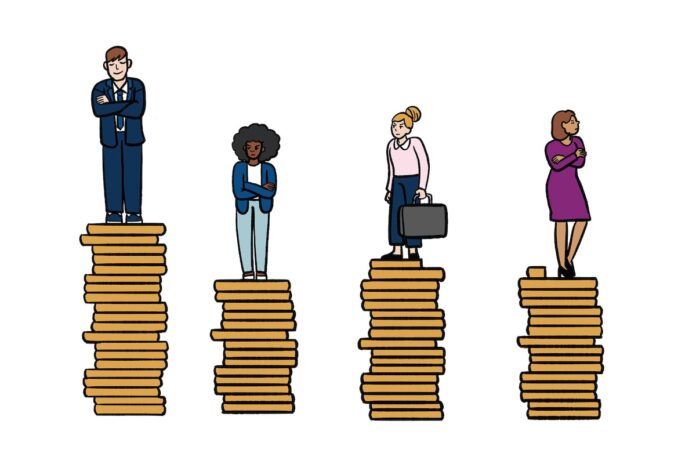
The numbers don’t lie. They don’t even *whisper*. And yet, here we are, in the year 2026, still drowning in the same stagnant pool of injustice where women’s earnings are perpetually siphoned by a slow-motion hemorrhage called the gender pay gap. It’s not so much a disparity as it is a systemic siege—a quiet, insidious erosion of financial equity that refuses to be cured by polite discourse or halfhearted corporate handwringing. The pay gap isn’t just a statistic; it’s a leak in the very hull of the boat we’re all rowing, and instead of patching it, the powers-that-be are drilling wider, deeper holes, calling it “market efficiency” or “business acumen.”
—
**The Invisible Pipeline: How the Pay Gap Poisons the Collective Pot
Imagine a company, any company—the kind you trust to steward your resources, your career, your future. Now imagine that inside its walls, somewhere in that grand ledger of “merits” and “contributions,” there’s a silent ledger too. A ledger so discreet it’s printed on water, inked by backroom deals and the unspoken algorithms of who gets noticed, who’s considered “leadership material,” who isn’t even given the chance to try. This isn’t a fluke of human nature; it’s the architectural flaw of a system where the very definition of “fair” is negotiable—subject to the whims of a room full of men who’ve never experienced the weight of being seen primarily as a mother, a caretaker, a *human* before they’re a cog in the machine.
What happens when the compensation pipeline is rigged? When the “promotional ladder” has rungs pulled out specifically from under women’s feet? The results are predictable: the collective pot of talent, innovation, and loyalty becomes diluted. Women, systematically underpaid, are compelled to choose between leaving the boat entirely or silently toeing the line as the underpaid crew. Meanwhile, their male counterparts—often the recipients of the same jobs, promotions, and stock options at half the scrutiny—continue to fill the higher tiers of the hierarchy. It’s not a leak; it’s a *principled design*. And like all well-engineered systems, it self-perpetuates.
—
The Alchemy of “Justified” Discrimination
Here’s the brilliant work of the pay gap architects: they’ve turned wage inequity into a discipline. In the corporate lab of “objective measurement,” gender becomes an invisible variable—unless, like salt in the yeast, its absence (or presence) transforms the entire recipe. Women are judged not by their merits but by the prejudices embedded in those merits. A 30-something woman might be told, *casually*, that she’s “too soft,” “distracted,” or “unambitious,” while a man in the same role with equal achievements is simply labeled *executable*.
Neopotism, or the hiring of friends and like-minded peers, is the linchpin. It’s the unspoken clause in every job description: *“We’ll find someone who thinks like us.”* And what does “thinking like us” mean? Not intelligence, not innovation, but the ability to speak in blunt terms, take bold risks, and—perhaps most critically—own a portfolio that includes unseemly behavior when necessary. Men are rewarded for their audacity; women are penalized for the same. A male colleague overzealous with a client? *Visionary.* A female counterpart with equal ambition? *Intimidating.* The system doesn’t just favor men’s progress; it actively penalizes women’s success, then rewrites history to prove the system was *fair*.
—
The Myth of “Choice”: When “Flexibility” Comes with a Chainsaw
Consider the phrase: “Women have a choice to work full-time.” Let’s deconstruct it. The choice between motherhood and a thriving career is rarely a *choice* at all—it’s a pressure cooker of societal expectations where a woman who opts for either path (or both) is condemned to some degree: the mom who “left her career,” the career woman who “forfeited her family.” No woman escapes unscathed from this binary.
And when the system demands that mothers *prove* their commitment—or, more often, their *regret*—it’s not “work-life balance” it’s a chainsaw at the ankle. The woman who’s “too focused on family” is demoted. The woman who’s “just a bit lazy” (often by virtue of being a mother) is docked promotions. Meanwhile, fathers who take paternity leave? Often met with praise—as if the cultural script reads: *“Well, here’s your free pass.”* The burden of care is never equally shared; it’s a load disproportionately placed on women’s shoulders while corporate profit margins expand by the day.
—
When Silence Is a Superweapon
Here’s the most perverse irony: the longer the gender pay gap persists, the quieter women become. As the tide of feminist discourse has ebbed in certain spaces—replaced by performative allyship and performative outrage—the truth leaks out only when women band together, desperate not just to be seen, but *heard*. But the damage is done. Studies show women hesitate four times longer than men to share their salaries, burdened by the fear of retaliation, the stigma of “complaining,” or the terrifying realization that confronting the problem could make them untouchable. After all, what employer wants to deal with a woman who *knows* their system is rigged—and won’t play ball?
This silence is a superweapon. For decades, women have been the secret keepers of this disparity, the ones who accept “informal raises” that never quite close the gap, the ones who tolerate “merit” systems that ignore real metrics and privilege anecdotes. The system thrives on invisibility. Remove the transparency, remove the protest, remove *any* hint of a unified voice, and the leaks become chronic—undone, unseen, and impossible to stop through sheer attrition.
—
What to Do When the Boat Is Full of Liars
The pay gap isn’t a problem to “solve”—it’s a paradigm in motion. It’s not a technical issue; it’s a fundamental flaw in how power operates. So what’s the solution? There isn’t one that begins with a handshake. The first step is collective defiance—not the hollow “we stand together” phrases of the past decade, but an organized, relentless dismantling of the myths that sustain it.
Start locally. Women must reclaim transparency—not through passive-aggressive whispers at cocktail parties, but through formal, documented sharing of salaries. Companies must be shamed, lawsuits must be filed, and *leaders* must be held accountable by a public that no longer tolerates passive non-action. Reward transparency, penalize opacity. Make it so costly to discriminate that the benefits of the old system outweigh the costs. And perhaps most crucially: elevate women’s voices beyond performative allyship. When men take the helm of this fight—not as patrons, but as fellow revolutionaries—the game fundamentally changes.
Finally, recognize that justice isn’t the same as vengeance. It’s the understanding that no society can flourish when half its population is actively *underwater*. It’s the refusal to let another generation mistake “progress” for incrementalism. The gender pay gap is a leak? No. It’s a war. And the drill bit hasn’t stopped turning.





