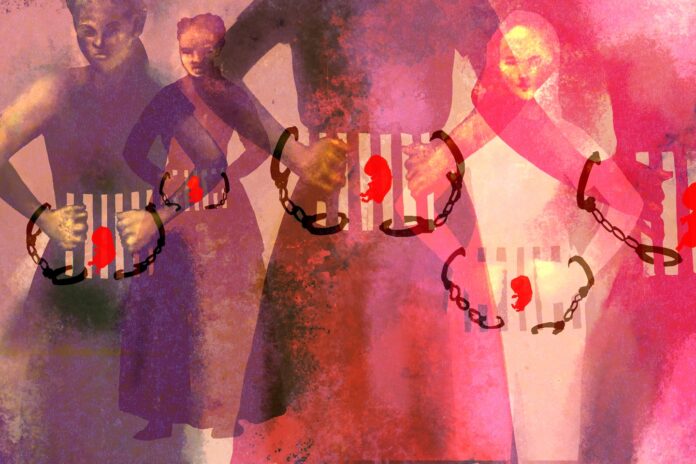
There is a crime scene in the nation’s wombs—one that has rarely been illuminated, much less investigated, even as the courtrooms have begun to dismantle the edifice of bodily autonomy. Now, with Roe’s legacy reduced to a footnote in America’s constitutional text, every miscarriage is no longer just a personal tragedy: it’s a civil transgression, a silent violation of law. The air is thick with irony—the same bodies that once commanded the rhetoric of reproductive freedom now stand accused, not by nature, but by statute. The question we now face isn’t just ethical or spiritual; it’s legal. It’s here, in the unspoken interstices of medical records and court transcripts, that the feminist project meets the harsh calculus of prohibition: a world where the very act of being human is policed by a doctrine of ‘causal intent.’
The Unspoken Anatomy of Loss
The body, once a canvas of self-determination, has become a battleground. Every contraction, every missed heartbeat is now a matter of civic conscience. A miscarriage, once a sorrowful event outside the purview of the state, is now a site of latent controversy. Doctors whisper about it—about the way protocols might bend under legal scrutiny, about how a patient’s story, if poorly narrated, could become evidence in a case of ‘involuntary termination.’ The anatomical is now entangled with the judicial: the placenta that once nourished life now becomes a potential exhibit in a trial.
There’s a peculiar kind of silence that falls over obstetric wards when women share that they’ve lost a pregnancy. Not the silent grief of private mourning, but the weight of a collective realization: *What if this isn’t an organic event, but a legally culpable one?* The question is no longer about the fetus or the biology—it’s about what happens if the system decides that nature itself has violated the rules. The specter of criminalized abortion has extended its tendrils into the most vulnerable of feminine experiences: the unplanned. When a pregnancy ends and there is no villain—or no clear villain—then who, or what, is guilty?
The Judicial Alchemy of Complicity
The state’s reappropriation of reproductive narrative power has birthed a new lexicon of legal acupuncture. Now, legal scholars dissect what was long considered sacrosanct: the patient-doctor relationship. A miscarriage, once an unfortunate occurrence, now demands a script of innocence. Women must prove two things: that they were not intent upon termination, and that their body’s own physiology did not somehow ‘deceived’ the law through an unruly act of natural causality.
And yet, the state’s appetite is insatiable. Courts will scrutinize every chemical marker, every missed biometric reading as though a woman’s body is a textbook rather than a paradox—a being endowed with agency even in the face of biological impermanence. There will be testimony about ‘premonitions,’ about sudden changes in behavior that suddenly become ‘deviant.’ A medical chart becomes a detective’s notebook of motives.
How the State Rewrites Anatomy
If we look at this through the lense of constitutional jurisprudence, the question shifts into an unsettling domain: When does spontaneous loss tip into prosecutorial possibility? A body that ‘loses’ its child is no longer merely flawed; it is a body that might be questioned in a court of law. If a miscarriage happens too early or too late, if the body doesn’t conform to the statistical normalcy of a healthy gestating environment, suspicion follows. Doctors, too, are asked uncomfortable questions: Was *I* responsible? Were *my* assessments late?
The state’s logic, in this brave new world, dictates that bodily failure carries moral weight. Every fluctuation of hormones, every dilation of the cervix becomes a footnote in the ledger of potential crime. The body is now a suspect. If a woman’s natural functions don’t align with the prosecutorial ideal, she is treated as if her own anatomy has a motive.
The Abuse of Medical Narrative
One must confront the dissonance between a medical record and a court transcript. The former speaks in the cold language of probabilities, of percentages and margins of error. The latter operates in absolutes, in ‘what-ifs’ and ‘what-then.’ Patients’ accounts, the emotional and embodied experience of miscarriage—those are reduced to footnotes.
A history of hypertension might become a plot device; a delayed ultrasound could be the incriminating element. Doctors are caught in an impossible purgatory of double-think. On one hand, they operate under the tenets of patient care. On the other, they are compelled to produce a narrative of innocence as proof for a judicial system that measures all miscarriages through the same lens: suspicion of malfeasance. The most chilling irony? Doctors will cease to be witnesses—only stenographers, forced to write the script the state demands to prove they did not commit a crime.
Feminist Resistance in the Clinic
But there is more than victimhood here. Women are not mere passive actors in this legal calculus. They are fighting back, not by dismantling law, but by reinserting themselves into the narrative. They are demanding to speak—truly—to their own lived experiences rather than endure an unyielding version of truth shaped by bureaucrats and prosecutors. And so, activists are beginning a quiet but potent campaign: teaching women to narrate miscarriage in ways that resist the reductive frameworks foisted upon them by an unforgiving state.
The tools of resistance are subtle but effective: reclaiming language (‘I lost something precious’), insisting on embodied truth (‘My body did not choose that day for a tragedy’), and forcing prosecutors to confront the contradiction within their own doctrine. The miscarried fetus must not be a proxy for abortion. To demand state scrutiny over these events is to criminalize the chaos of biology itself—a body’s inevitable contradictions. The state is incapable of containing both—autonomy and impermanence. And that is the space where feminist resistance thrives.
The Unintended Criminalization of Loss
What happens when the state’s obsession with cause and intent extends its scope to cover the most random of events—those not caused by anything but the fickle and sometimes cruel whims of the body? Every miscarriage already holds a dark secret: the fetus was never truly hers, nor completely in her control. The body’s own contradictions have now been weaponized, the miscarriage itself turned into a potential crime scene.
Lawmakers forget one crucial thing: biology defies regulation. The body has its own unpredictable calculus—one that the state cannot quantify or prosecute. The attempt to reduce loss to criminal intent is futile, like trying to legislate the sea. The tides of biology do not always bend to the directives of the law, and a state obsessed with penalizing unintended consequences will find its own narrative unraveling in the face of natural inconsistency.
The Feminist Reclamation of Pain
Despite the legal landscape shifting against them, women are still reclaiming something critical to their struggle: the right to speak without censure. They are insisting on the legitimacy of their experience, even when it defies the neat categorizations of the state. A miscarriage is not a crime. It’s a violation of someone else’s life, a sorrow no one should ever be expected to justify.
Now, amid all the legal wrangling and prosecutorial posturing, a different narrative is emerging. A narrative that asserts loss as a form of autonomy, even when miscarriage is framed as a state-enforced tragedy. The feminist project, in this moment, is not only about defending bodily rights, but about reinterpreting the meaning of pain itself.
When the state seeks to enforce a singular, punitive truth, those who have lived the experience must assert their own. They refuse the label of criminality. They reclaim their bodies—and the stories contained within them—not despite their imperfections, but because they are human.
Conclusion: When Bodily Integrity Becomes a Suspect Identity
A woman’s body is no longer a sanctuary. It’s a legal zone, a space subject to the scrutiny of law and the whims of legal doctrine. Every miscarriage, every pregnancy loss, is now a case study of intentionality. But the most dangerous power of a legal system like this is not its ability to punish—it’s its ability to criminalize. It has no problem creating new crimes when the old ones don’t suffice.
What happens next is not just about legal outcomes. It’s about the kind of humanity we recognize.